Bitcoin traded at $68,269 on Feb. 26, 2026, at 8 a.m. EST, pressing up against a stubborn resistance cluster that continues to dictate the short-term tone. The structure is constructive, momentum is attempting to pivot, and price is hovering in what seasoned traders would call a decision zone.
Bitcoin Chart Outlook
On the daily chart, bitcoin‘s broader structure remains corrective within a larger uptrend. Price previously declined from roughly $93,000 to a capitulation wick near $59,900, where demand stepped in decisively before a base formed. Since then, higher lows have printed, with the current zone centered between $67,000 and $69,000.
Still clear as day, major support rests at $60,000, with secondary support between $63,000 and $65,000, while resistance is clearly defined between $70,000 and $72,000. A daily close above $72,000 would open the door toward $78,000 to $80,000, while repeated rejection near $70,000 risks rotation back toward the mid-$60,000s. The bias remains constructive — but only if key levels hold.
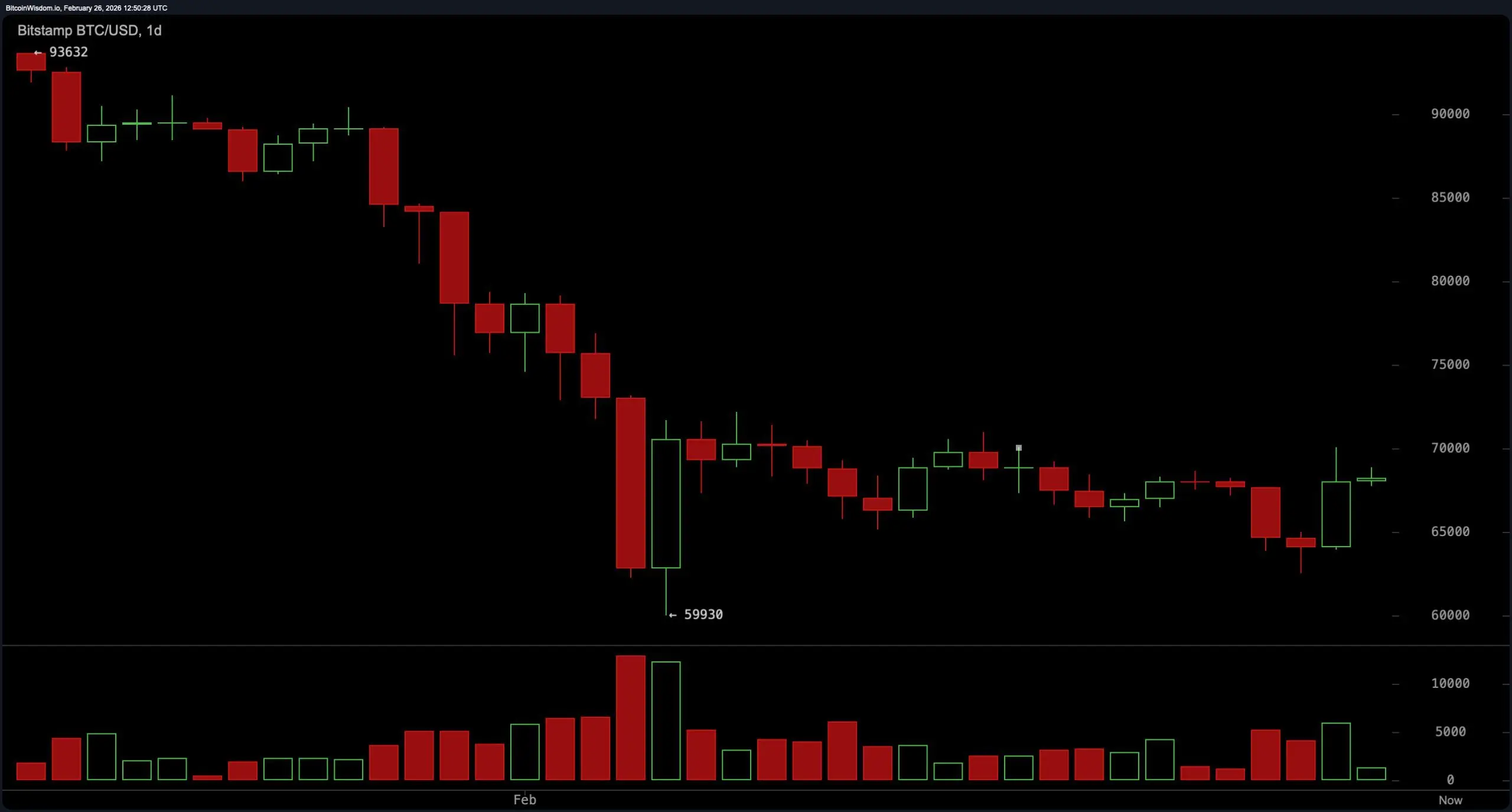 BTC/USD 1-day chart via Bitstamp on Feb. 26, 2026.
The four-hour bitcoin chart shows a V-shaped recovery from $62,500 to $70,038, followed by a controlled pullback rather than disorderly selling. Higher lows continue to form, and momentum is cooling without reversing. Intraday support sits between $67,000 and $68,000, with a stronger footing at $65,000. Resistance at $70,000 has been repeatedly respected, making a sustained four-hour close above that level the technical pivot traders are watching. Until then, this is a structured consolidation beneath a ceiling that refuses to budge.
BTC/USD 1-day chart via Bitstamp on Feb. 26, 2026.
The four-hour bitcoin chart shows a V-shaped recovery from $62,500 to $70,038, followed by a controlled pullback rather than disorderly selling. Higher lows continue to form, and momentum is cooling without reversing. Intraday support sits between $67,000 and $68,000, with a stronger footing at $65,000. Resistance at $70,000 has been repeatedly respected, making a sustained four-hour close above that level the technical pivot traders are watching. Until then, this is a structured consolidation beneath a ceiling that refuses to budge.
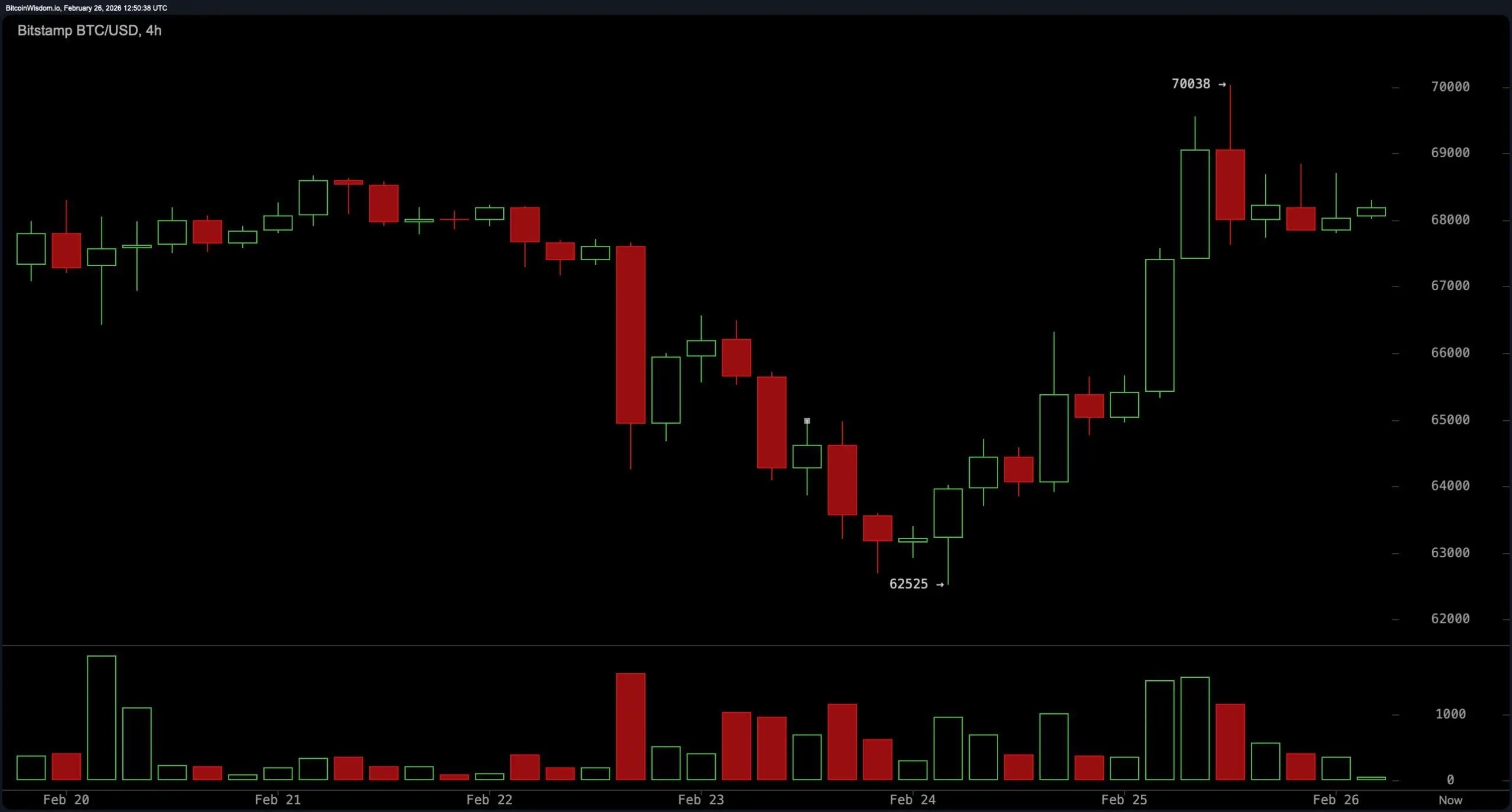 BTC/USD 4-hour chart via Bitstamp on Feb. 26, 2026.
On the one-hour timeframe, bitcoin is compressing sideways beneath resistance after rallying from roughly $63,800 to $70,000. The current range between $68,000 and $69,000 comes alongside declining volume, often a precursor to volatility expansion. Equal highs around $69,500 to $70,000 suggest liquidity is resting just above, while the range low sits near $67,800 and breakdown risk emerges below $67,500. This is classic coil behavior — the kind that tends to resolve with conviction once liquidity is tapped.
BTC/USD 4-hour chart via Bitstamp on Feb. 26, 2026.
On the one-hour timeframe, bitcoin is compressing sideways beneath resistance after rallying from roughly $63,800 to $70,000. The current range between $68,000 and $69,000 comes alongside declining volume, often a precursor to volatility expansion. Equal highs around $69,500 to $70,000 suggest liquidity is resting just above, while the range low sits near $67,800 and breakdown risk emerges below $67,500. This is classic coil behavior — the kind that tends to resolve with conviction once liquidity is tapped.
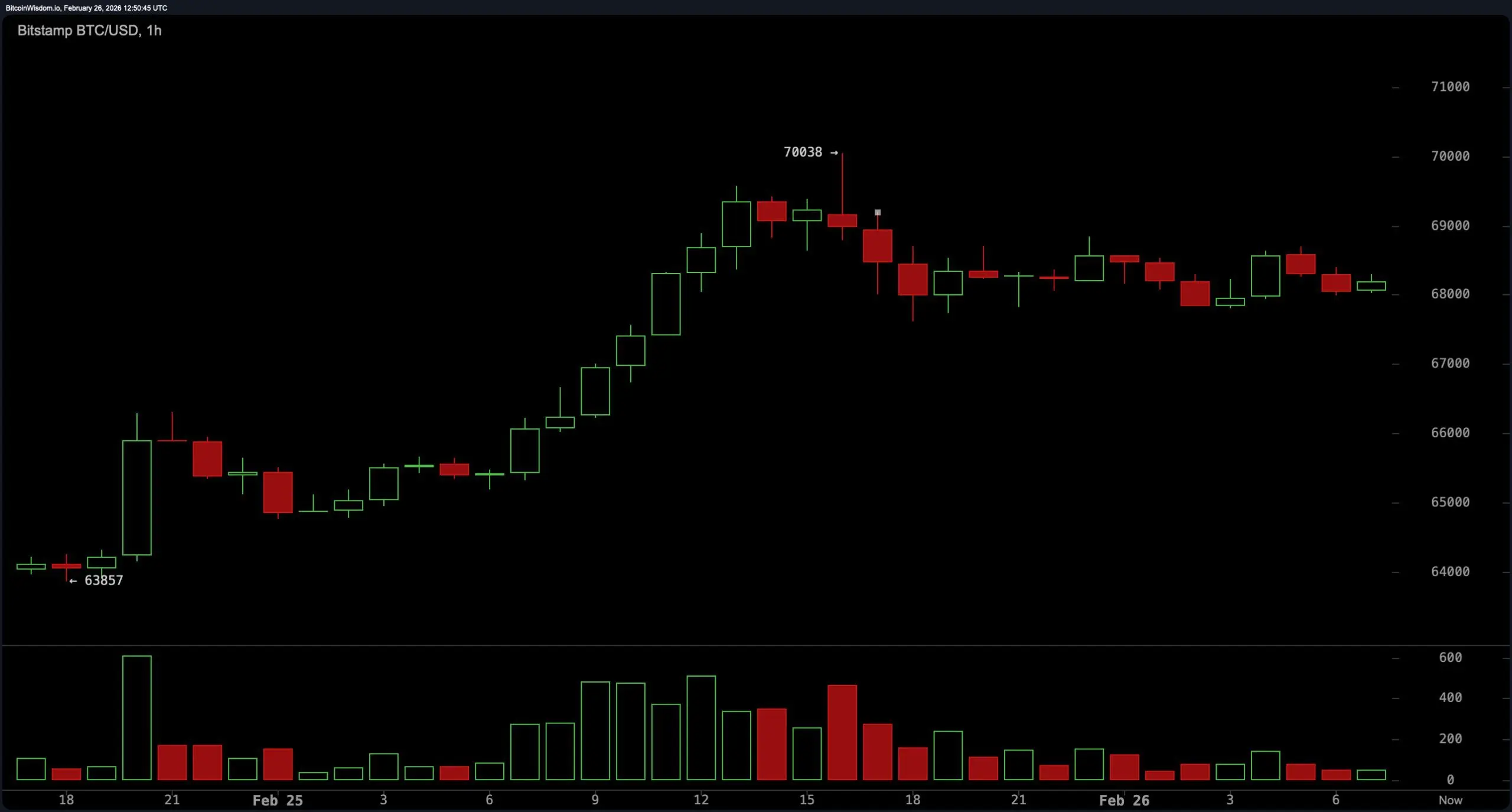 BTC/USD 1-hour chart via Bitstamp on Feb. 26, 2026.
Oscillators present a balanced but intriguing mix. The relative strength index ( RSI) reads 43, the Stochastic stands at 50, and the commodity channel index (CCI) prints 22 — all neutral readings. The average directional index (ADX) at 54 reflects meaningful trend strength, even if direction remains contested. The Awesome oscillator sits at negative 6,666, while momentum is at negative 622, and the moving average convergence divergence ( MACD) level is at negative 3,196, leaning positive in signal despite residing in negative territory. In other words, underlying momentum is attempting to turn before the price fully commits.
BTC/USD 1-hour chart via Bitstamp on Feb. 26, 2026.
Oscillators present a balanced but intriguing mix. The relative strength index ( RSI) reads 43, the Stochastic stands at 50, and the commodity channel index (CCI) prints 22 — all neutral readings. The average directional index (ADX) at 54 reflects meaningful trend strength, even if direction remains contested. The Awesome oscillator sits at negative 6,666, while momentum is at negative 622, and the moving average convergence divergence ( MACD) level is at negative 3,196, leaning positive in signal despite residing in negative territory. In other words, underlying momentum is attempting to turn before the price fully commits.
Moving averages reveal a split technical battlefield. The exponential moving average (EMA) (10) at $67,301 and simple moving average (SMA) (10) at $66,936 align favorably beneath the current price. The EMA (20) at $69,240 contrasts with the SMA (20) at $67,865, while the EMA (30) at $71,761 and SMA (30) at $71,044 remain overhead.
Longer-term pressure persists with the EMA (50) at $76,123, SMA (50) at $79,194, EMA (100) at $83,720, SMA (100) at $84,199, EMA (200) at $91,296 and SMA (200) at $97,903. Short-term averages are curling upward, but the higher time-frame stack remains elevated — meaning reclaiming $70,000 to $72,000 is not merely psychological, it is structural.
Overall, bitcoin is compressing beneath a major resistance cluster around $70,000. If that ceiling flips into support, the path toward $75,000 and beyond becomes technically coherent. If rejected again, the $65,000 region likely re-enters focus before the next attempt. This market is not confused — it is coiled. And when compression resolves, it rarely does so politely.
Bull Verdict:
If bitcoin converts the $70,000 to $72,000 resistance band into support with a confirmed higher-timeframe close, the technical structure shifts decisively in favor of continuation toward the $78,000 to $80,000 region, with short-term moving averages curling upward and momentum indicators attempting to pivot from negative territory.
Bear Verdict:
If price fails again at $70,000 and loses the $67,000 to $65,000 support pocket, the compression resolves lower, opening the door for a deeper rotation toward $63,000 and potentially a retest of the $60,000 macro support as higher-timeframe moving averages continue to weigh overhead.
FAQ 🔎
- What is bitcoin’s price on Feb. 26, 2026?
Bitcoin is trading at $68,269, consolidating just below the $70,000 resistance level.
- What is the key resistance level for bitcoin right now?
The primary resistance zone sits between $70,000 and $72,000 on the daily timeframe.
- What are bitcoin’s major support levels?
Key support levels are $67,000 to $68,000 intraday, $65,000 stronger support, and $60,000 macro support.
- What do the indicators suggest about bitcoin’s momentum?
The relative strength index ( RSI), Stochastic and commodity channel index (CCI) are neutral, while momentum and moving average convergence divergence ( MACD) show early signs of upside pressure.
Related Articles
Solv Protocol and Utexo Launch Bitcoin-Native Yield Infrastructure
Solv Protocol has integrated with Utexo to launch a bitcoin-native yield infrastructure that uses the RGB protocol and Lightning Network to enable direct, atomic swaps between bitcoin and USDT.
Key Takeaways:
Solv Protocol and Utexo integrated to launch native BTC yield with atomic swaps for $2 b
Coinpedia13m ago
Zonda Exchange CEO Blames Missing Founder for $336M in Lost Bitcoin
Zonda CEO Przemysław Kral has attributed the exchange's loss of access to 4,500 BTC, valued at $336 million, to missing founder Sylwester Suszek's failure to transfer private keys. Amid allegations of bankruptcy and intensified withdrawal requests, Kral insists Zonda remains solvent and will pursue legal action while searching for Suszek, who disappeared in 2022.
GateNews1h ago
BTC drops 0.52% in 15 minutes: Whale inflows to exchanges combined with insufficient liquidity amplify sell pressure
From 2026-04-17 10:15 to 2026-04-17 10:30 (UTC), the BTC price rapidly fell within the 75214.3 – 75725.9 USDT range. The cumulative return over 15 minutes was -0.52%, and the amplitude reached 0.68%. During this period, market sentiment shifted from cautious to bearish, volatility on the board increased, mainstream trading pairs saw an increase in主动 sell-side volume, buy-side acceptance became constrained, and overall trading activity declined significantly.
The primary driver behind this unusual move is that large holders (whales) concentrated their short-term inflows into exchanges. On-chain data shows that net inflows to addresses holding more than 1000 BTC per address changed from a steady state to a positive value, directly boosting exchange balances over the short term. Historical data indicates that whale inflows to exchanges are highly correlated with sell pressure in the medium to short term. In the same period, order book snapshots reflected a significant increase in the volume of主动 sell orders, and the成交价梯度 shifted downward, highlighting that weak market absorption capacity caused a short-term drop in price.
In addition, in the derivatives market, the long/short positioning structure tilted toward shorts. The number of主动 sell contracts exceeded that of buys in a short time, and rising pressure to close long positions further intensified the downtrend. Market liquidity overall was relatively weak; the number of active addresses over the past 10 minutes was only about 42k, and both fees and the mempool were near their lowest levels of the recent month. Against a backdrop of insufficient capital absorption, the marginal impact of large sell orders was amplified. On the macro front, the Federal Reserve’s monetary policy tightening and industry media repeatedly downgraded BTC’s near-term expectations led investors’ risk appetite to generally decline, creating a resonance at the level of market sentiment.
In the short term, it is still necessary to stay alert to liquidity risk and the price impact of one-way large transactions in specific trading pairs. Going forward, focus on key developments such as changes in whales’ on-chain holdings, exchange balances, and rebounds in activity metrics, as well as the potential impact of macro policy direction on risk assets. Relevant users should primarily guard against the risk of sharply amplified short-term price volatility and promptly track more market information.
GateNews2h ago
Bitcoin Developers Propose Freezing Coins That Skip Quantum-Safe Migration Under BIP-361
A draft proposal circulating among Bitcoin developers would give holders roughly five years to move their coins to quantum-resistant addresses or watch them become permanently unspendable on the network.
Key Takeaways:
BIP-361, co-authored by Casa CTO Jameson Lopp, proposes freezing Bitcoin in le
Coinpedia2h ago
BTC slides 0.70% in the short term: On-chain fund outflows and derivatives deleveraging align to weigh on the market
Between 09:30 and 09:45 (UTC) on 2026-04-17, the BTC price’s return within 15 minutes was -0.70%. During the day, it fluctuated in the 75511.9 to 76307.6 USDT range, with an amplitude of 1.04%. Short-term market sentiment became more cautious; although capital activity increased, volatility noticeably accelerated.
The main driving force behind this move is the large-scale outflow of funds on-chain and active deleveraging in the derivatives market. On-chain data shows that, within this time window, the net outflow from BTC exchanges increased, with a 24-hour net outflow of -2,844.68 BTC. Investors transferred a large amount of BTC to cold wallets, significantly weakening market liquidity and pressuring buy-side demand, which dragged prices lower. In the derivatives space, open interest in perpetual contracts fell in tandem; some leveraged funds actively reduced exposure, indicating the market’s more conservative stance on short-term price action, thereby further weakening support.
In addition, multiple large transfers and whale address activity occurred frequently during the anomaly period, amplifying pressure on capital flows and causing sentiment in the derivatives market to turn even colder. The funding rate dropped briefly within the window, indirectly reflecting that some position holders moved into cold wallets for safer risk management. At the same time, the number of active addresses remained persistently high at over 120k, suggesting network participation was not hit and the fundamentals remained stable; however, the combined effect of frequent outflows amplified market volatility in the short term.
What needs to be watched is that continuous net outflows of funds on-chain and a decline in holdings pose a threat to the stability of support levels. Large address behavior could lead to further capital escaping. In the short term, focus on changes in exchange BTC balances, on-chain transfer volumes, whale address flow, and the dynamics of derivatives open interest. If capital does not return later, volatility risk may further expand; it is recommended to closely monitor real-time market conditions and key on-chain indicators.
GateNews2h ago
The U.S. vetoes the Iran-war powers resolution, while the BTC price trades in a range near $75,000
On April 17, Bitcoin traded in a tight range near $75,500. The U.S. vetoed a war-powers resolution against Iran, while Israel and Lebanon reached a 10-day ceasefire—geopolitical signals moved in opposite directions. Institutional fund inflows coexisted with outflows on-chain; Bitcoin’s correlation with the Nasdaq briefly turned negative—leaving the market waiting for a breakout in either direction.
GateInstantTrends2h ago


