Bitcoin traded flat near $66,000 on Feb. 18, showing little momentum despite sharp intraday swings. The day’s debate centered on comments from Cryptoquant’s CEO, Ki Young Ju, who questioned whether dormant coins — including Satoshi Nakamoto’s 1.1 million bitcoins — should ever be frozen at the protocol level.
Bitcoin Stagnates in Narrow Range
Bitcoin exhibited a characteristic lack of momentum on Wednesday, remaining largely range-bound even as the community descended into a fierce ideological civil war. Throughout the preceding 24-hour window, the top cryptocurrency oscillated between $65,840 and $68,000. While the price experienced several instances of high-velocity “whipsaw” movements—straying briefly before a rapid corrective snapback—it ultimately found its gravity within that narrow corridor.
As of 3 p.m. EST, bitcoin was again trading just below the $66,000 mark, logging a 2.6% decline over the day. This price action left the total market capitalization of the crypto-economy essentially drifting lower, alongside reflecting a “wait-and-see” approach from institutional desk traders.
The day’s primary narrative was dominated by Cryptoquant CEO Ki Young Ju, whose latest X article has sent shockwaves through the ecosystem. Ju has posed a pointed question to the community: Should it authorize a protocol-level “freeze” on dormant coins, particularly Satoshi Nakamoto’s storied 1.1 million BTC trove?
“Would you support freezing dormant coins, including Satoshi’s, to save BTC from quantum attacks? Or is it against Bitcoin’s core ethos? If this alone already divides us, the quantum debate must start now,” the Cryptoquant executive wrote.
Ju estimates that 6.89 million BTC are currently housed in legacy P2PK (pay-to-public-key) addresses. Because these older address types expose public keys directly on the blockchain, they are theoretically vulnerable to future quantum computing attacks that could derive private keys and drain the funds.
Critics, however, have decried the idea of such changes as a fundamental betrayal of bitcoin’s core value proposition. To freeze these coins, the network would require a drastic protocol upgrade, effectively breaking the rule of immutability. While there is a broad consensus regarding the long-term threat of quantum computing, the community remains bitterly divided over whether the cure is worse than the disease.
Geopolitical Winds: The ‘Risk-off’ Pivot
Despite the high-stakes debate over Satoshi’s coins, bitcoin’s price action on Feb. 18 appeared largely detached from internal politics, focusing instead on the escalating drums of war in the Middle East. Media reports suggest that U.S. and Israeli military strikes on Iran are imminent, a development that threatens to plunge the region into a state of total kinetic conflict.
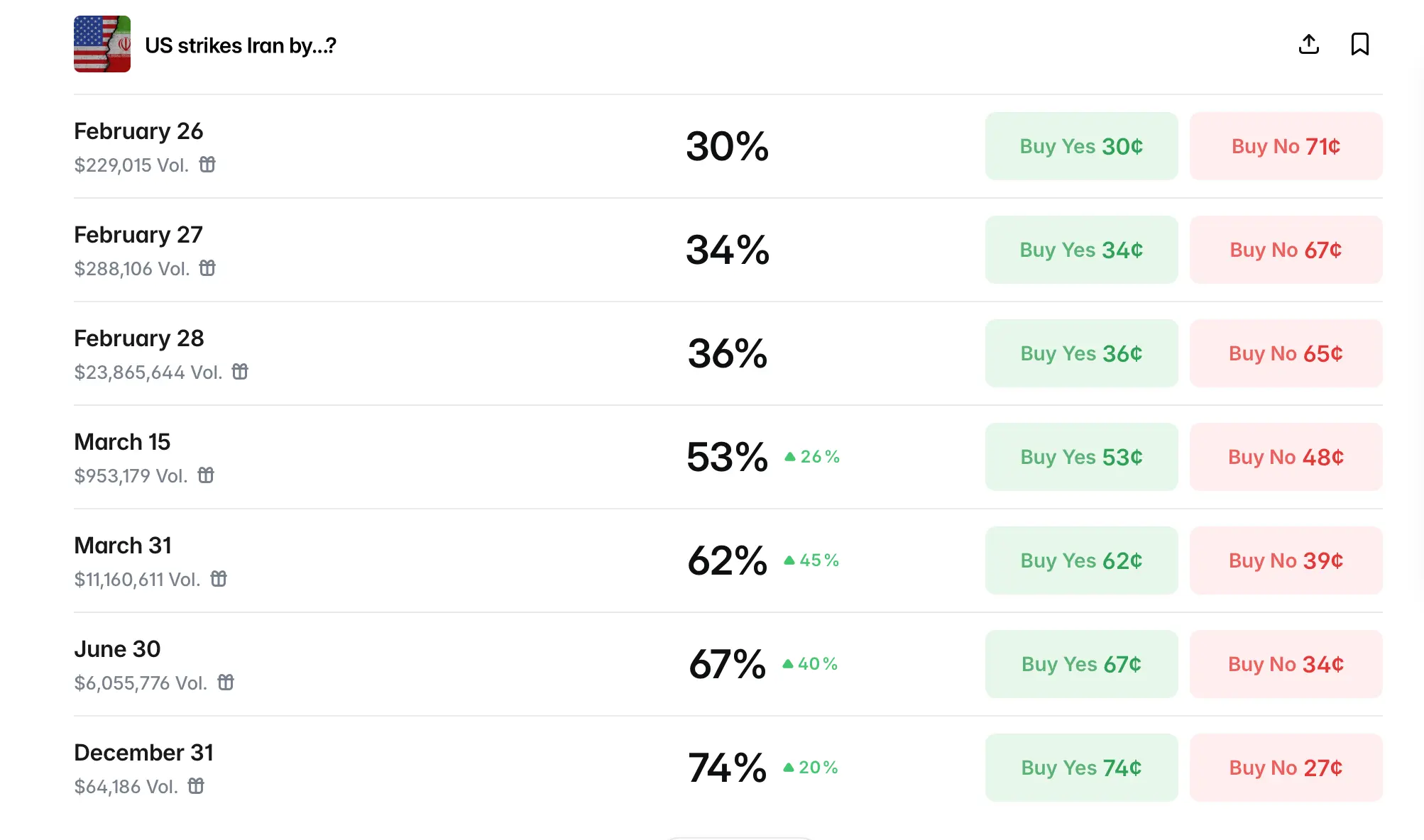 Polymarket odds on the escalation between the U.S. and Iran on Feb. 18, 2026, at 3 p.m. EST.
A wider conflict is expected to disrupt critical trade arteries and send crude oil prices into a vertical climb. For bitcoin, the impact remains a subject of intense speculation. While long touted as digital gold, recent price correlations suggest bitcoin has behaved more like a risk-on tech asset. This means, in the event of a regional conflagration, the initial reflex from investors may be a flight to traditional safe-haven assets, including U.S. Treasuries and gold.
Polymarket odds on the escalation between the U.S. and Iran on Feb. 18, 2026, at 3 p.m. EST.
A wider conflict is expected to disrupt critical trade arteries and send crude oil prices into a vertical climb. For bitcoin, the impact remains a subject of intense speculation. While long touted as digital gold, recent price correlations suggest bitcoin has behaved more like a risk-on tech asset. This means, in the event of a regional conflagration, the initial reflex from investors may be a flight to traditional safe-haven assets, including U.S. Treasuries and gold.
This will potentially put further downward pressure on bitcoin as liquidity tightens across global markets.
FAQ ❓
- Where is bitcoin trading now? It hovered between $67K and $68K, showing little momentum.
- What sparked the community debate? Cryptoquant’s CEO proposed freezing dormant coins, including Satoshi’s stash.
- Why is the proposal controversial? Critics say freezing coins breaks bitcoin’s immutability despite quantum risks.
- How do geopolitics affect bitcoin? Escalating Middle East tensions, specifically between Iran and the U.S., have pushed investors toward gold and Treasuries, pressuring BTC.
Disclaimer: The information on this page may come from third parties and does not represent the views or opinions of Gate. The content displayed on this page is for reference only and does not constitute any financial, investment, or legal advice. Gate does not guarantee the accuracy or completeness of the information and shall not be liable for any losses arising from the use of this information. Virtual asset investments carry high risks and are subject to significant price volatility. You may lose all of your invested principal. Please fully understand the relevant risks and make prudent decisions based on your own financial situation and risk tolerance. For details, please refer to
Disclaimer.
Related Articles
BTC 15-minute pump 0.55%: Large on-chain funds inflows and options positioning resonate to lift spot prices
2026-04-09 17:00 to 2026-04-09 17:15 (UTC), the BTC spot market saw a rapid spike with a +0.55% return. The price range was 72,063.9 to 72,518.5 USDT, and the full-period amplitude reached 0.63%. This upswing coincided with rising market attention; volatility clearly intensified, drawing funds into short-term trading in a mix of cautious sentiment and localized increased volume.
The main driving force behind this move was concentrated inflows to exchanges from on-chain large transfers, which pushed up spot market buy orders in a short time. Data shows that, in the past 24 hours, on-chain BTC transfers
GateNews53m ago
Mainstream CEX and DEX funding-rate displays suggest an increasingly bearish market sentiment
On April 10, the Bitcoin price broke through $72k again. According to Coinglass data, the funding rates on major trading platforms show that the market’s bearish sentiment is strengthening. Funding rates are used to balance the contract price with the asset price; a rate below 0.005% indicates that the market is broadly bearish.
GateNews1h ago
Over the past 1 hour, forced liquidations across the entire market totaled $101 million, including $80.39 million in BTC liquidations.
Gate News message, on April 9, CoinGlass data shows that over the past 1 hour, liquidations across the entire network totaled $101 million, including $97.07 million from short liquidations and $3.54 million from long liquidations. In addition, the liquidation amount for BTC reached $80.39 million, while the liquidation amount for ETH reached $11.79 million.
GateNews2h ago
CME Group BTC futures liquidity falls to a 14-month low, with basis trading failures triggering institutional capital outflows
The Chicago Mercantile Exchange’s Bitcoin futures market has continued to weaken. In March 2026, the daily average open interest fell to $7.2 billion, hitting a new low since February 2024, and has been declining for five straight months. The main reason is the large-scale unwinding of basis trades, which eliminated the arbitrage spread and caused leveraged capital to exit.
GateNews2h ago
BTC 15-minute pump of 1.03%: integer-level breakout and macro risk-hedging resonance amplifying the move
From 2026-04-09 15:30 to 15:45 (UTC), the BTC return rate recorded +1.03%, with the price ranging from 71,291.5 to 72,226.9 USDT, and the amplitude reaching 1.31%. During the abnormal move, market attention rose rapidly, volatility noticeably intensified, and prompted investors to closely watch short-term trends.
The main driver behind this abnormal move was BTC breaking through the 72,000 USDT integer level at 15:34, which directly activated some algorithmic trading and drew short-term funds in. The rapid breakout above this key price level boosted spot and derivatives trading volumes in the short term
GateNews2h ago


