Bitcoin is back in compression mode on Feb. 17, 2026, trading at $68,021 after probing an intraday range between $67,381 and $69,999. With $36.58 billion in 24-hour volume and a $1.37 trillion market cap, this is not a sleepy tape — it is a market pausing, recalibrating, and daring traders to overreact.
Bitcoin Chart Outlook
The daily chart continues to frame the broader narrative: stabilization within a descending structure. Price remains below the prior peak near $97,900 and is oscillating between $68,000 and $70,000, reflecting balance rather than breakout conditions. Major support stands at $60,000 to $62,000, with intermediate support at $66,500 to $68,000. Overhead, $72,000 to $75,000 remains the primary resistance band, and only a decisive daily close above $75,000 would invalidate the prevailing macro structure. Until then, the bias is cautious. This is digestion, not ignition.
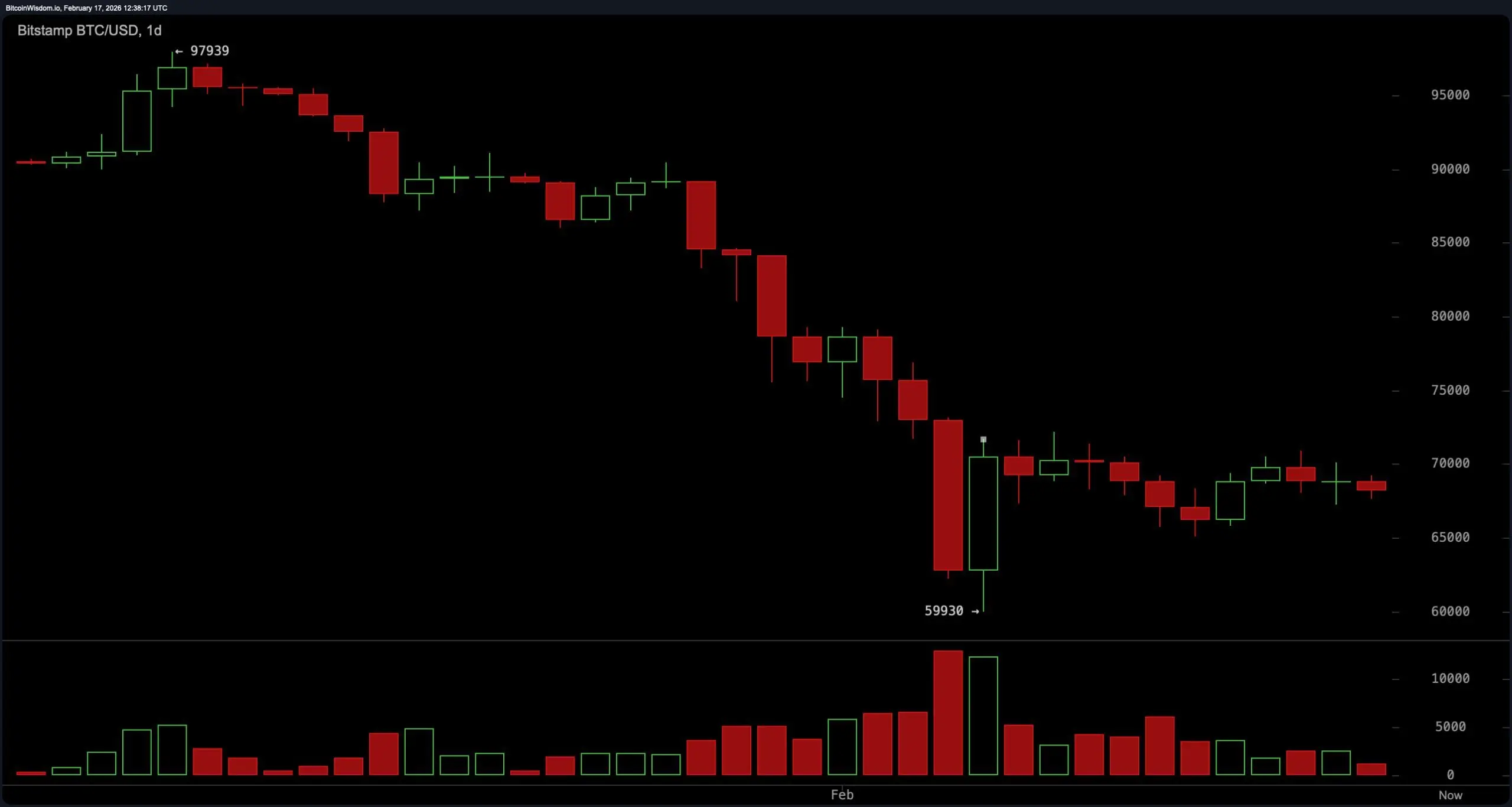 BTC/USD 1-day chart via Bitstamp on Feb. 17, 2026.
On the four-hour chart, bitcoin is fluctuating within a defined range following its vigorous recovery from the $60,000 threshold. A sequence of descending peaks is emerging, gradually compressing price action into lateral consolidation. Volume has diminished during upward attempts, signaling limited conviction behind rallies. The defined trade zones remain clear: support between $66,500 and $68,000 and resistance between $72,000 and $73,000. Mean-reversion dynamics dominate this time frame, as neither side has delivered the decisive expansion required to shift structure. In plain terms, this is a range trader’s playground — not a breakout artist’s stage.
BTC/USD 1-day chart via Bitstamp on Feb. 17, 2026.
On the four-hour chart, bitcoin is fluctuating within a defined range following its vigorous recovery from the $60,000 threshold. A sequence of descending peaks is emerging, gradually compressing price action into lateral consolidation. Volume has diminished during upward attempts, signaling limited conviction behind rallies. The defined trade zones remain clear: support between $66,500 and $68,000 and resistance between $72,000 and $73,000. Mean-reversion dynamics dominate this time frame, as neither side has delivered the decisive expansion required to shift structure. In plain terms, this is a range trader’s playground — not a breakout artist’s stage.
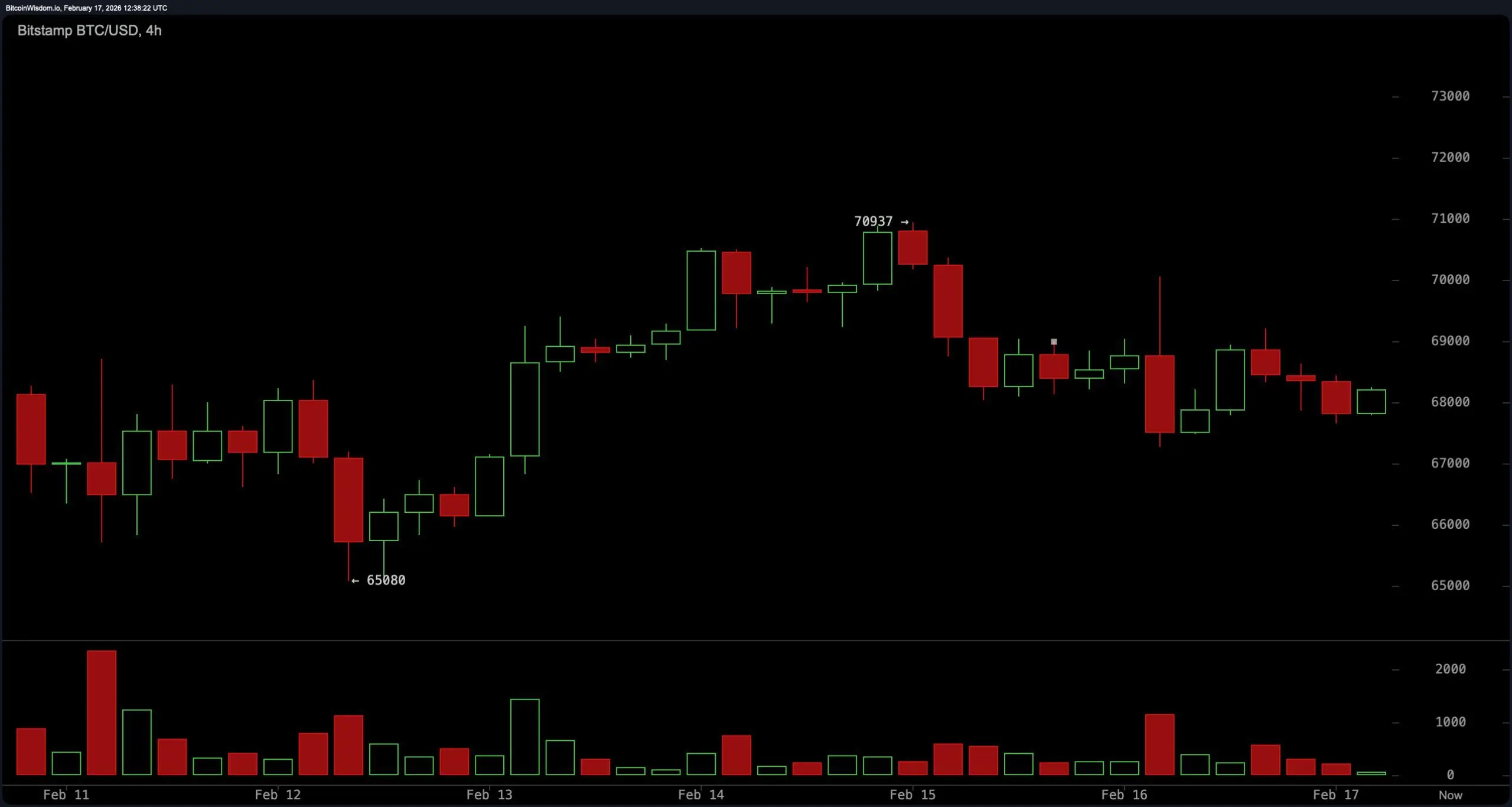 BTC/USD 4-hour chart via Bitstamp on Feb. 17, 2026.
The one-hour chart leans softer. Descending peaks and marginal new lows characterize the short-term trend, while momentum appears subdued. Recoveries have been corrective in nature rather than impulsive, reinforcing the idea that intraday strength lacks sustained follow-through. The $68,000 to $68,500 zone has functioned as a bounce area, while failed recoveries near $70,500 to $71,000 have attracted renewed pressure. Sellers maintain influence over intraday flows, and until that sequence of lower highs is disrupted, the short-term structure remains tactically fragile.
BTC/USD 4-hour chart via Bitstamp on Feb. 17, 2026.
The one-hour chart leans softer. Descending peaks and marginal new lows characterize the short-term trend, while momentum appears subdued. Recoveries have been corrective in nature rather than impulsive, reinforcing the idea that intraday strength lacks sustained follow-through. The $68,000 to $68,500 zone has functioned as a bounce area, while failed recoveries near $70,500 to $71,000 have attracted renewed pressure. Sellers maintain influence over intraday flows, and until that sequence of lower highs is disrupted, the short-term structure remains tactically fragile.
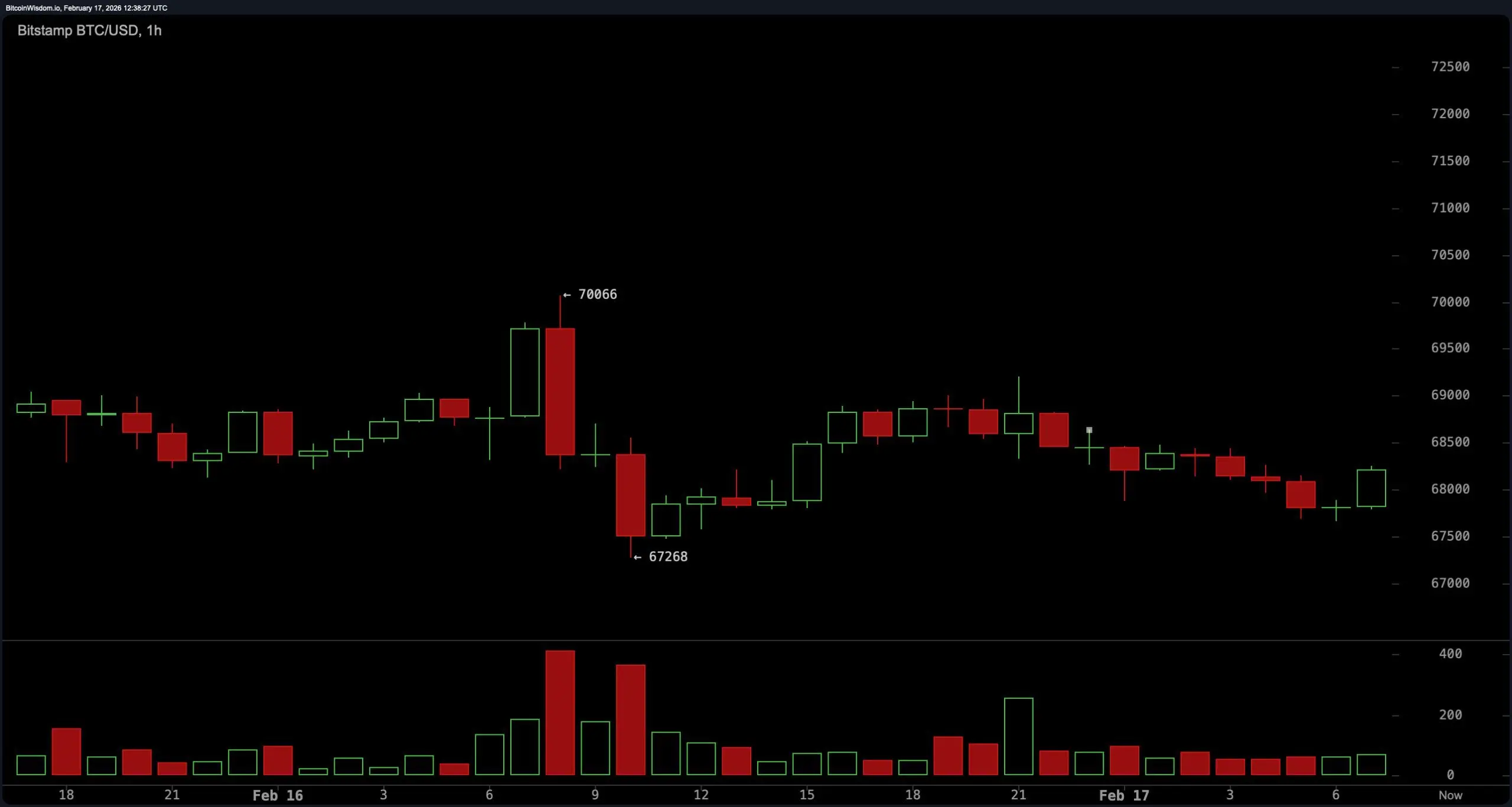 BTC/USD 1-hour chart via Bitstamp on Feb. 17, 2026.
Oscillators reflect a market in equilibrium rather than exhaustion. The relative strength index ( RSI) at 36, Stochastic at 48 and commodity channel index (CCI) at negative 47 all register neutral readings. The average directional index (ADX) at 57 signals strong trend conditions, though not necessarily directional clarity. The Awesome oscillator prints negative 11,127, while momentum at negative 453 and the moving average convergence divergence ( MACD) level at negative 4,643 show constructive signals within the report’s framework. Internally, there are flickers of stabilization — but no fireworks.
BTC/USD 1-hour chart via Bitstamp on Feb. 17, 2026.
Oscillators reflect a market in equilibrium rather than exhaustion. The relative strength index ( RSI) at 36, Stochastic at 48 and commodity channel index (CCI) at negative 47 all register neutral readings. The average directional index (ADX) at 57 signals strong trend conditions, though not necessarily directional clarity. The Awesome oscillator prints negative 11,127, while momentum at negative 453 and the moving average convergence divergence ( MACD) level at negative 4,643 show constructive signals within the report’s framework. Internally, there are flickers of stabilization — but no fireworks.
Moving averages (MAs) continue to lean heavy. The exponential moving average (EMA) (10) at $69,519 contrasts with the simple moving average (SMA) (10) at $68,739. The EMA (20) at $72,810 and SMA (20) at $72,074 reinforce near-term overhead resistance, while the EMA (50) at $80,180 and SMA (50) at $83,491 sit well above the current price. Higher still, the EMA (100) at $87,067 and SMA (100) at $86,987, along with the EMA (200) at $93,608 and SMA (200) at $100,105, underscore the broader technical gravity bitcoin must eventually overcome.
Bull Verdict:
A decisive four-hour close above $72,500 with expanding participation would shift short- and mid-term structure, opening the door toward the $72,000 to $75,000 resistance corridor and challenging the descending framework on the daily chart. Sustained strength above $75,000 would invalidate the broader bearish structure and signal that compression has resolved to the upside.
Bear Verdict:
A breach of $66,000 would confirm weakening support on the lower time frames and expose bitcoin to a move back toward the $60,000 to $62,000 major support zone. Failure to defend that corridor would reinforce the prevailing descending formation on the daily chart and extend the current corrective phase rather than conclude it.
FAQ ❓
- What is bitcoin’s price on Feb. 17, 2026? Bitcoin is trading at $68,827.93, consolidating between key support at $66,500 and resistance near $72,000.
- Is bitcoin bullish or bearish right now? Bitcoin remains range-bound within a descending structure, with cautious bias until a decisive break above $75,000 or below $66,000.
- What are the key bitcoin support and resistance levels? Major support sits at $60,000 to $62,000, while major resistance stands between $72,000 and $75,000.
- What would confirm bitcoin’s next breakout? A strong four-hour close above $72,500 or a breakdown below $66,000 would signal the next directional move.
Disclaimer: The information on this page may come from third parties and does not represent the views or opinions of Gate. The content displayed on this page is for reference only and does not constitute any financial, investment, or legal advice. Gate does not guarantee the accuracy or completeness of the information and shall not be liable for any losses arising from the use of this information. Virtual asset investments carry high risks and are subject to significant price volatility. You may lose all of your invested principal. Please fully understand the relevant risks and make prudent decisions based on your own financial situation and risk tolerance. For details, please refer to
Disclaimer.
Related Articles
BTC drops 0.62% over 15 minutes: exchange net inflows intensify and short-term arbitrage converges to trigger volatility
From 18:00 to 18:15 on April 9, 2026 (UTC), the BTC price return recorded -0.62%, closing in the range of 71857.8 to 72375.1 USDT, with a trading range of 0.72%. Market attention was notably elevated, volatility intensified, and capital moved quickly within a short period. Overall market sentiment has become more cautious, and investors’ willingness to trade in the short term has increased.
The main driving force behind this abnormal move is an increase in net inflows to BTC exchanges during the anomaly window; the 10-minute net flow reached 755.92 BTC, indicating that some investors chose to transfer funds to exchanges to seek arbitrage opportunities in the midst of the volatility issue
GateNews16m ago
BTC 15-minute pump 0.55%: Large on-chain funds inflows and options positioning resonate to lift spot prices
2026-04-09 17:00 to 2026-04-09 17:15 (UTC), the BTC spot market saw a rapid spike with a +0.55% return. The price range was 72,063.9 to 72,518.5 USDT, and the full-period amplitude reached 0.63%. This upswing coincided with rising market attention; volatility clearly intensified, drawing funds into short-term trading in a mix of cautious sentiment and localized increased volume.
The main driving force behind this move was concentrated inflows to exchanges from on-chain large transfers, which pushed up spot market buy orders in a short time. Data shows that, in the past 24 hours, on-chain BTC transfers
GateNews1h ago
Mainstream CEX and DEX funding-rate displays suggest an increasingly bearish market sentiment
On April 10, the Bitcoin price broke through $72k again. According to Coinglass data, the funding rates on major trading platforms show that the market’s bearish sentiment is strengthening. Funding rates are used to balance the contract price with the asset price; a rate below 0.005% indicates that the market is broadly bearish.
GateNews1h ago
Over the past 1 hour, forced liquidations across the entire market totaled $101 million, including $80.39 million in BTC liquidations.
Gate News message, on April 9, CoinGlass data shows that over the past 1 hour, liquidations across the entire network totaled $101 million, including $97.07 million from short liquidations and $3.54 million from long liquidations. In addition, the liquidation amount for BTC reached $80.39 million, while the liquidation amount for ETH reached $11.79 million.
GateNews2h ago
CME Group BTC futures liquidity falls to a 14-month low, with basis trading failures triggering institutional capital outflows
The Chicago Mercantile Exchange’s Bitcoin futures market has continued to weaken. In March 2026, the daily average open interest fell to $7.2 billion, hitting a new low since February 2024, and has been declining for five straight months. The main reason is the large-scale unwinding of basis trades, which eliminated the arbitrage spread and caused leveraged capital to exit.
GateNews2h ago


