High IV and ETF outflows signal caution despite early dip-buying attempts.
The crypto assets saw another large options expiry on Friday as the market weakness continues. As per onchain reports, roughly $2.9 billion in Bitcoin and Ether contracts expired as prices remained under strain. Derivatives data points to rising caution, while spot flows confirm limited fresh demand. And even though early signs of bottom-fishing have appeared, conviction remains thin.
Bitcoin Max Pain at $74K After $2.5B Options Expiry
As per market data, a total of 38,000 Bitcoin options expired, carrying a notional value of $2.5 billion. Meanwhile, the put-call ratio was 0.71, meaning more traders were betting on further southbound movements.
February 13 Options Expiration Data
38,000 BTC options expired with a Put-Call Ratio of 0.71, maximum pain point at $74,000, and notional value of $2.5 billion.
215,000 ETH options expired with a Put-Call Ratio of 0.82, maximum pain point at $2,100, and notional value of $410… pic.twitter.com/07TKfJxmMi
— Greeks.live (@GreeksLive) February 13, 2026
Maximum pain sat at $74,000, meaning that level would inflict the most losses on options holders. Around 215,000 ETH options also expired, with a notional value of $410 million. ETH posted a higher put-call ratio of 0.82 and a maximum pain level at $2,100.
Options that expired accounted for about 9% of total open interest. Despite sizeable notional value, positioning remains concentrated in later BTC expiries, especially late March and late June. February 13 contracts carried weight, yet they did not dominate overall structure. Therefore, the broader positioning remains largely intact.
Looking at the volatility trend, MarketChameleon data shows Bitcoin implied volatility at 58.9. That places it in the 98th percentile over the past year. Implied volatility has been lower 98% of the time during the last 12 months.
Current readings sit 24% above the 20-day moving average of 47.5. Rising implied volatility means options traders expect bigger price swings ahead, even though the spot market has started to move more slowly.
BTC, ETH Derivatives Signal Caution as Spot ETFs See Fresh Outflows
Puts are still dominating flows, showing traders are hedging for more downside. ETH looks more defensive than BTC, backed by its higher put-call ratio and typically higher volatility profile.
After the latest sell-off, small pockets of dip-buying have started to show up. Skew is edging higher, and some block trades are rotating into calls. Basically, the positioning suggests selective bounce plays rather than strong conviction in a full trend reversal.
Spot flows continue to reflect a risk-off tone. As per SoSoValue data, Bitcoin spot ETFs recorded $410 million in net outflows on Thursday. Ethereum spot ETFs followed the same pattern, posting $113 million in net outflows and no fresh entries.
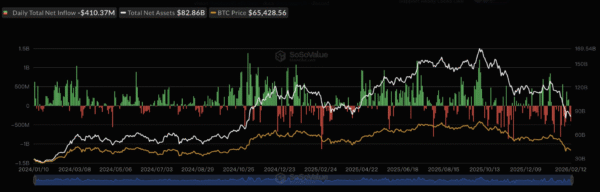
_Image Source: _SoSoValue
With no new money stepping in, institutional players appear to be reducing exposure rather than building positions.
For now, the market structure still leans bearish. Although heavy selling has slowed, traders remain cautious. The high implied volatility, steady ETF outflows, and defensive options positioning show caution remains in play. Although prices may stabilize, a stronger move higher will likely require fresh inflows and calmer volatility.
Disclaimer: The information on this page may come from third parties and does not represent the views or opinions of Gate. The content displayed on this page is for reference only and does not constitute any financial, investment, or legal advice. Gate does not guarantee the accuracy or completeness of the information and shall not be liable for any losses arising from the use of this information. Virtual asset investments carry high risks and are subject to significant price volatility. You may lose all of your invested principal. Please fully understand the relevant risks and make prudent decisions based on your own financial situation and risk tolerance. For details, please refer to
Disclaimer.
Related Articles
Morgan Stanley Bitcoin ETF Drives 3-Fold Impact as 16,000 Advisors Open Path to Multi-Billion Demand
Bitcoin demand is set to expand rapidly as Morgan Stanley deploys its 16,000 advisors and launches a low-cost ETF, driving institutional inflows and strengthening crypto’s position in mainstream portfolios.
Key Takeaways:
Morgan Stanley’s 16,000 advisors unlock major bitcoin demand, driving
Coinpedia1m ago
DWF Labs Co-Founder: The current market is boring, but it hasn’t disappeared—builders or investors still have a lot to do.
DWF Labs co-founder Andrei Grachev said the market is currently in a “boring” phase, with many important activities quietly underway. He advised investors to stay patient and look for a better timing. He emphasized that opportunities still exist in the market—such as holding Bitcoin or participating in altcoins—and urged retail investors to keep learning and remain optimistic.
GateNews27m ago
Researchers propose a transaction scheme for quantum-resistant Bitcoin without needing a fork
Gate News message, on April 12, a researcher proposed a transaction scheme that enables quantum-resilient protection for Bitcoin without requiring a fork. At present, the quantum computing threat to Bitcoin is still at the theoretical level. Meanwhile, tech companies such as Google and Cloudflare have already begun preparing countermeasures and set a target timeline to complete the migration of quantum cryptography after 2029.
GateNews1h ago
Contract whale “sets 10 big targets first” — the short position is up $3.21 million; the BTC short opening price is $71,554.61.
Gate News message, April 12, according to on-chain analyst Ai Yi (@ai_9684xtpa) statistics, the short positions of the contract whale “first set 10 big targets” (@Jason60704294) are currently up $3.21 million. Of this, the BTC short positions are 2,567.49 BTC, with an opening price of $71,554.61, and an unrealized profit of $1.19M; the ETH short positions are 38,465.22 ETH, with an opening price of $2,248.74, and an unrealized profit of $2.03M.
GateNews1h ago
$789 Million Fresh Capital: Bitcoin ETFs See Highest Weekly Inflow Since February - U.Today
Bitcoin ETFs saw a significant resurgence with $789 million in weekly inflows, the highest since February. BlackRock led the charge, contributing 80% of this total, signaling renewed institutional interest in the market after a period of withdrawals.
UToday1h ago
Strategy Yesterday increased its holdings of 3,447 BTC through STRC, worth $250 million
Gate News message: On April 12, according to @BitcoinArchive monitoring, Strategy added 3,447 bitcoins worth $250 million yesterday (April 11) through its perpetual preferred stock product STRC. This increase is equivalent to the supply of bitcoin mined by the network over the past 8 days.
GateNews1h ago


