Cardano (ADA) is still rolling out new upgrades even with the market under pressure. This week, it approved a major LayerZero integration, linking the network to over 160 blockchains. A new privacy stablecoin called USDCx is also set to launch at the end of February.
On top of that, Cardano’s Midnight partner chain has now confirmed a mainnet rollout before the end of March. The fundamentals keep improving, but the price action is still chained to Bitcoin’s next move.
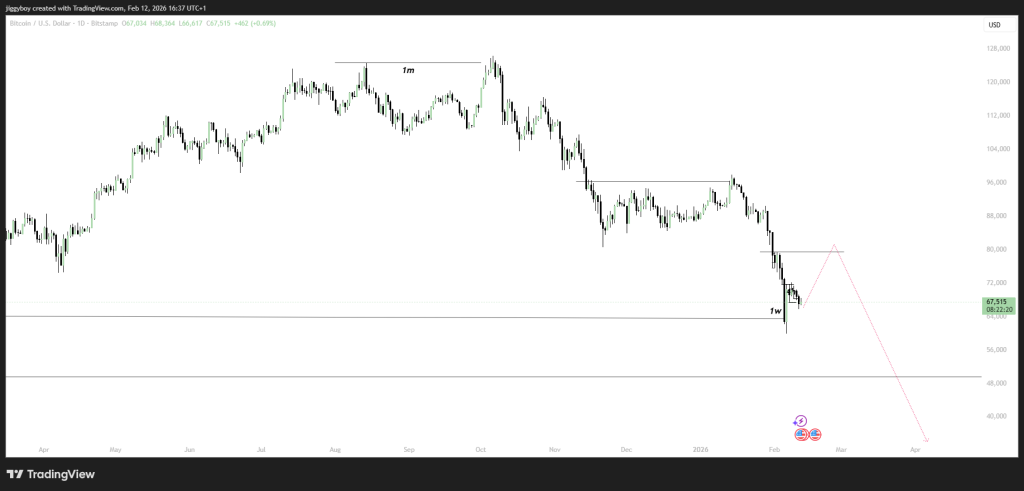
However, the Bitcoin chart looks weak. Price has been falling for months, and the big drop came after the early February breakdown.
The BTC price lost a major support zone and dropped hard into the mid-$60,000s, with only a small bounce showing up so far.
That kind of move usually doesn’t happen in isolation. When Bitcoin breaks down this aggressively, it often leads to one of two outcomes: either a relief rally back into resistance, or another leg lower once the bounce fades.
The BTC chart even shows a possible rebound toward the $80,000 area, but that level now looks like a ceiling, not a launchpad.
Source: TradingView.com
- Could Bitcoin Price Still Drop Another 30%?
- Factors That Could Still Pressure ADA Lower
- What the Bitcoin Scenario and These Factors Could Mean for ADA Price
Could Bitcoin Price Still Drop Another 30%?
A 30% drop from current levels would take Bitcoin down near the $47,000–$50,000 range. That might sound extreme, but the structure on the chart makes it possible.
There’s a lot of empty space below the current zone, and the next major support sits much lower than where the BTC price is trading today.
If fear stays high and macro pressure continues, Bitcoin could easily drag the rest of the market down with it. And Cardano, like most large-cap altcoins, tends to follow Bitcoin closely during heavy selloffs.
_****BlackRock Enters Uniswap, UNI Jumps 40%: Bigger Move Coming?**
Factors That Could Still Pressure ADA Lower
Bitcoin is the main driver, but it isn’t the only reason Cardano could stay under pressure. Market sentiment is still extremely fragile right now, and in fear-heavy conditions even strong development progress can get ignored.
The ADA price remains highly correlated with the broader risk-off environment, so weakness can continue even if Cardano itself is shipping upgrades.
There’s also regulatory uncertainty hanging over the space. Grayscale has filed for a spot ADA ETF, but approval is far from guaranteed, and without a clear institutional catalyst in the near term, buyers may stay cautious.
Whale accumulation and oversold signals help, but they don’t automatically create a reversal if the wider market remains stressed.
What the Bitcoin Scenario and These Factors Could Mean for ADA Price
When you put everything together, the ADA price is still vulnerable if Bitcoin breaks down further. The first downside level remains the recent low near $0.226, and if fear spikes again, the $0.20 zone becomes the next major area to watch.
In a deeper market washout, ADA could even slide toward the $0.15–$0.17 range before a true bottom forms.
However, Cardano does have real catalysts ahead. Midnight is expected to launch before the end of March, LayerZero interoperability is now approved, and USDCx is on the way.
These upgrades could strengthen the ecosystem into Q2, but until broader sentiment improves, downside targets stay firmly in play.
Cardano’s fundamentals are improving, but price is still trapped in a market ruled by Bitcoin and fear. If BTC drops hard again, ADA could revisit $0.226 quickly, with $0.20 as the next major line. A deeper washout could push it into the $0.15–$0.17 zone before a true bottom forms.
For bulls, the first real recovery signal would be reclaiming $0.326 and holding above it. Until then, the Cardano price remains in a zone where macro pressure and market fear can keep dragging prices lower, even with major upgrades on the horizon.
Disclaimer: The information on this page may come from third parties and does not represent the views or opinions of Gate. The content displayed on this page is for reference only and does not constitute any financial, investment, or legal advice. Gate does not guarantee the accuracy or completeness of the information and shall not be liable for any losses arising from the use of this information. Virtual asset investments carry high risks and are subject to significant price volatility. You may lose all of your invested principal. Please fully understand the relevant risks and make prudent decisions based on your own financial situation and risk tolerance. For details, please refer to
Disclaimer.


