

Trade
Trading Type
Spot
Trade crypto freely
Pre-Market
Trade new tokens before they are officially listed
Margin
Magnify your profit with leverage
Convert & Block Trading
0 Fees
Trade any size with no fees and no slippage
Alpha
Points
Get promising tokens in streamlined on-chain trading
Leveraged Tokens
Get exposure to leveraged positions simply
Futures
Futures
Hundreds of contracts settled in USDT or BTC
Options
HOT
Trade European-style vanilla options
Unified Account
Maximize your capital efficiency
Demo Trading
Futures Kickoff
Get prepared for your futures trading
Futures Events
Participate in events to win generous rewards
Demo Trading
Use virtual funds to experience risk-free trading
Earn
Launch
CandyDrop
Collect candies to earn airdrops
Launchpool
Quick staking, earn potential new tokens
HODLer Airdrop
Hold GT and get massive airdrops for free
Launchpad
Be early to the next big token project
Alpha Points
NEW
Trade on-chain assets and enjoy airdrop rewards!
Futures Points
NEW
Earn futures points and claim airdrop rewards
Investment
Simple Earn
Earn interests with idle tokens
Auto-Invest
Auto-invest on a regular basis
Dual Investment
Buy low and sell high to take profits from price fluctuations
Soft Staking
Earn rewards with flexible staking
Crypto Loan
0 Fees
Pledge one crypto to borrow another
Lending Center
One-stop lending hub
VIP Wealth Hub
Customized wealth management empowers your assets growth
Private Wealth Management
Customized asset management to grow your digital assets
Quant Fund
Top asset management team helps you profit without hassle
Staking
Stake cryptos to earn in PoS products
Smart Leverage
NEW
No forced liquidation before maturity, worry-free leveraged gains
GUSD Minting
Use USDT/USDC to mint GUSD for treasury-level yields


More
Promotions
Activity Center
Join activities and win big cash prizes and exclusive merch
Referral
20 USDT
Earn 40% commission or up to 500 USDT rewards
Announcements
Announcements of new listings, activities, upgrades, etc
Gate Blog
Crypto industry articles
VIP Services
Huge fee discounts
Proof of Reserves
Gate promises 100% proof of reserves






Silver Crashed 14% in a Day, Wiping Out $550 Billion – Here's Why
Source: Coindoo Original Title: Silver Crashed 14% in a Day, Wiping Out $550 Billion – Here’s Why Original Link: https://coindoo.com/silver-crashed-14-in-a-day-wiping-out-550-billion-heres-why/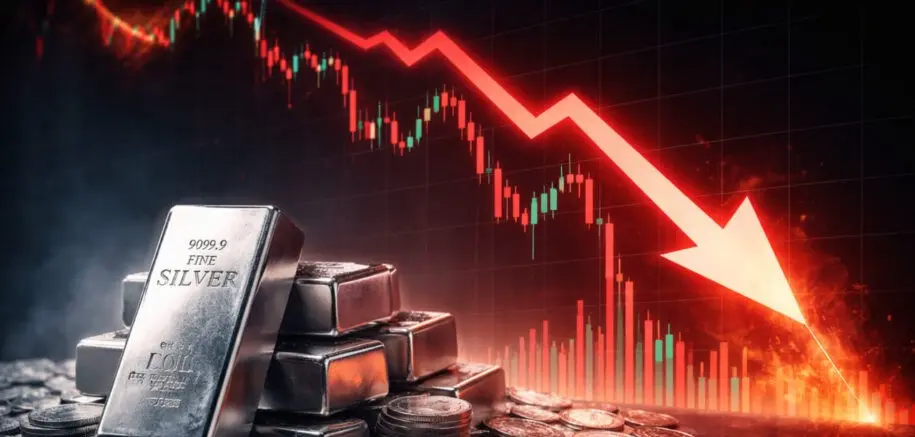
Silver prices suffered a violent correction late Sunday, plunging roughly 14% in a matter of minutes during overnight trading before stabilizing.
The sudden drop erased weeks of gains and briefly sent silver tumbling from the low $80s to near the low $70s, shocking traders and triggering a wave of speculation across markets. The market cap of silver dropped by $550 billion in a single day.
Key Takeaways
At the time of writing, silver is hovering around the $72-$73 range, well off the session lows but still sharply lower on the day. The speed, timing, and structure of the move suggest this was not a normal selloff – and almost certainly not retail-driven.
Why the timing mattered
The collapse began shortly after 2:00 a.m. Eastern time on Monday, a period known for extremely thin liquidity in global precious metals markets. During these hours, the order book is shallow, meaning large orders can move prices far more aggressively than during peak trading sessions.
That timing alone challenges the popular narrative that retail traders were responsible. Retail participation rarely concentrates enough volume to move futures markets by double digits in minutes, especially overnight. Instead, the price action pointed to urgency – not discretion.
It was pointed that a forced liquidation of a large institutional position could be the likely trigger. According to online chatter, a leveraged entity tied to precious-metals derivatives appears to have breached margin requirements, prompting its prime broker or clearing firm to liquidate positions automatically. Once that process began, silver was sold aggressively at market, overwhelming overnight liquidity and triggering the cascade lower.
A mechanical selloff, not sentiment
Silver did not behave like a market reacting to news, data, or shifting sentiment. Prices did not pause at technical levels, nor did they show signs of gradual distribution. Instead, bids were swept rapidly, with futures cascading lower almost vertically.
This pattern is consistent with forced liquidation. When a large institutional player breaches margin requirements, positions are no longer managed by traders. Control shifts to automated risk systems whose sole mandate is to restore solvency as fast as possible.
In that scenario, there is no concern for execution quality, technical indicators, or market impact. The system sells at market until collateral requirements are met. In thin conditions, that process can overwhelm available liquidity in seconds.
Stress spreads beyond silver
The silver crash coincided with renewed signs of stress in funding markets. Overnight, the Federal Reserve injected $34 billion into the banking system via its emergency overnight repo facility, on top of roughly $17 billion added just two days earlier.
While the liquidity injection was not officially linked to silver, the timing raised concerns about counterparty risk. When a large participant is forced out of leveraged positions, clearing houses must ensure settlement continues smoothly. If a participant cannot meet obligations, the burden shifts up the chain, forcing rapid liquidity provisioning.
This dynamic often triggers what traders describe as a “correlation spike,” where selling spreads beyond the original asset. In these moments, markets are not repricing fundamentals – they are raising cash.
Derivatives made the drop worse
Options positioning likely amplified the move. As silver prices collapsed, dealers hedging short option exposure were forced to sell futures into a falling market. That mechanical hedging pressure can turn a sharp drop into a feedback loop, where lower prices force more selling, which then pushes prices even lower.
This is why the decline accelerated so quickly. It was not a reflection of new information, but of market structure working against itself under stress.
What changed – and what didn’t
Despite the dramatic price action, there was no new macro data, policy shift, or supply-demand shock tied to silver. The metal’s fundamental backdrop did not change overnight. What changed was positioning.
Forced liquidations tend to cleanse leverage from the system. Weak or overextended players are flushed out, ownership shifts, and markets eventually regain balance. While volatility can persist in the short term, the structural pressure that caused the crash does not usually last once liquidation flows are exhausted.
What to watch next
The key test now is how silver behaves during normal, liquid trading hours. Stability, tighter spreads, and controlled price action would reinforce the view that Sunday’s move was a one-off liquidity event. Renewed heavy selling during peak sessions, by contrast, would suggest deeper systemic stress.
For now, the evidence points to a classic liquidity cascade – fast, mechanical, and largely disconnected from fundamentals – rather than a broad loss of confidence in silver itself.