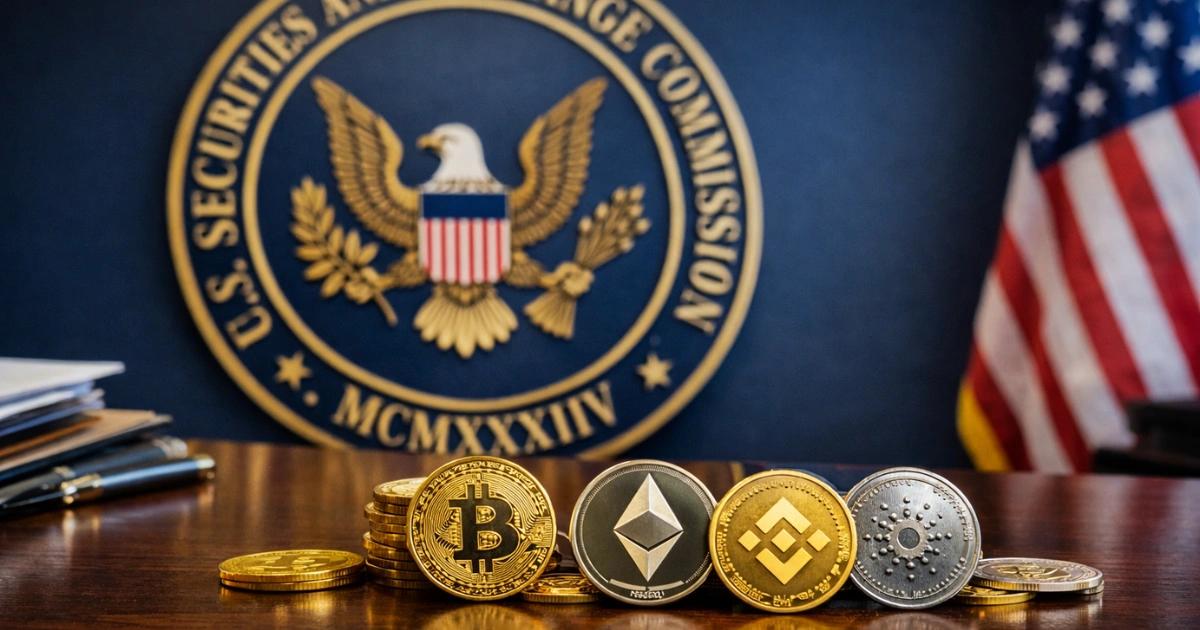
SEC Chair Paul Atkins confirms that the crypto safe harbor framework has been submitted to the White House for review. It aims to introduce a new startup exemption and an innovation exemption, reshaping the regulatory logic for digital assets.
SEC Chair Paul Atkins confirmed that the “Safe Harbor” framework proposal—highly anticipated by the cryptocurrency industry and designed to exempt qualifying projects from registration in their early stages—has been submitted to the White House for review.
On Monday, Paul Atkins disclosed at a digital asset summit jointly hosted by Vanderbilt University and the Blockchain Association that this proposal, which first appeared last month, has now entered the final review process within the White House administrative system. The final review and vetting are being carried out by the Office of Information and Regulatory Affairs (OIRA) under the U.S. Office of Management and Budget (OMB).
We will soon present regulatory rules for cryptocurrencies. The proposal is currently in the OIRA review stage—this is indeed an exciting development, as it is the final step before formal issuance.
Among the safe harbor proposals put forward by Paul Atkins, the clause that has drawn the most attention from the market is the “Startup Exemption.” Its purpose is to allow cryptocurrency startups to raise operating funds smoothly while also protecting investors.
Under the proposal, this exemption would allow crypto projects to begin without immediately registering, and to raise a specified amount of funds within 4 years, provided they must disclose the necessary information.
In addition, Paul Atkins also proposed the idea of an “Investment Contract Safe Harbor,” which would complement the Token Taxonomy guidance released by the SEC in March this year. For the cryptocurrency industry, the token taxonomy guidance is undoubtedly a historic milestone. This is the SEC’s first time, in an official document, to clearly define under what circumstances and conditions digital assets would be deemed “securities.”
Regulation and obstacles: legislation and administrative rules go hand in hand
At the same time that the SEC is actively pushing forward a regulatory framework, the U.S. Congress is also working to regulate the cryptocurrency industry through legislation. However, over the past year, the legislative process has been slow and repeatedly met with setbacks.
Paul Atkins said the reason legislation is necessary is that regulatory bodies like the SEC “need clear and unshakable (Chiseled in Stone) legal authority.”
He explained that, compared with administrative rules that could be changed at any time by shifts in party control or a new president taking office, a bill passed through the legislature after three readings has real long-term durability. He said:
We can certainly do a lot on the regulatory front, but in the end we still must ensure these rules take root for real and aren’t easily overturned.
“Innovation exemption” sparks a struggle between Wall Street and crypto circles
On the other hand, the SEC is also developing an “Innovation Exemption” mechanism. The concept is similar to building a “regulatory sandbox” for on-chain assets—allowing industry participants to test innovative financial products and services in a controlled environment.
However, over the past year, this exemption concept has sparked intense debate between crypto advocates and traditional financial institutions. Traditional Wall Street forces worry that an overly broad and lenient exemption scope could weaken investor protection mechanisms and market oversight.
Citadel Securities, a major market maker, has strongly urged that the U.S. SEC should formulate rules through a formal “Notice-and-comment” administrative process. By contrast, the Blockchain Association pushed back on Monday, arguing that cumbersome procedures are not absolutely necessary. It said the SEC has previously used exemption mechanisms multiple times and absolutely has the authority to exercise that mechanism under the law.
In response, at the summit, Paul Atkins openly supported the position of the crypto community and clearly stated that the SEC does indeed have the authority to promote an exemption mechanism. He said:
We are about to release the specific details regarding the Innovation Exemption. I’m quite excited about this—there is still a great deal of room for us to be pioneering in this area.
- This article is reprinted with authorization from: 《Block Cast》
- Original title: 《SEC “Crypto Safe Harbor” Proposal Sent to the White House for Review! Chair Paul Atkins: To Be Issued Short-Term》
- Original author: Crypto Sister MEL
Disclaimer: The information on this page may come from third parties and does not represent the views or opinions of Gate. The content displayed on this page is for reference only and does not constitute any financial, investment, or legal advice. Gate does not guarantee the accuracy or completeness of the information and shall not be liable for any losses arising from the use of this information. Virtual asset investments carry high risks and are subject to significant price volatility. You may lose all of your invested principal. Please fully understand the relevant risks and make prudent decisions based on your own financial situation and risk tolerance. For details, please refer to
Disclaimer.


