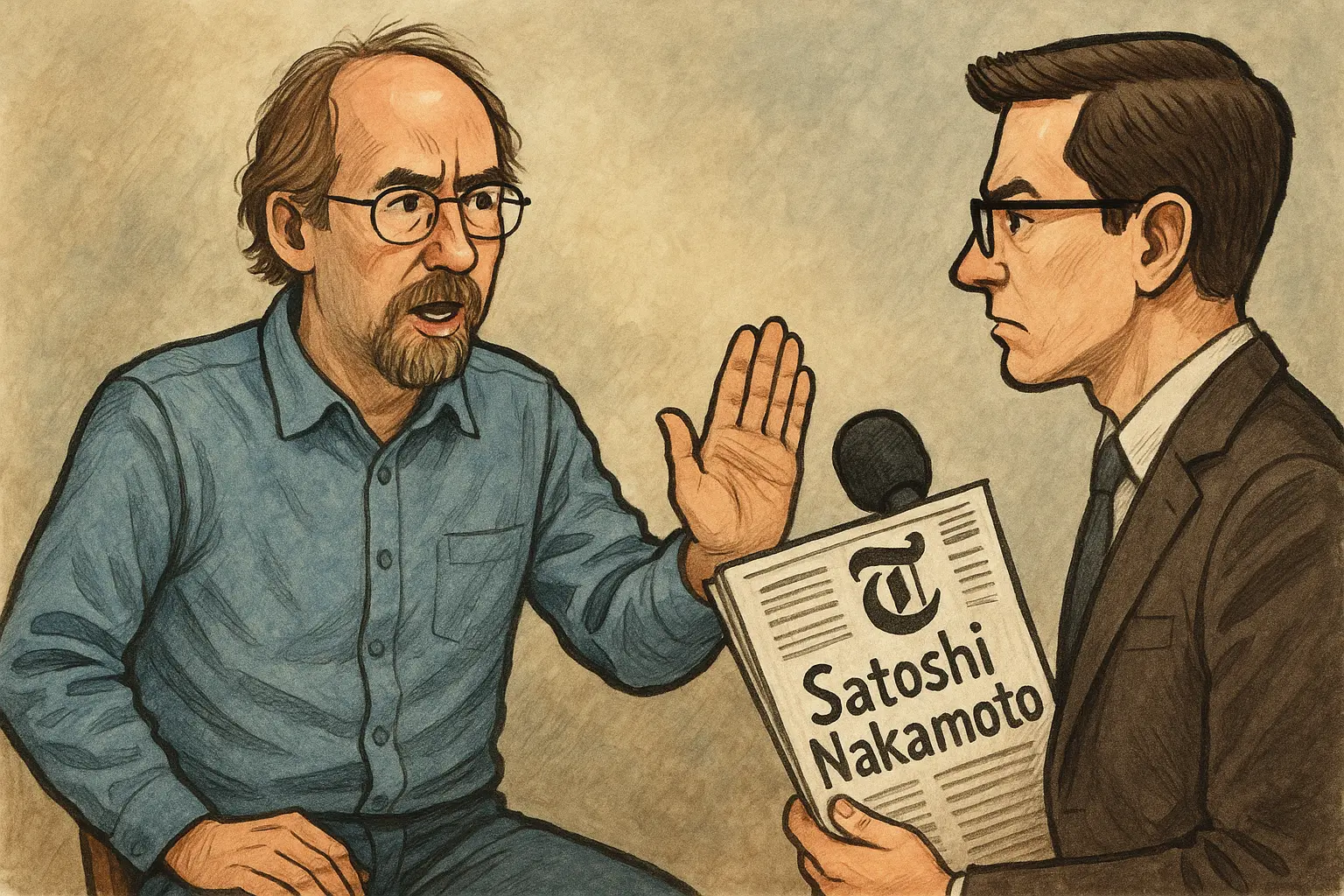
The well-known investigative reporter John Carreyrou of The New York Times published a deep-dive investigation spanning 18 months, pointing to Blockstream CEO Adam Back as possibly being the Bitcoin creator Satoshi Nakamoto, sparking widespread discussion across the global crypto community. Adam Back immediately issued a statement on social media, explicitly denying the claim.
The Key Evidence Behind The New York Times Investigation: Hashcash, Cypherpunk, and the Mysterious Gap
Carreyrou’s investigation report puts forward several indirect indicators. First, Adam Back is the creator of Hashcash—a proof-of-work (PoW)-based anti-spam system. Its underlying principles were directly referenced in Bitcoin’s original white paper, forming the technical foundation for Bitcoin’s mining mechanism.
Second, in the late 1990s, Back was actively involved in Cypherpunk forums, where he extensively discussed concepts such as digital cash and decentralized systems—ideas whose direction closely aligns with Bitcoin’s design philosophy. A third indicator is the so-called “mysterious gap” in timing—Back had previously been active in related online discussions for a long time, but around the crucial period when Bitcoin emerged in 2008, his online activity showed an unusually quiet spell. The investigation also notes that Back’s written style shares some similarities with Satoshi Nakamoto’s white paper and early forum posts.
Adam Back’s Official Denial: Addressing Confirmation Bias Arguments and Bitcoin’s “No-Owner” Advantage
After the report was published, Adam Back quickly posted a statement on the X platform, denying that he is Satoshi Nakamoto.
Four Core Arguments Behind Adam Back’s Denial
General research background: Before Bitcoin appeared, many cryptography researchers were exploring digital cash and decentralized systems; Back was only one of them
Confirmation bias effects: Because Back has spent years writing a large volume of articles related to encryption technology, analysts are more likely to find passages in his massive body of text that resemble Satoshi Nakamoto—but these connections are ultimately the result of subjective selective interpretation
Back’s position on Satoshi Nakamoto’s identity: Back says he doesn’t know who Satoshi Nakamoto is, adding “maybe that’s even better”
The “no-known-founder” advantage: Back believes that Bitcoin not having a known founder is one of its core advantages. It prevents any individual from controlling the Bitcoin network, ensuring the system remains neutral and independent in the long run
The Mystery of Satoshi Nakamoto: The Only Solid Method Is Bitcoin Using the Genesis Wallet
Since the Bitcoin network went live in 2009, Satoshi Nakamoto’s identity has remained the industry’s most famous unsolved puzzle. Over the years, multiple figures—including Hal Finney and Nick Szabo—were suspected. Craig Steven Wright, in particular, sparked legal disputes for claiming to be Satoshi Nakamoto, but was ultimately rejected in court.
In the cryptography community, it’s widely believed that the only way to fully verify Satoshi Nakamoto’s identity is to use private keys related to the Genesis Block to produce digital signatures, or to move the estimated ~1.1 million bitcoins in the Genesis wallet that have never been spent. Adam Back has never carried out such an action, and under this standard, all indirect evidence cannot provide mathematical-level certainty.
Frequently Asked Questions
Why did Adam Back become one of the most closely watched candidates for Satoshi Nakamoto?
The Hashcash proof-of-work system created by Adam Back was directly cited by the Bitcoin white paper. Combined with his record of activity in Cypherpunk forums, his deep background in cryptography research, and the slump in online activity during the period when Bitcoin was introduced, this made him the core target of The New York Times investigation.
What is confirmation bias, and how does Adam Back use it to refute similarity allegations?
Confirmation bias refers to the tendency for people to selectively look for supporting evidence within an existing framework of beliefs, while ignoring information that doesn’t fit the assumptions. Adam Back points out that because he has spent years writing a large number of cryptography articles, when analysts look for “similarities,” they must perform selective matching—this is not an objective comparison conclusion, but a typical manifestation of confirmation bias.
How can Satoshi Nakamoto’s identity ultimately be confirmed?
The cryptography community widely believes that the only conclusive verification method is to use private keys related to the Genesis Block to create digital signatures, or to move the estimated ~1.1 million bitcoins in the Genesis wallet that have never been spent. Before performing this action, all forms of indirect evidence cannot reach the level of certainty in cryptography terms.
Disclaimer: The information on this page may come from third parties and does not represent the views or opinions of Gate. The content displayed on this page is for reference only and does not constitute any financial, investment, or legal advice. Gate does not guarantee the accuracy or completeness of the information and shall not be liable for any losses arising from the use of this information. Virtual asset investments carry high risks and are subject to significant price volatility. You may lose all of your invested principal. Please fully understand the relevant risks and make prudent decisions based on your own financial situation and risk tolerance. For details, please refer to
Disclaimer.


