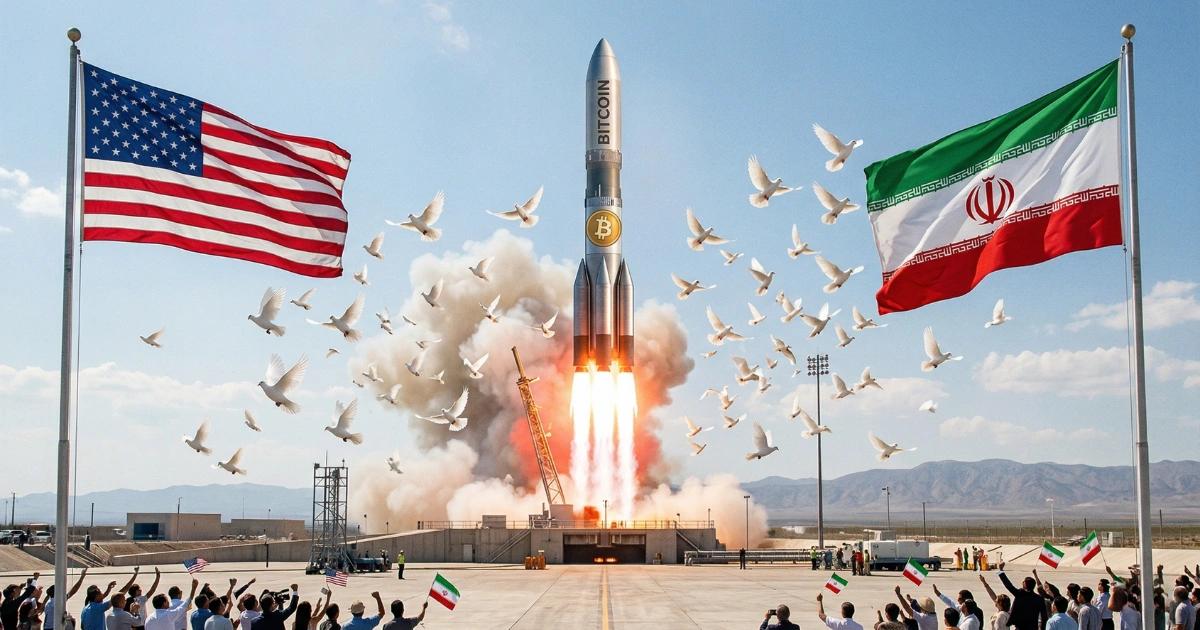
Pakistan brokered a two-week ceasefire between the U.S. and Iran. Bitcoin surged past $72,000, oil prices plunged 13%, and global market sentiment flipped rapidly.
Pakistan’s mediation pays off as the U.S. and Iran reach a two-week ceasefire agreement
At a critical moment marked by heightened global geopolitical tensions, an unexpected diplomatic breakthrough injected fresh confidence into a tightly wound market. Hours before the deadline of eight-point ultimatum set by U.S. President Donald Trump, Pakistan’s Prime Minister Shehbaz Sharif urgently proposed a two-week bilateral ceasefire between the United States and Iran. Sharif called on the belligerents via the social platform X to exercise restraint, giving diplomacy room to negotiate in order to achieve long-term peace and stability for the region. He said efforts to resolve the conflict peacefully are steadily progressing and have the potential to deliver tangible results in the near term.
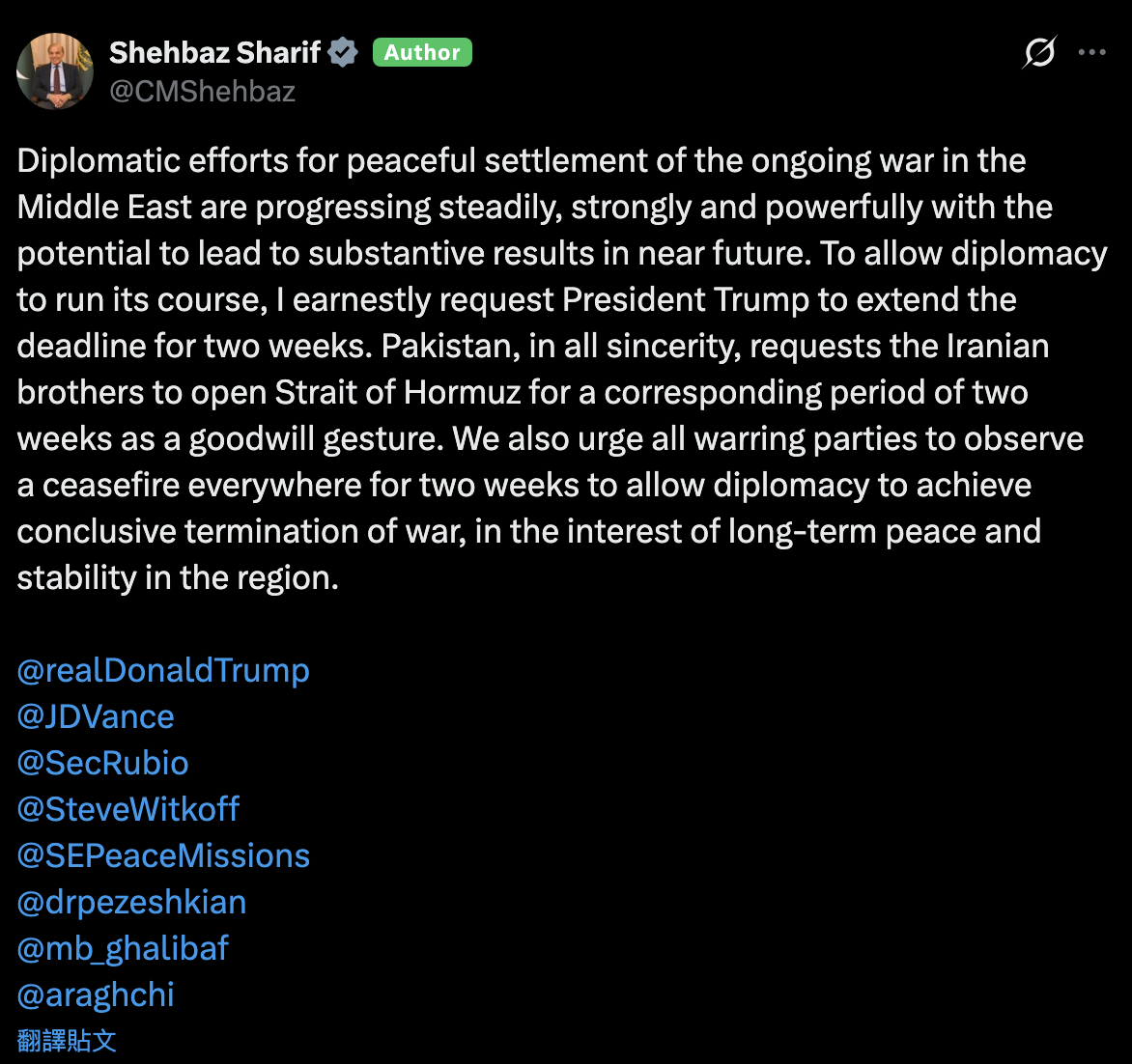
Image source: X/@CMShehbaz Pakistani Prime Minister Shehbaz Sharif calls on the belligerents to exercise restraint and gives diplomacy room to negotiate
The proposal was quickly met with positive responses from both sides. U.S. President Donald Trump then confirmed on Truth Social that he agreed to pause the bombing and attack operations against Iran for two weeks. Trump said that the U.S. military had achieved and surpassed all military objectives, and that negotiations with Iran for a long-term peace agreement have made significant progress.
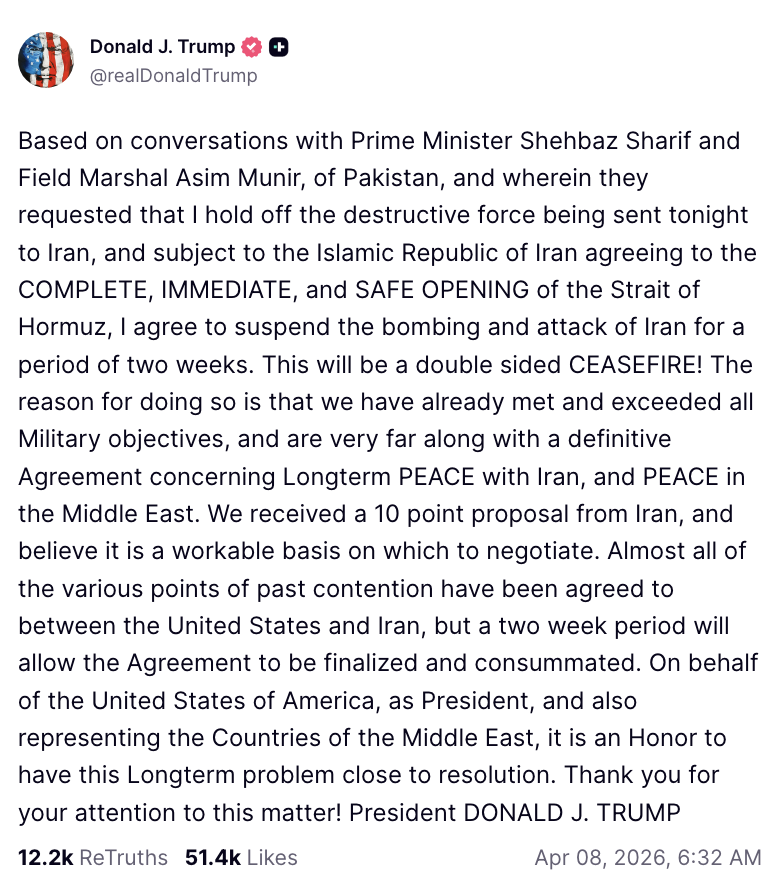
Image source: Truth Social/@realDonaldTrump U.S. President Donald Trump later confirmed on Truth Social that he agreed to pause the bombing and attack operations against Iran for two weeks
Meanwhile, Iran’s Supreme National Security Council also announced acceptance of the two-week ceasefire proposal, while emphasizing that the agreement represents a pause in defensive operations and does not mean the war is completely over. Iranian Foreign Minister Abbas Araghchi said that if attacks against Iran stop, Iran’s armed forces will halt defensive operations and, subject to coordination with the military and consideration of technical limitations, will reopen the Strait of Hormuz for safe passage.
Bitcoin breaks above the 72,000 level as short positions get bloodied by $600 million
As risk-hedging sentiment cooled and risk appetite returned, the cryptocurrency market rebounded strongly. Bitcoin ($BTC) in just over an hour exploded out of the slump of sideways trading around $69,000, breaking through the important psychological level of $72,000 in one move. It even touched $72,753 at the peak, setting a new high in nearly 20 days since March 18. Compared with the grim situation earlier that day, when it fell below $68,000 amid fears of escalation, this rally is up more than 5%, showing how highly crypto assets are sensitive to changes in the broader economic and political landscape.
The surge in price triggered a chain reaction of large-scale leveraged liquidations. According to data from CoinDesk, Bitcoin’s rapid rise triggered liquidations of nearly $600 million in crypto futures contracts across the entire market. Among these forcibly closed positions, more than $400 million came from short positions. This powerful short squeeze further reinforced the upward price trend, forcing traders who were previously bearish to cover their positions and pushing Bitcoin to hold above $71,000.
Market sentiment has shifted from extreme pessimism to cautious optimism. On the day before the ceasefire agreement was reached, the Crypto Fear & Greed Index had just recorded an 11-point score of “Extreme Fear,” reflecting investors’ intense anxiety about what comes next. However, as the U.S. and Iran reached consensus, market participants reassessed Bitcoin’s pricing logic.
Analysts believe that although Bitcoin is often viewed as a safe-haven asset, in the early stages of an extreme geopolitical crisis, it typically falls in sync with risk assets. Only when the situation eases or when diplomatic measures intervene does its characteristic as a barometer of global sentiment drive a retaliatory rebound.
International oil prices plunge 13%, U.S. stock index futures rise on hopes of peace
News of the U.S.-Iran ceasefire didn’t just ignite the crypto market—it also had a major impact on traditional financial markets, with the energy sector seeing the sharpest reaction. With Iran signaling the reopening of the Strait of Hormuz, this key shipping lane—carrying about one-fifth of the world’s oil supply—if restored, would greatly ease the threat of energy supply disruption. West Texas Intermediate (WTI) crude fell sharply by about 13%, slipping below the $100 mark to the $95 to $98 range per barrel. Brent crude also saw a similar drop.
In the stock market, investors rushed back as geopolitical risk eased. According to data provided by Cryptopolitan, U.S. Dow Jones Industrial Average index futures jumped 967 points, up about 2.1%. S&P 500 index futures and Nasdaq 100 index futures also rose 2.1% and 2.3%, respectively.
Asian markets were also boosted. Taiwan’s stock market opened on Wednesday with an explosive rally: TSMC surged NT$80, lifting the index by 1,214 points and setting the 5th largest intraday point gain in history. Japan’s Nikkei 225 surged by 2,563 points, and South Korea’s Kospi composite index also rose more than 6%.
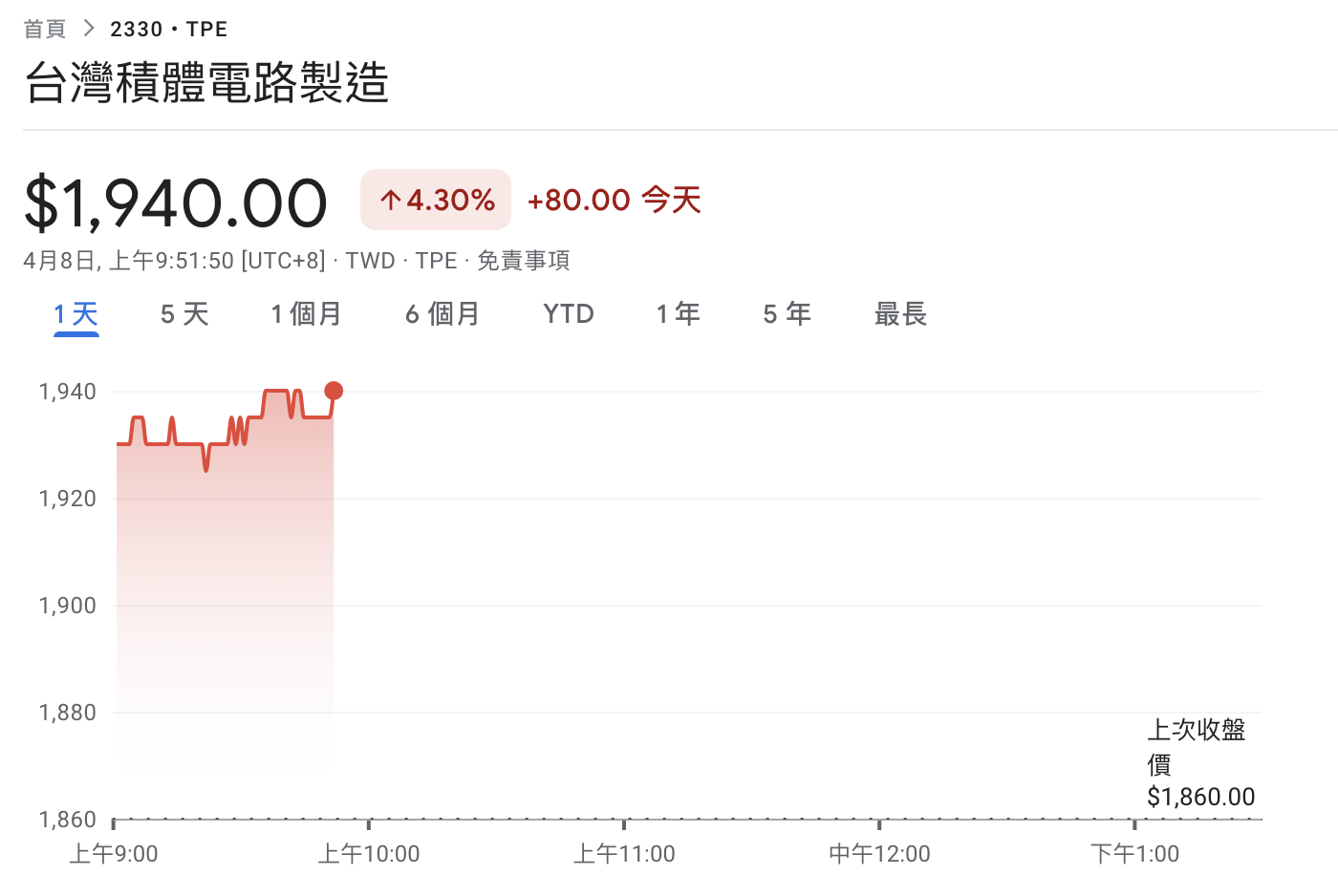
Image source: Google Finance TSMC surged today by NT$80
The actions of major institutions such as Morgan Stanley are also drawing extra attention right now. Reports indicate that the banking giant with $7 trillion in assets plans to launch its first bank-issued Bitcoin spot ETF on April 8 (4/8) on the New York Stock Exchange (NYSE), which undoubtedly adds expectations of renewed capital inflows to the already-recovering crypto market. The collapse in oil prices effectively curtailed market fears of runaway inflation, giving the U.S. Federal Reserve (Fed) more flexibility in future interest-rate decisions and optimizing the overall risk environment for financial markets.
The ceasefire window is only two weeks; the market is cautious about the progress of talks
Although the market is currently enjoying the dividends of peace, senior analysts warn that the foundation of this ceasefire agreement remains fragile. While a two-week window temporarily eases the looming threat of airstrikes, the core issues—including Iran’s nuclear weapons program and disputes over regional influence—have not been fundamentally resolved. The terms such as “technical limitations” and “military coordination” specifically mentioned in official Iranian statements suggest that the reopening of the Strait of Hormuz may still involve variables.
In addition, the market is paying close attention to the negotiation pace of the Trump administration. While Trump claims that military objectives have been achieved and that he is moving toward a long-term peace agreement, his foreign policy has always been highly uncertain. If within the next 14 days the two sides fail to reach agreement on substantive terms, geopolitical pressure could return to the market at any time. Investors need to closely watch the deadline at the end of the two weeks; market volatility could spike again then.
At present, Bitcoin has successfully regained key support levels and has shown resilience to move in sync with broader economic assets. The sustainability of this rally depends on substantive progress in diplomatic negotiations and the stability of global risk appetite. During the two-week buffer period, the crypto market may enter a high-level range-bound period. We will watch how governments and international organizations use this peaceful window to push for a final agreement. For investors, the brief pause in the U.S.-Iran war provides an opportunity to take profits and also serves as a window to reassess the risk boundaries of their portfolios.
Disclaimer: The information on this page may come from third parties and does not represent the views or opinions of Gate. The content displayed on this page is for reference only and does not constitute any financial, investment, or legal advice. Gate does not guarantee the accuracy or completeness of the information and shall not be liable for any losses arising from the use of this information. Virtual asset investments carry high risks and are subject to significant price volatility. You may lose all of your invested principal. Please fully understand the relevant risks and make prudent decisions based on your own financial situation and risk tolerance. For details, please refer to
Disclaimer.


