
X rolls out a mandatory verification mechanism for crypto content, with accounts locked upon their first mention; this comes as the latest response highlights the grim situation in which scam amounts in 2025 may approach 17 billion dollars.
X launches a mandatory verification mechanism; accounts are locked upon the first post
Social media platform X has recently introduced a new round of anti-scam measures. When an account publishes content related to cryptocurrency for the first time, the account will immediately trigger a lock mechanism, requiring users to complete identity verification before they can continue posting.
The mechanism mainly targets scenarios in which accounts are compromised and then used to promote investment scams. X product lead Nikita Bier said the system will recognize whether the account is “mentioning cryptocurrency for the first time.” Once the conditions are triggered, it will suspend the account’s ability to post. The move is seen as significantly reducing the success rate of hackers using highly trusted accounts to spread scam information in a short period of time.
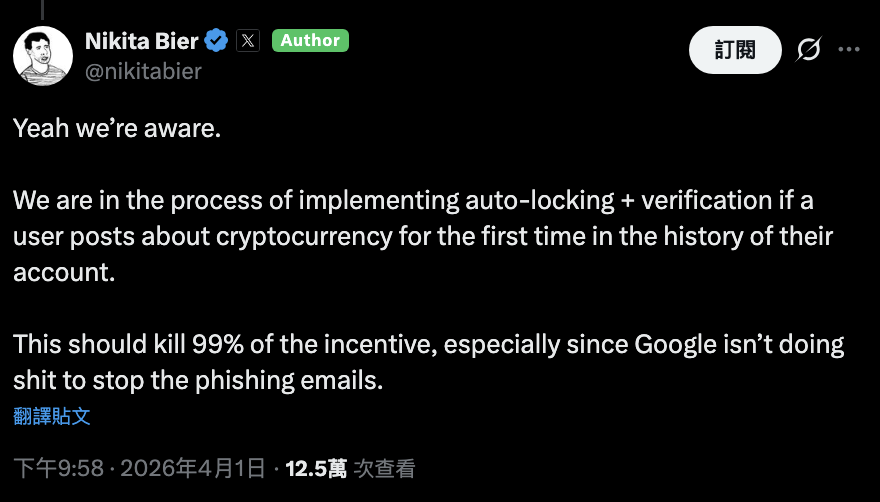
Source image: X/@nikitabier X product lead Nikita Bier said the system will recognize whether the account is “mentioning cryptocurrency for the first time.” Once the conditions are triggered, it will suspend the account’s ability to post
The platform noted that in the past, attackers often stole account credentials through phishing pages. After taking over an account, they would immediately publish investment scam content. The new mechanism aims to cut off operational permissions directly during this “golden window,” preventing scam spread.
Crypto scam volume surges; full-year may reach 17 billion dollars
According to Chainalysis statistics, crypto scam amounts in 2025 have already reached about 14 billion dollars (about 420 billion New Taiwan dollars) and may be revised upward to 17 billion dollars after complete reporting, indicating the scam industry is still expanding rapidly.
At the same time, data from the Federal Trade Commission show that in the first three quarters of 2025, investment scam cases reached 113,842, with cumulative losses of about 6.1 billion dollars, or about 183 billion New Taiwan dollars, which is nearly at the level of all of 2024.
Further analysis points out that cryptocurrency has become one of the key tools for scam fund flows, second only to bank transfers. Because transactions on the blockchain are difficult to reverse, once funds are transferred out, victims can almost never get their money back, which significantly increases the success rate of scams.
Social platforms become a scam entry point; trust mechanisms are abused
Data shows that about 38% of investment scam cases originate from social media platforms, making it the largest source of entry. Compared with 29% in 2020, this suggests scam activity is rapidly shifting toward leveraging social trust mechanisms.
Hackers typically target accounts with a fan base. Once the intrusion succeeds, they post investment opportunities or airdrop activities using an identity that followers recognize, leveraging followers’ trust to carry out scams. This type of attack also increases the amount of each scam; the average transaction amount rises from 782 dollars in 2024 to 2,764 dollars in 2025.
In addition, scam cases impersonating celebrities or official accounts have also seen explosive growth, with a year-over-year increase of up to 1,400%, becoming one of the most major tactics in crypto scams today.
Platforms and email vulnerabilities intertwine; the anti-fraud system faces challenges
X said that the account lock mechanism is only a temporary defensive measure, because the source of scams often comes from external systems, such as email phishing attacks. Some industry insiders point out that shortcomings in email services’ spam filtering make phishing links easier to penetrate users, forming a complete attack chain.
As certain email services adjust their features, their spam protection capability may decline, further increasing the likelihood that users are exposed to scam risks.
Overall, this policy shift indicates social platforms are moving from “content governance” to “behavior restrictions,” attempting to block scams through more coercive measures. However, in an environment of highly liquid crypto assets and anonymity, the scam industry still has a high level of adaptability. The tug-of-war between platforms and regulators is unlikely to end in the short term.
This article is generated by the Crypto Agent compiling information from various parties, with review and editing by 《Crypto City》. It is still in the training stage and may contain logical deviations or information errors. The content is for reference only and should not be taken as investment advice.
Disclaimer: The information on this page may come from third parties and does not represent the views or opinions of Gate. The content displayed on this page is for reference only and does not constitute any financial, investment, or legal advice. Gate does not guarantee the accuracy or completeness of the information and shall not be liable for any losses arising from the use of this information. Virtual asset investments carry high risks and are subject to significant price volatility. You may lose all of your invested principal. Please fully understand the relevant risks and make prudent decisions based on your own financial situation and risk tolerance. For details, please refer to
Disclaimer.


