Original Title: Oil Is the War
Original Author: Garrett
Translation/Compilation: Peggy, BlockBeats
Editor’s Note: While the market still treats oil-price volatility as the 「result variable」 of war, this article argues that what really needs to be understood is how the war itself is being priced through oil.
As the Strait of Hormuz continues to be obstructed, the global crude-oil supply system is forced to be restructured—Asian buyers massively shift to U.S. crude, WTI moves past Brent, and this marks structural changes in the pricing mechanism and the direction of trade flows. The short-term spread can be explained by contracts, but on a deeper level, it’s about the question of 「who can still supply」.
The author further points out that the key misjudgment in the current market is not the price, but time. The futures curve still implies a premise: the conflict will end in the short term and supply will recover. But the more likely path is a long-drawn attrition war. This means that elevated oil prices are no longer merely a phase-specific shock; they will evolve into a more persistent structural condition, with the range potentially moving up to 120–150 U.S. dollars.
Within this framework, crude oil is no longer just a commodity; it becomes an 「upstream variable」 for all assets. Its repricing will filter through step by step along interest rates, exchange rates, the stock market, and credit markets.
The market has priced in the war happening, but it has not yet priced in the war continuing.
The following is the original text:
Trump gave Iran a 10-day deadline. That was already a week ago. Yesterday, he reminded everyone again: the countdown has only 48 hours left. Tehran’s response was: no.
Five weeks ago—on February 28, when the U.S.-Israel air force attacked Iran—market pricing logic was still a kind of 「surgical」 airstrike: two weeks, at most three; the Strait of Hormuz reopens to navigation; oil prices spike and then fall back, and everything returns to normal.
But our assessment at the time was: it won’t.
From day one, our core view has been that this war will first escalate, and only later, potentially, cool down. The most likely path is ground forces getting involved, and then evolving into a long, grinding conflict. The duration of the Strait of Hormuz interruption will far exceed the assumptions the market is willing to include in its model. We have already laid out the complete logic in our duration framework, our Hormuz oil-pricing model, and our analysis of war variables.
The core judgment is simple: Iran doesn’t need to win—it only needs to raise the cost of the war enough to force Washington to look for a way out. And this 「way out」 will not come with the strait reopening smoothly.
After five weeks, every key part of this assessment is being gradually verified. The Strait of Hormuz still hasn’t resumed normal operations. Brent crude closed at around 110 dollars. The Pentagon is preparing for ground operations over the coming weeks. Trump’s war aims have also slid from 「de-nuclearization」 toward 「sending the other side back to the Stone Age」, but he still can’t clearly define what constitutes 「victory。」
The deployment of ground forces is the escalation inflection point we’ve been tracking. Marine forces and airborne units have already assembled in the theater, and this moment is approaching.
But more critical than the next round of airstrikes or the next ultimatum is oil.
Oil is not a byproduct of this war—oil is the core of the war itself. The stock market, bond market, crypto market, the Federal Reserve, and even your day-to-day food spending—everything else is a downstream variable. As long as you get the call on oil prices right, everything follows. Once you get it wrong, all other decisions will lose their meaning.
WTI crude oil prices have just risen above Brent for the first time since 2022, and this change has drawn the market’s attention.
Good—this is how it should be.
WTI above Brent: everyone is asking what
On April 2, WTI crude closed at 111.54 U.S. dollars, and Brent closed at 109.03 U.S. dollars. WTI was at a premium to Brent of 2.51 U.S. dollars, the largest spread since 2009. And just two weeks ago, WTI was still trading at a noticeable discount relative to Brent.
Everyone is asking: what happened? Below is the brief version, and then the version closer to the truth.
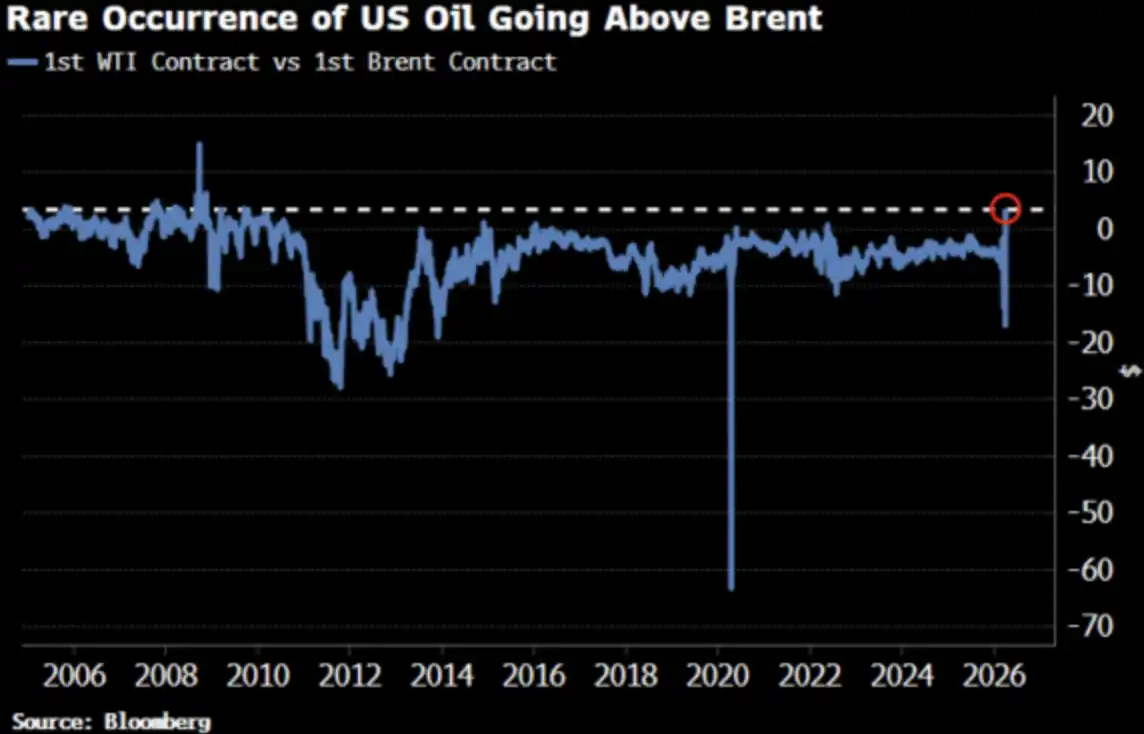
Brief version: Mismatch in contract tenors
WTI’s near-month contract corresponds to May delivery, while Brent’s near-month contract has already rolled out to June. With supply this tight, 「delivering one month earlier」 means a higher price—WTI is simply happening to deliver earlier.
Adi Imsirovic, an oil trader currently at Oxford with 35 years of trading experience, said that on top of historically high freight and insurance costs, buyers are willing to pay nearly 30 U.S. dollars per barrel more for Brent crude with a delivery month one month earlier. In his 35-year career, he has never seen anything like this.
This is a 「mechanism-level」 explanation—it’s correct, but it’s not complete.
The real version: the entire price curve is shifting
The convergence of WTI and Brent is not just an occasional mismatch in the near-month contracts. Bloomberg notes that this phenomenon is clearly visible across multiple contract months, all the way through the forward curve. In other words, the entire price curve is being repriced.
What’s the reason? A shift in Asian demand. In late March, Asian refineries locked in about 10 million barrels of U.S. crude for May shipments; they also purchased about 8 million barrels in the prior week. Kpler expects that U.S. exports to Asia in April will reach 1.7 million barrels per day, higher than March’s 1.3 million barrels per day. Refineries in China, South Korea, Japan, and ExxonMobil’s refineries in Singapore are buying U.S. crude—because this is currently 「the only cargo you can still get」.
The Strait of Hormuz is still closed. Murban, the benchmark crude in Abu Dhabi—also the alternative most similar to WTI—has disappeared from the global market. WTI is becoming the world’s 「marginal pricing oil。」
This isn’t panic buying; it’s a change in the structure of liquidity.
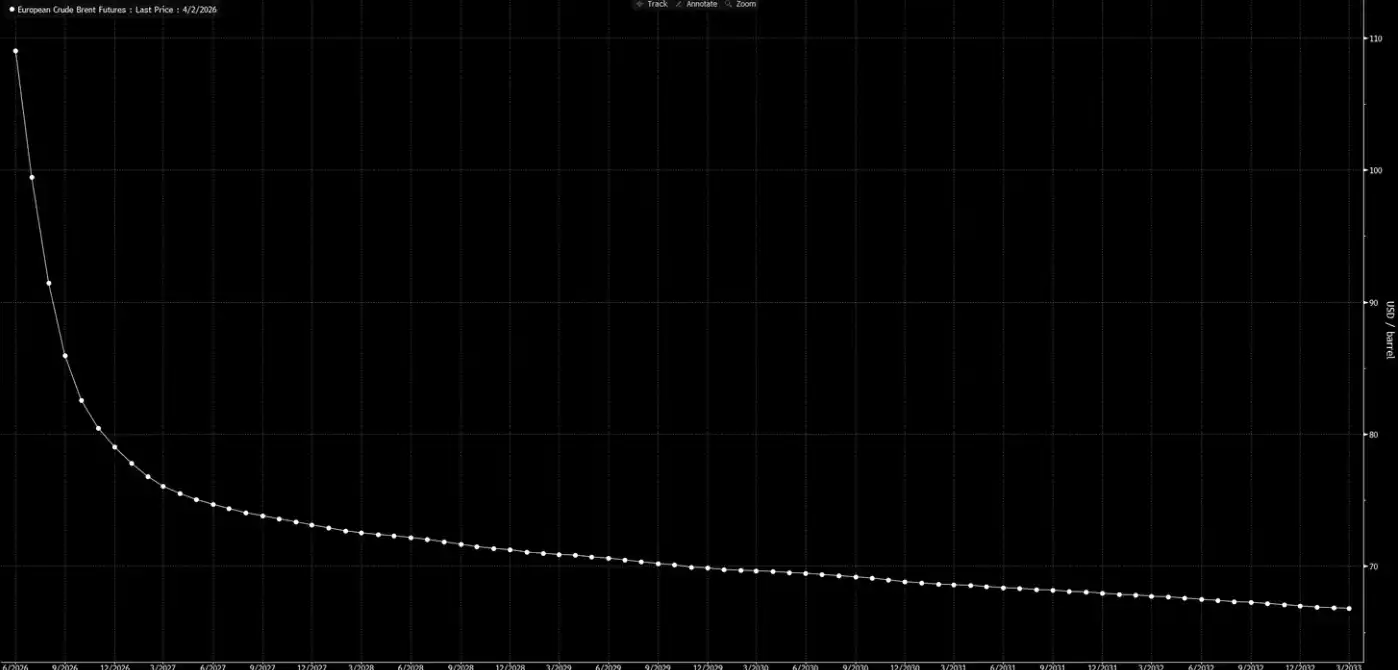
Now look at the forward price curve again.
This curve is transmitting a signal: this is just a temporary shock, and everything will return to normal before Christmas.
Our view is: this curve is 「dreaming」.
Three outcomes, one baseline path
We proposed this analytical framework in 《Weekly Signal Playbook》. So far, nothing has changed. If anything has changed, it’s that the probability of the baseline scenario has been increasing further.
This war will ultimately end in only three ways:
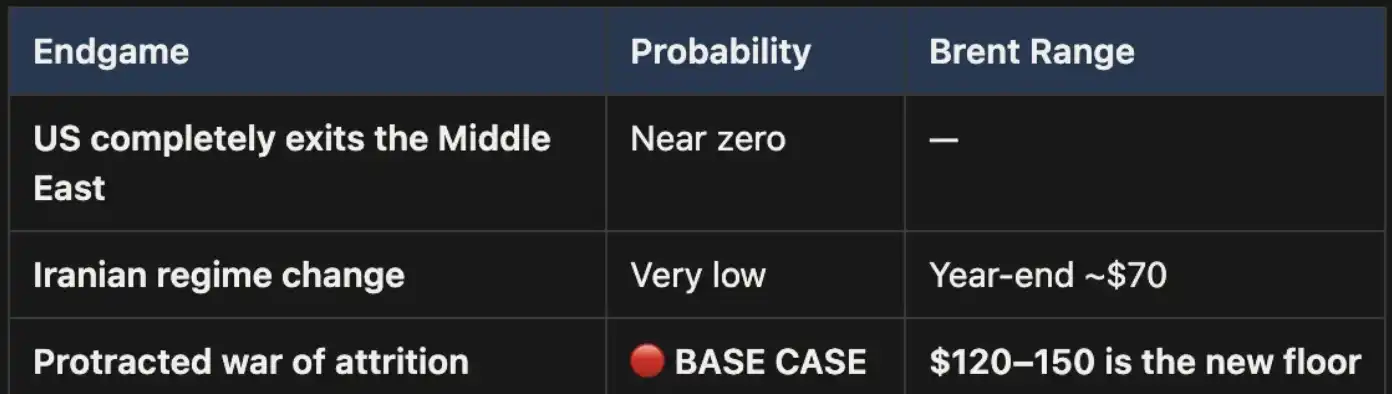
The figure lists three outcomes: one, the U.S. fully withdraws from the Middle East; two, regime change in Iran (similar to the 2003 Iraq); three, a long attrition war (attrition war)
Outcome one is politically almost impossible to achieve.
Outcome two also doesn’t hold up: terrain conditions, troop requirements, and the evolving logic of guerrilla warfare all indicate that this path is costly and hard to conclude. Iran’s land area is three times that of Iraq, and its population is close to twice as large—let alone the mountainous terrain that won’t leave room for invaders. This is not 2003.
Outcome three is the baseline scenario, and it is far ahead in terms of probability. If the conflict evolves into a long attrition war, the disruption to the Strait of Hormuz will persist, and oil prices will remain high. This high level will be structural rather than temporary. The current forward price curve clearly underprices this point.
One thing most people overlook is: if you look only at the oil industry itself, a long war might actually align with the United States’ strategic interests. Middle East crude production capacity would be damaged during the conflict, and global buyers would have to shift to North American energy because there are too few other alternative sources left. Moreover, higher oil prices would also incentivize U.S. producers to expand output—adding rigs and increasing shale-oil investment. Take a look at the chart below, and you’ll find that historically, nearly every major spike in oil prices has been followed by a round of rising U.S. production within the next 12 to 18 months.
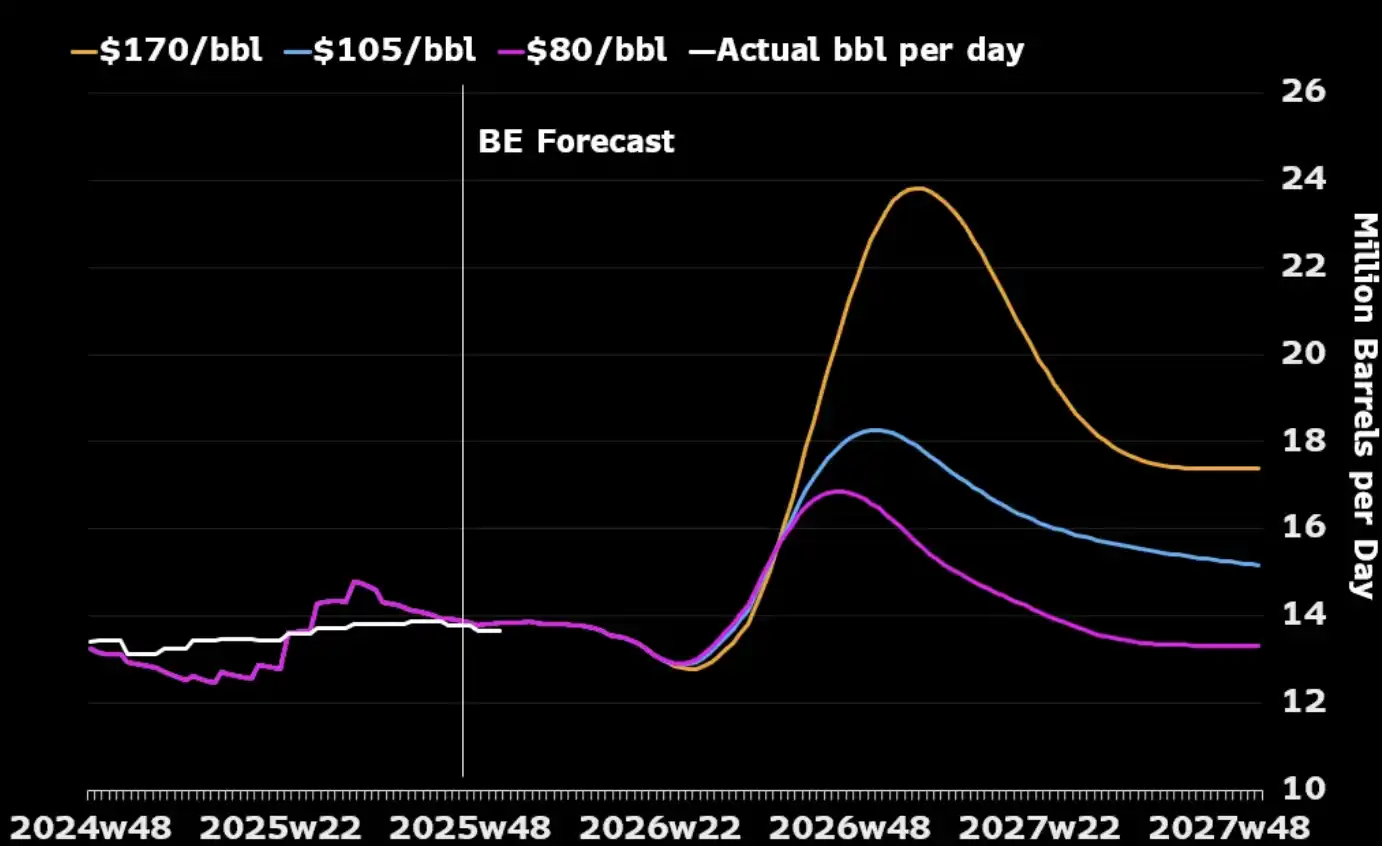
The only cost the United States truly needs to manage is domestic: how to avoid gasoline prices staying above 4 U.S. dollars per gallon for a long time, thereby triggering political backlash. This is a 「pain-point threshold」, not a condition that determines whether the war ends.
The 「arithmetic」 of prices
With the Strait of Hormuz closed, a Brent price of 110 U.S. dollars is not a ceiling—it’s just the starting point. Under our baseline scenario, as long as the strait remains closed, oil prices will stay in the 120 to 150 U.S. dollar range.
Every week that passes, inventories are being depleted. UBS data shows that global inventories have fallen to the five-year average by the end of March—and that was even before the latest round of escalation. Macquarie gives the view that if the war drags past June and the strait is still not open, the probability of oil prices surging to 200 U.S. dollars is 40%.
The front-month spread (i.e., the spread between the latest two Brent contracts) has already widened to 8.59 U.S. dollars per barrel. The market is paying an approximately 8% premium for 「delivery one month earlier」—a level of tightness on par with 2008.
But in 2008, there was no physical lockup of 15% of global supply.
Now, nearly all models, all price curves, and all Wall Street year-end forecasts are built on the same premise: this conflict will end, the Strait of Hormuz will reopen, oil prices will return to normal, and the world will go back to how it was.
Our judgment is: it won’t.
The back end of the forward curve hasn’t caught up with reality yet. The market has priced in 「war happening」, but it hasn’t priced in 「war continuing」. Before the Strait of Hormuz reopens, every dip in crude oil is an opportunity. This is our core position, and we will not hedge.
Oil is the first node. When 「ground forces move in」 and there is no quick victory—when the conflict becomes the long attrition war we judged from day one—repricing won’t stop with crude oil itself; it will transmit in sequence to interest rates, exchange rates, the stock market, and credit markets. This is what’s going to happen next.
[Original Link]
Click to learn more about Law-mode BlockBeats’ hiring openings
Welcome to join the official Law-mode BlockBeats community:
Telegram subscription group: https://t.me/theblockbeats
Telegram group chat: https://t.me/BlockBeats_App
Twitter official account: https://twitter.com/BlockBeatsAsia


