The almost complete blockade of digital connectivity that the Iranian regime has imposed since the conflict against the U.S.-Israel coalition began has already reached over 810 hours. Citizens who try to get through the blockade cracks face punishment or even death.
Iran’s Internet Blockade Passes 815 Hours
While drones and missiles are the main characters in the conflict between the Iranian regime and the U.S.-Israel coalition, there’s a digital war waging in the shadows since the hostilities started, involving Iranian citizens trying to maintain their connection to the world.
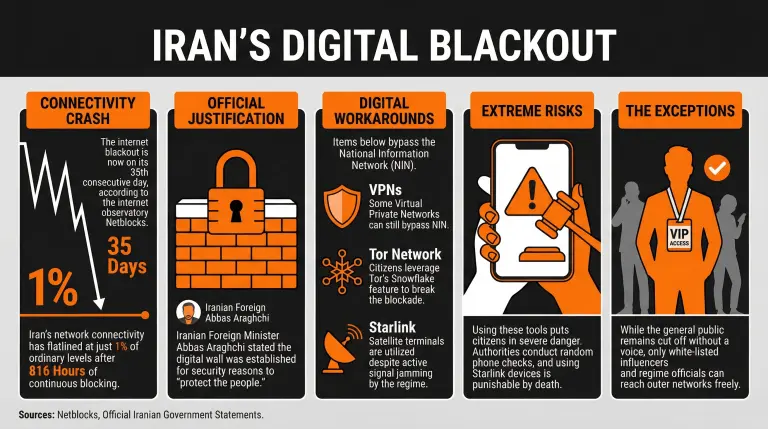
According to Netblocks, an internet observatory, the digital blockade affecting the Iranian population has reached its 35th day, cutting the country’s network connectivity to only 1%.
The organization stated:
“The internet blackout in Iran is now on its 35th consecutive day as connectivity flatlines at 1% of ordinary levels after 816 hours. The general public remain cut off from the world without vital updates and without a voice as the incident closes its fifth week.”
Iranian citizens have been employing several techniques to slip through the cracks of the regime’s digital wall, which, according to Iranian Foreign Minister Abbas Araghchi, was established for security reasons to “protect the people.” Reports state that some virtual private networks (VPNs) can still be used to reach outside the National Information Network (NIN), Iran’s own digital intranet. Tor, through its Snowflake feature, can also be leveraged to break the blockade.
Nonetheless, the use of these tools can also put the lives of Iranians in danger, as the national authorities are cracking down on their use, even turning to check citizens’ phones to review if these tools are installed.
Starlink devices, which have been illegal for quite some time, with their usage punishable by death according to the law, are still available, even as the Iranian regime is also using jamming strategies to affect the satellite links provided by these terminals.
Only white-listed influencers and regime officials can reach outer networks freely, and this situation is expected to continue as long as the conflict endures.
FAQ
- How severe is the current internet blackout in Iran? The nationwide digital blockade has reached its 35th day, dropping connectivity to just 1% amid the U.S.-Israel coalition conflict.
- How are Iranian citizens bypassing the National Information Network? People are risking severe punishment by using specialized VPNs and Tor to break through the regime’s intranet wall.
- What are the risks of using Starlink terminals in Iran? The government is actively jamming satellite links and considers the use of black-market Starlink devices a crime punishable by death.
- Does anyone in Iran have unrestricted global internet access? Only state-approved regime officials and whitelisted influencers are currently allowed to connect to outside networks.
Disclaimer: The information on this page may come from third parties and does not represent the views or opinions of Gate. The content displayed on this page is for reference only and does not constitute any financial, investment, or legal advice. Gate does not guarantee the accuracy or completeness of the information and shall not be liable for any losses arising from the use of this information. Virtual asset investments carry high risks and are subject to significant price volatility. You may lose all of your invested principal. Please fully understand the relevant risks and make prudent decisions based on your own financial situation and risk tolerance. For details, please refer to
Disclaimer.


