As blockchain use cases continue to grow, developer demands for foundational infrastructure are evolving rapidly. Traditional public chain development typically relies on Smart Contract platforms—such as deploying applications on Ethereum—which lowers the entry barrier but restricts developers to the rules of the underlying chain, including consensus mechanisms, execution environments, and performance constraints.
With multi-chain architecture emerging as an industry trend, Substrate offers developers a more flexible, chain-level approach. As a core infrastructure of the Polkadot ecosystem, Substrate empowers developers to build highly customized blockchains and connect them to the Polkadot network for shared security and cross-chain interoperability.
What Is Substrate?
Substrate is a modular blockchain development framework built by Parity Technologies to help developers rapidly create custom blockchains. Unlike Smart Contracts, which are limited to deployment on existing public chains, Substrate enables developers to build a blockchain from the ground up and tailor its operational logic to their needs.
This means developers can freely select consensus mechanisms, governance models, transaction fee structures, and execution environments, without being bound by the limitations of existing blockchain platforms. Substrate provides a rich library of reusable modules, so developers don’t have to write core blockchain code from scratch—dramatically reducing development complexity.
Crucially, blockchains built with Substrate can seamlessly connect to the Polkadot network as parachains, gaining shared security and cross-chain interoperability.
Why Is Substrate Critical for Polkadot?
Polkadot’s core mission is to create a network that enables multi-chain interoperability. Achieving this requires that different blockchains can be quickly built and integrated into a unified ecosystem. Substrate was designed specifically to meet this need.
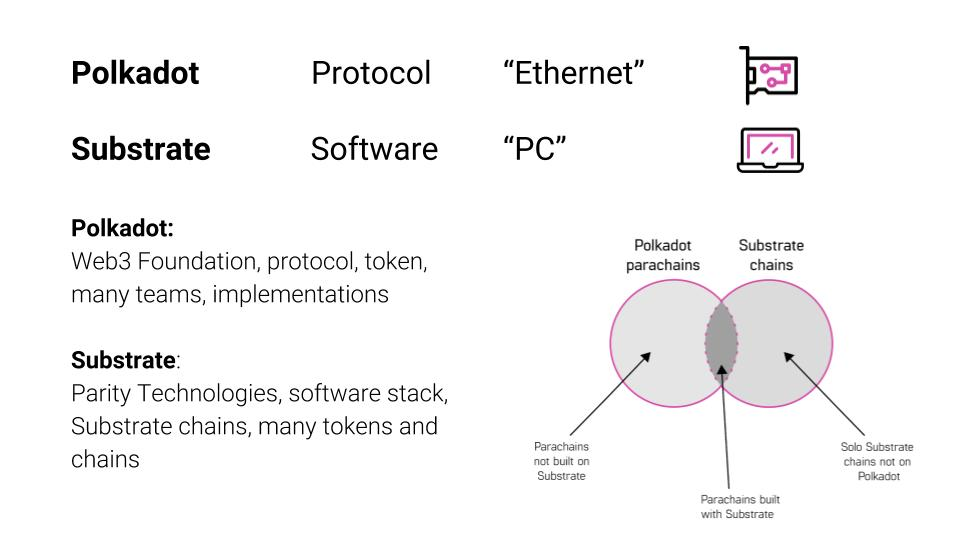
With Substrate, developers can create purpose-built blockchains tailored to their business requirements and connect them to the Polkadot (DOT) network as parachains. This approach allows every chain within the Polkadot ecosystem to maintain independent functionality while sharing network security and cross-chain capabilities.
Put simply, Substrate is the foundational tool that powers Polkadot’s ecosystem scalability. Without Substrate, efficient parachain expansion and a highly flexible multi-chain ecosystem would be difficult to achieve.
How Does Substrate Work?
Substrate is built on the principle of modular development. It breaks down core blockchain functions into composable modules—such as account systems, governance, consensus, and transaction processing. Developers can mix and match these modules to quickly assemble a blockchain that meets their business needs.
This modular architecture significantly boosts development efficiency. Instead of building every underlying feature from scratch, developers can customize on top of existing components. Substrate also allows for custom logic, enabling even more complex chain-level features.
Additionally, Substrate is natively compatible with Polkadot’s network standards, making it easy for chains built with Substrate to connect to the Polkadot Relay Chain and interoperate with other parachains.
How Is Substrate Different from Smart Contract Development?
Traditional Smart Contract development involves deploying applications on existing public chains, such as running contracts on Ethereum (ETH). While this approach is fast, developers can’t change the underlying chain rules and are confined to the platform’s framework.
Substrate, by contrast, provides chain-level development capabilities. Developers can directly define blockchain logic—choosing consensus mechanisms, configuring governance, or optimizing performance parameters. This flexibility lets developers build blockchains perfectly suited to their own business needs.
In essence, Smart Contract development is like “renting a platform,” while Substrate is about “building your own platform.”
What Are Substrate’s Key Advantages?
Substrate’s greatest strength is flexibility. Developers can build custom blockchains without being limited by a single platform’s rules—making it ideal for projects that require specialized performance, governance, or business models.
Another major advantage is development efficiency. Substrate’s modular components streamline the complex blockchain development process, enabling teams to launch products faster.
Additionally, Substrate-built chains can connect to the Polkadot network for shared security and cross-chain interoperability. This “independent chain + shared network resources” model delivers both flexibility and lower security costs.
Why Is Substrate the Core Framework for Polkadot Parachains?
Polkadot parachains must meet unified network standards to work seamlessly with the Relay Chain and other parachains. Substrate was purpose-built for this requirement, making it the core tool for Polkadot parachain development.
After building a chain with Substrate, developers can easily connect to the Polkadot network and leverage shared security through the Relay Chain. This reduces both development and maintenance costs and accelerates parachain deployment.
From an ecosystem perspective, Substrate enables Polkadot to rapidly expand its network of application-specific chains—boosting overall ecosystem activity and driving demand for the DOT token.
What Challenges Does Substrate Face?
Despite its powerful capabilities, Substrate has a steep learning curve. Building a full blockchain requires more advanced technical skills than deploying Smart Contracts, so development teams must commit more resources.
Moreover, Substrate’s flexibility brings greater complexity. Developers need a deep understanding of chain architecture, security, and governance.
As a result, Substrate is best suited for projects with clear chain-level requirements—not for every blockchain use case.
Summary
Substrate is a modular blockchain development framework that empowers developers to build custom blockchains and seamlessly connect them to the Polkadot (DOT) network. It enhances blockchain development flexibility and provides critical support for the expansion of the Polkadot parachain ecosystem.
As a cornerstone of Polkadot’s multi-chain architecture, Substrate enables developers to balance chain-level autonomy with shared network resources—making it the essential development framework at the heart of the Polkadot ecosystem.
FAQs
What’s the difference between Substrate and Smart Contract development?
Smart Contracts are used to build applications on existing public chains, whereas Substrate lets developers build a complete blockchain from scratch.
Why is Substrate important for Polkadot?
Substrate enables rapid creation of parachains that can connect to Polkadot, making it a vital foundation for the Polkadot ecosystem’s growth.
What are Substrate’s main advantages?
Key advantages include modular development, high flexibility, and access to Polkadot’s shared security network.
Do all Polkadot parachains use Substrate?
Most Polkadot parachains are built on Substrate because it offers the highest compatibility with the Polkadot network.







