Within the DeFi ecosystem, stablecoins have long functioned as both a medium of exchange and a store of value. However, traditional stablecoins generally do not generate returns directly—users must engage in lending or yield farming to earn rewards, which limits capital efficiency.
Yield-bearing stablecoins aim to merge “stability” with “yield generation.” Unitas is one such protocol, developed in response to this trend. By embedding Delta Neutral strategies into the stablecoin framework, Unitas allows users to participate in on-chain yield distribution while holding stable assets, enhancing capital efficiency and broadening stablecoin use cases.
Unitas Overview: From Stablecoin to Yield Engine
Unitas operates as a multi-module capital flow system, with a core process: users deposit assets → mint USDu → funds move to the strategy layer → execute neutral strategies → generate returns → distribute to sUSDu.
In this structure, USDu acts as the foundational stable asset for circulation, while the strategy layer deploys these assets into market-neutral positions to mitigate price volatility risk. Ultimately, returns are distributed in the form of sUSDu, establishing a closed-loop “stablecoin + yield engine” system.
Unitas Minting and Redemption: USDu Creation and Exit Mechanism
In the Unitas system, users mint USDu by depositing specific assets. This process forms the stablecoin’s minting mechanism. Unlike stablecoins that depend on over-collateralization or centralized reserves, Unitas prioritizes strategic deployment of assets after minting.
When users wish to exit, they can redeem USDu back into the underlying assets. Redemption typically involves adjusting strategy positions and releasing capital, ensuring the system maintains overall stability while meeting liquidity needs.
This “mint—deploy—redeem” cycle gives USDu both the characteristics of a stablecoin and an entry point into Unitas’s yield strategy system.
Unitas Component Design: JLP Neutral Strategy and Liquidity Efficiency
Unitas’s core lies in its strategy layer, where JLP (liquidity pool) and Delta Neutral strategies are central components.
JLP provides on-chain liquidity, enabling the protocol to earn trading fees while taking on some market exposure. To minimize this exposure, Unitas uses a hedging mechanism to establish offsetting positions, achieving market neutrality.
This design enhances liquidity efficiency: assets are not just held as reserves—they’re actively deployed in the market to generate additional returns. The hedging structure allows the protocol to pursue yield while managing price volatility risk.
Unitas Yield Generation Loop: The USDu to sUSDu Conversion
At the yield generation layer, Unitas establishes a conversion path from USDu to sUSDu.
When assets are deployed in the strategy layer, they generate continuous returns, which are accumulated and mapped to sUSDu through a specific mechanism. After users convert USDu to sUSDu, they gain a claim on the protocol’s strategy returns.
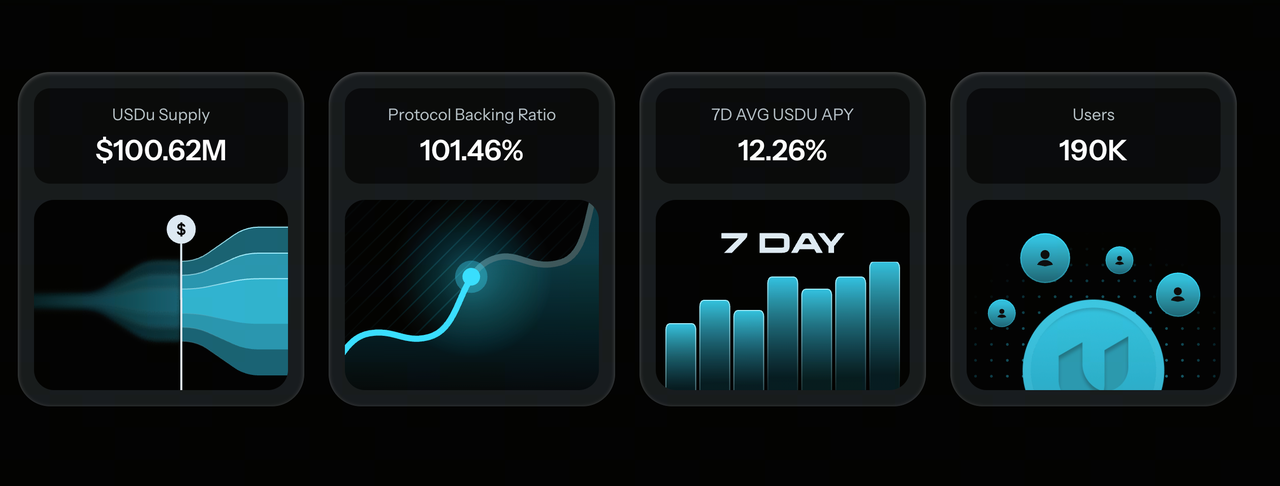
Over time, sUSDu’s value increases as returns accrue, reflecting the user’s share of yield. Upon redemption, users can convert sUSDu back to USDu or the underlying assets to realize their returns.
This mechanism separates yield distribution from stablecoin circulation, increasing system flexibility.
Unitas Key Mechanisms: Managing Extreme Market Volatility
While Delta Neutral strategies are designed to minimize market directional risk, the system may still face challenges during extreme market events.
First, significant volatility can cause hedging structures to deviate, impacting the neutrality of the strategy. Second, the liquidity pool itself may face additional risks from market shifts. Changes in funding rates or shallow market depth can also affect yield stability.
To mitigate these risks, the protocol dynamically adjusts positions, optimizes parameters, and manages liquidity. These mechanisms aim to maintain system stability across different market conditions.
Summary
Unitas is fundamentally a system that combines stablecoin functionality with strategy execution. With USDu as the entry point, the protocol channels assets into the strategy layer, generates returns through Delta Neutral structures, and ultimately distributes yield to users via sUSDu.
This model shifts stablecoins from being solely stores of value to on-chain assets with yield potential, while also introducing complexity related to strategy execution and market dynamics.
FAQs
How does Unitas generate returns?
Unitas primarily earns returns from trading fees in liquidity pools and funding rates within its hedging structure. Using Delta Neutral strategies, the protocol holds both long and short positions to reduce price risk, capturing yield from market activity, which is then distributed to sUSDu holders.
How does USDu maintain its stability?
USDu’s stability is supported by asset backing and hedging strategies, rather than a single reserve mechanism. The protocol deploys assets into neutral strategies to dampen price volatility and uses a redemption mechanism to keep USDu pegged to its target price.
What’s the difference between USDu and sUSDu?
USDu is a stablecoin designed for circulation, while sUSDu is a yield-accruing asset. USDu serves payment and trading needs, whereas sUSDu represents a user’s share of protocol returns, with its value increasing as strategy yield grows.
What is Unitas’s Delta Neutral strategy?
A Delta Neutral strategy is a trading approach that reduces market volatility risk by hedging long and short positions. In Unitas, this strategy is used to generate yield without taking on significant directional risk, supporting the stablecoin’s yield mechanism.
How does Unitas differ from traditional stablecoins like USDT?
Unitas generates yield through strategy execution, while traditional stablecoins primarily rely on reserve assets for stability. Stablecoins like USDT focus on price pegs and circulation, whereas Unitas adds a yield component, making it more akin to a “yield-generating asset.”