STABLE Mainnet and TGE Launch Simultaneously — Native USDT Chain Debuts with Hot Airdrop Rewards
STABLE: Next-Generation Layer-1 Blockchain Engineered for Stablecoins
Image: https://www.stable.xyz/
StableChain, widely known as STABLE, is a Layer-1 blockchain supported by leading exchanges and institutions, purpose-built for stablecoins such as USDT. Unlike general-purpose blockchains like Ethereum or Tron, StableChain is designed specifically as “stablecoin settlement infrastructure.” Users can utilize USDT as the native gas token, with all transactions and payments settled in USDT, resulting in extremely low fees and near-instant settlement speeds.
This approach aims to lower entry barriers for users. There is no need to hold separate native gas tokens (such as Ether) to pay transaction fees—holding USDT alone is sufficient for transfers and trades. This dramatically streamlines stablecoin payments and everyday usage.
Mainnet and TGE Go Live Together: A Landmark Moment
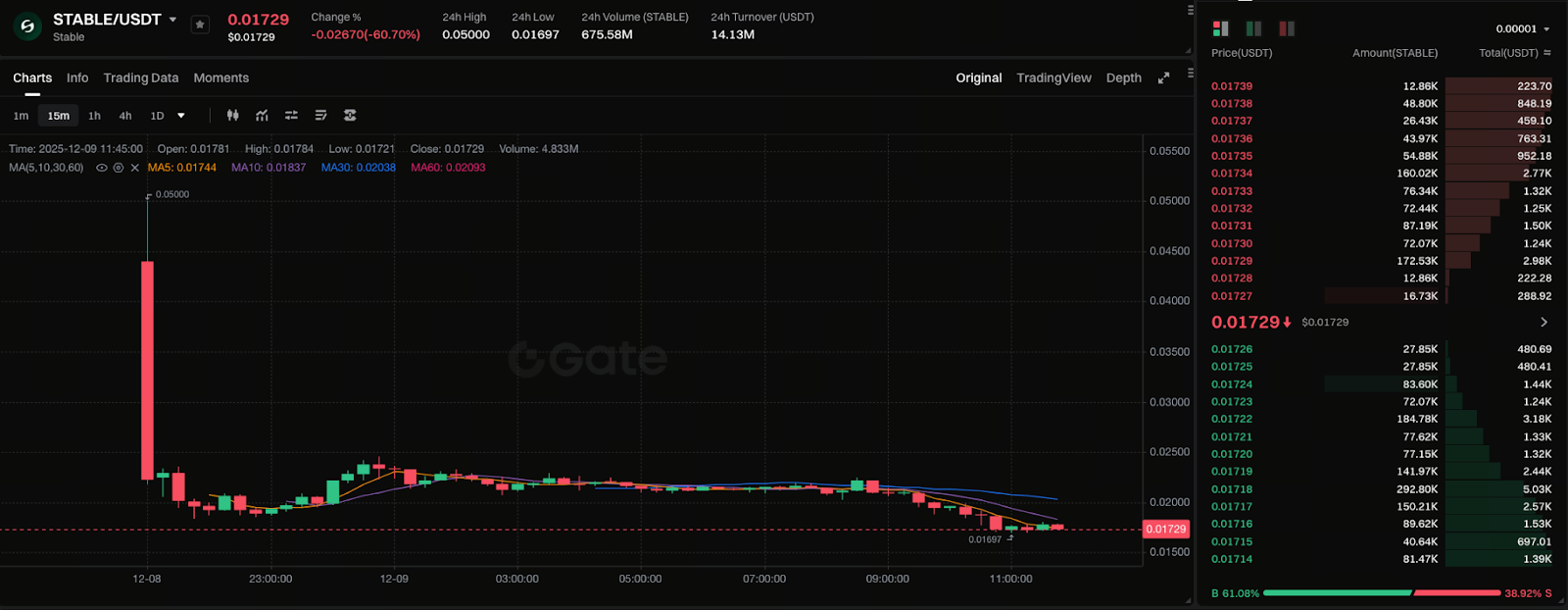
Image: https://www.gate.com/trade/STABLE_USDT
According to official announcements and multiple media reports, StableChain launched its mainnet on December 8, 2025, alongside its Token Generation Event (TGE). This milestone marks StableChain’s transition from “test/warm-up phase” to “full-scale operation and ecosystem launch.” With validator nodes now live and the network consensus mechanism activated, both users and developers can leverage StableChain’s mainnet for stablecoin transfers, settlements, and DeFi applications.
STABLE Tokenomics and Airdrop Framework
While StableChain uses USDT as gas, the project has also introduced its native token, STABLE. This token primarily serves to incentivize, reward, and govern ecosystem participants, including developers, liquidity providers, and early contributors.
According to official disclosures, STABLE has a fixed total supply allocated as follows:
- 10% for Genesis distribution, supporting initial liquidity, community rewards, and ecosystem launch.
- Approximately 40% for developers and ecosystem initiatives, fueling future grants, partnerships, and incentive programs.
- The remainder is allocated to the team, early investors, and advisors, with portions locked and released gradually.
For airdrops and incentives, at mainnet launch, the project distributed STABLE rewards and airdrops through several channels. Early participants—including depositors, liquidity providers, and users of ecosystem services—could earn STABLE rewards. Depositors are expected to receive airdrop rewards equal to 3%–7% of their deposit amount. Those meeting multiple criteria (such as both depositing and providing liquidity) are eligible for higher allocations. The claim window is now open, with the deadline set for March 2, 2026 (UTC).
STABLE Market Pricing and Value Potential Analysis
STABLE’s launch sparked strong initial market interest. In select spot and derivatives markets, STABLE/USDT traded as high as $0.032. At this price point, full circulation of STABLE would yield a Fully Diluted Valuation (FDV) in the billions of dollars. Some market analysts and data platforms project STABLE’s FDV could exceed $2–3 billion.
However, some caution that since all StableChain transaction fees are paid in USDT and STABLE is not used as gas, its actual utility and demand may be limited. STABLE functions primarily as an incentive, governance, and reward token for the ecosystem. Its long-term value will depend on ecosystem growth, application adoption, and community engagement.
For everyday users and investors, STABLE’s value should be assessed by the ecosystem’s development, developer participation, and real-world deployment of DeFi, payments, and compliant on-chain applications, rather than short-term speculation.
Significance and Outlook for Users and Ecosystem Participants
- For typical crypto users, StableChain’s launch means USDT transfers are now faster, cheaper, and more convenient—ideal for stablecoin payments, cross-border settlements, and everyday transactions.
- For developers and DeFi projects, StableChain offers a purpose-built chain with native USDT support, making it ideal for stablecoin lending, payments, settlements, fiat on/off ramps, merchant integration, and more. The platform has strong potential to attract projects focused on stablecoin payments.
- For early participants—such as depositors, liquidity providers, and contributors—receiving STABLE via airdrop represents a passive earning opportunity. If the ecosystem grows successfully, these tokens could deliver significant future value.
In summary, the synchronized launch of STABLE’s mainnet and TGE is a major milestone for blockchain and stablecoin payments. While market price and liquidity remain uncertain, StableChain’s success in enabling stablecoin payments, settlements, merchant adoption, and ecosystem development could unlock substantial future potential.
Gate launched Stable (STABLE) spot trading on December 8, 2025, at 13:00 UTC.
Share
Content


Related Articles

2025 BTC Price Prediction: BTC Trend Forecast Based on Technical and Macroeconomic Data

Pi Coin Transaction Guide: How to Transfer to Gate.com

Flare Crypto Explained: What Is Flare Network and Why It Matters in 2025

How to Use a Crypto Whale Tracker: Top Tool Recommendation for 2025 to Follow Whale Moves

What is N2: An AI-Driven Layer 2 Solution