Within Web3 data infrastructure, both Sentio and The Graph serve critical roles in on-chain data processing, though their design objectives are not the same. The Graph is primarily focused on structured queries of on-chain data, while Sentio is distinguished by its real-time data indexing and monitoring capabilities. This fundamental difference shapes their distinct positioning in terms of application scenarios and developer experience.
For protocols that require real-time reactions to on-chain events, the speed of data indexing and advanced monitoring capabilities are vital. Conversely, for applications that need to query historical or aggregated data, flexible data interfaces take precedence. As a result, Sentio and The Graph, while both Web3 data protocols, are tailored to address different data requirements.
Sentio vs The Graph: Positioning and Core Differences
Sentio is a real-time on-chain data infrastructure platform for Web3, offering real-time data indexing, visual analytics, and auto alert functionality. Its core mission is to enable developers to rapidly capture on-chain events and transform raw data into actionable insights, supporting use cases such as protocol monitoring, risk alerts, and operational analysis.
Unlike traditional on-chain data protocols, Sentio’s defining feature is its focus on real-time performance. When an on-chain event occurs, the system swiftly completes the listening, parsing, and output process, synchronizing results to visualization dashboards or alert systems.
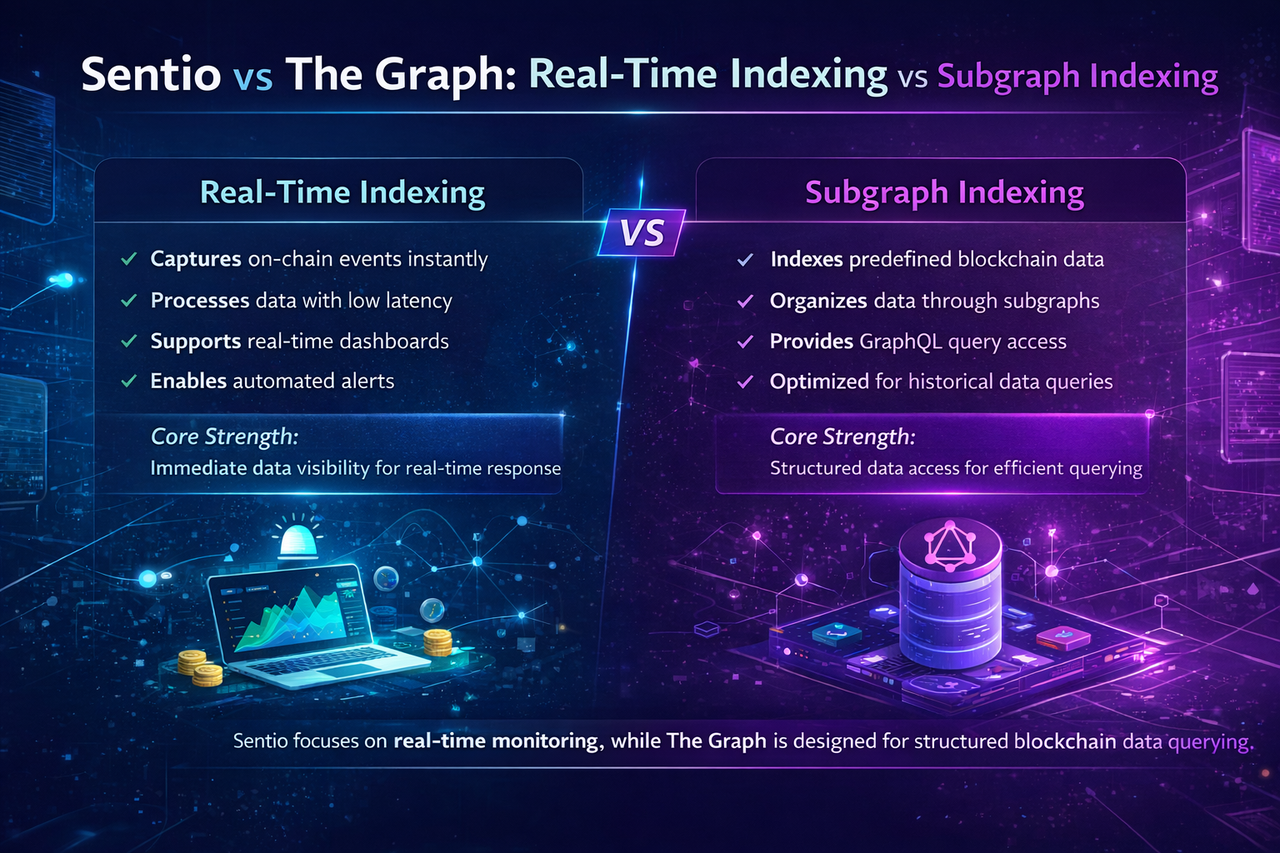
The Graph, as a decentralized data indexing protocol, enables developers to define and query on-chain data through subgraphs. Its primary goal is to structure complex blockchain data and provide it to decentralized applications via a unified interface, thereby reducing the complexity of on-chain data access.
In The Graph’s architecture, developers must predefine the events and data structures to be indexed. The system then organizes the data according to these specifications and exposes query services through the GraphQL interface.
| Comparison Dimension |
Sentio |
The Graph |
| Core Mechanism |
Real-time Indexing |
Subgraph Indexing |
| Data Response |
Real Time |
Delayed Sync |
| Query Method |
Real-time Monitoring |
GraphQL Query |
| Visualization Capability |
Built-in Support |
Requires External Implementation |
| Auto Alert |
Supported |
Not Supported |
| Applicable Scenarios |
Real-time Monitoring & Alerts |
Data Query & Aggregation |
Overall, Sentio is best positioned as a real-time monitoring solution, while The Graph excels as an on-chain data query protocol. They complement rather than replace each other, serving distinct layers of data needs.
What Is the Difference Between Real-Time Indexing and Subgraph Indexing Mechanisms?
The core distinction between Sentio and The Graph lies in their data processing approaches.
Sentio’s real-time indexing mechanism is centered on on-chain event listening. When a transaction or state change occurs on-chain, the system immediately captures the relevant event, parses and processes the data, and quickly outputs it to the monitoring system. This allows developers to receive feedback almost instantly after an event, supporting real-time monitoring and auto alerting.
In contrast, The Graph’s subgraph indexing mechanism is designed for structured data organization. Developers must first define subgraph rules, which the system uses to index on-chain data, storing it in the query layer and exposing it via GraphQL. This approach is highly effective for data querying and aggregation, but real-time responsiveness is not its main objective.
In essence, Sentio is focused on “immediate processing after events occur,” while The Graph is geared toward “efficient querying after data is organized.”
Real-time performance is one of the most significant differentiators between Sentio and The Graph.
Sentio’s real-time data indexing can rapidly process on-chain events and synchronize results to visualization dashboards or alert systems. This is especially critical for DeFi protocol monitoring and risk alerting. For instance, when a protocol experiences large fund movements or abnormal transaction patterns, Sentio can promptly detect these changes and trigger alerts.
The Graph’s indexing process typically depends on subgraph synchronization, resulting in a time lag before data updates are reflected in the query interface. While this delay is generally acceptable for historical data queries and aggregation, it can be a limitation for applications that require immediate response.
As such, Sentio offers a clear advantage in low-latency monitoring scenarios, whereas The Graph is better suited for data query-centric use cases.
Sentio vs The Graph: How Do Developer Experiences Differ?
From a developer’s perspective, The Graph provides a robust data query infrastructure. Developers define subgraph schemas, configure indexing logic, and deploy subgraphs, then retrieve the required data via GraphQL. This model offers high flexibility, but comes with configuration and maintenance overhead.
Sentio, on the other hand, is designed as a real-time monitoring platform. Developers can set up on-chain event listeners and leverage built-in visualization dashboards to observe data changes—eliminating the need to build custom monitoring interfaces. This integrated approach lowers the barrier to deploying real-time monitoring systems and accelerates data feedback for development teams.
Therefore, The Graph is ideal for building data query APIs, while Sentio excels at rapid deployment of real-time monitoring capabilities.
Sentio vs The Graph: What Are the Differences in Application Scenarios?
Because of their differing design objectives, Sentio and The Graph are suited to distinct application scenarios.
The Graph is best used as an on-chain data query layer, such as providing data APIs for decentralized applications, aggregating historical on-chain data, or powering API services. Its strength lies in data reading and organization, making it a go-to choice for applications that require frequent on-chain state queries.
Sentio is more suitable for scenarios demanding immediate response, such as DeFi protocol monitoring, security risk alerting, and real-time operational analytics. In these cases, on-chain data must not only be read but also processed and acted upon instantly after events occur—Sentio’s core advantage.
Summary
Sentio and The Graph are both essential components of Web3 data infrastructure, but they address different challenges. The Graph delivers structured data query capabilities through its subgraph mechanism, making it ideal as an on-chain data interface layer. Sentio, by contrast, empowers real-time monitoring and risk alerting with real-time indexing, visual analytics, and auto alert features.
As the demand for real-time data in Web3 applications grows, the importance of real-time indexing protocols is increasing. Understanding the distinctions between Sentio and The Graph enables developers to select the most appropriate data infrastructure solution for their business needs.
FAQs
What is the core difference between Sentio and The Graph?
Sentio specializes in real-time data monitoring and auto alerting, while The Graph focuses on on-chain data querying and aggregation.
Why is Sentio better suited for real-time monitoring?
Sentio can rapidly process data and output results immediately after on-chain events occur, making it ideal for scenarios that require instant response.
Does The Graph support real-time data?
The Graph can index on-chain data, but due to its reliance on subgraph synchronization, its real-time performance typically lags behind Sentio.
Can Sentio replace The Graph?
Their roles are distinct: Sentio is optimized for real-time monitoring, while The Graph is designed for data querying. They are complementary rather than interchangeable.







