As stablecoins continue to expand their influence in the crypto market, an increasing number of users are utilizing stablecoins for trade settlement, asset hedging, and cross-border payments. In today’s market, USD stablecoins are dominant, with USDT and USDC serving as industry staples, while the launch of PYUSD by PayPal has introduced a new competitive dynamic.
For traders, the liquidity and market acceptance of stablecoins directly impact trading efficiency. For payment users, the payment capability and security of stablecoins are even more critical. Notably, with PayPal’s entry into the stablecoin space, the competitive landscape between payment scenarios and on-chain financial applications is evolving.
What Are PYUSD, USDT, and USDC?
PYUSD, USDT, and USDC are all USD-pegged stablecoins, each designed to maintain a 1:1 peg with the US dollar. However, they are issued by different organizations and have distinct strategic focuses.
USDT, issued by Tether, is currently the largest USD stablecoin by market capitalization. Thanks to its high liquidity and broad support across trading platforms, USDT has become one of the most widely used stablecoins in global crypto trading.
USDC, issued by Circle, is renowned for its transparency and strong compliance standards. With comprehensive reserve disclosures, USDC enjoys high recognition among institutional users and regulated trading platforms.
PYUSD, launched by PayPal and issued by Paxos, places a stronger emphasis on payment functionality. By leveraging PayPal’s global payment network, PYUSD aims to drive large-scale adoption of stablecoins in payment scenarios.
What Are the Key Differences Between PYUSD, USDT, and USDC?
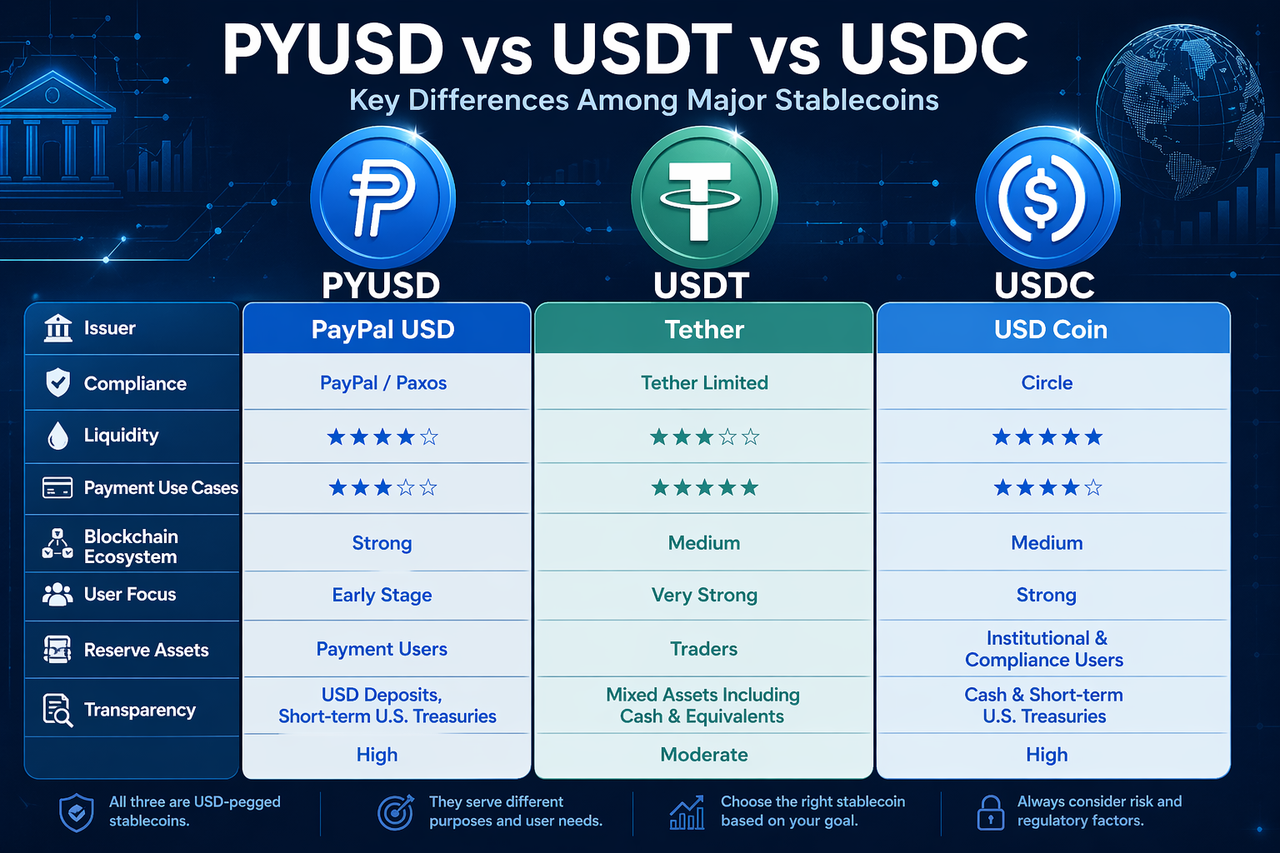
The main distinctions among these three major stablecoins lie in their issuers, regulatory transparency, liquidity, and application scenarios.
| Item |
PYUSD |
USDT |
USDC |
| Issuer |
PayPal / Paxos |
Tether |
Circle |
| Value Peg |
USD |
USD |
USD |
| Compliance |
High |
Medium |
High |
| Market Liquidity |
Medium |
High |
High |
| Payment Scenario |
Strong |
Medium |
Medium |
| On-Chain Ecosystem |
Early Stage |
Strong |
Strong |
| User Focus |
Payment Users |
Trading Users |
Compliant Users |
In summary, USDT leads in trading liquidity, USDC excels in compliance, and PYUSD is distinguished by its integration with payment scenarios. Each stablecoin occupies a unique market position, resulting in differing use cases.
Why Does USDT Dominate the Market?
USDT’s long-standing dominance in the stablecoin market is primarily due to its exceptional liquidity and widespread support across trading platforms. Nearly every major exchange offers USDT trading pairs, making it the core settlement tool for crypto asset transactions. For traders, high liquidity translates to lower slippage and greater trading efficiency, making USDT the most widely used stablecoin.
Additionally, USDT has established a vast on-chain circulation network spanning multiple public blockchains, including Ethereum, Tron, and Solana. This extensive ecosystem coverage drives high global usage and further cements its market leadership.
What Are USDC’s Advantages?
USDC’s strengths are rooted in transparency and regulatory compliance. Circle regularly publishes detailed reserve asset reports, highlighting that reserves are primarily held in cash and short-term US Treasury bonds. This commitment to transparency has earned USDC significant market trust.
For institutional investors and regulated platforms, compliance is a critical factor in stablecoin selection. With its transparent issuance model and clear regulatory framework, USDC is often the stablecoin of choice for institutions allocating funds on-chain. While its liquidity is slightly lower than USDT’s, USDC offers clear advantages in security and regulatory alignment.
What Is PYUSD’s Competitive Edge?
PYUSD’s most significant competitive edge is its integration with PayPal’s payment ecosystem. Unlike USDT and USDC, which are primarily used for trading, PYUSD is positioned as a payment tool. PayPal’s extensive global user and merchant base gives PYUSD a natural advantage in retail payment scenarios.
If PayPal successfully integrates PYUSD into cross-border payments and merchant settlements, it could create a differentiated competitive advantage in the stablecoin payments market. This payment capability is currently a weaker area for USDT and USDC, making it a key potential growth driver for PYUSD.
However, PYUSD’s current market size and on-chain ecosystem are still limited, making it less competitive with USDT and USDC in terms of trading liquidity. As a result, its short-term advantages are primarily strategic within payments, rather than trading.
Which Stablecoin Is Best for Your Needs?
The optimal stablecoin depends on your intended use.
For active crypto trading, USDT is typically the preferred choice due to its high liquidity and broad range of trading pairs, making it ideal for high-frequency trading. For those prioritizing fund safety and regulatory transparency, USDC is the more prudent option, thanks to its robust reserve disclosures—well-suited for long-term holding and institutional use.
For users focused on payment scenarios, especially those looking to transact digital dollars within the PayPal ecosystem, PYUSD offers unique advantages. While its ecosystem is still developing, it holds long-term potential in payment integration.
Conclusion
PYUSD, USDT, and USDC are all major USD stablecoins, but each occupies a distinct market niche. USDT dominates trading markets through superior liquidity, USDC is the benchmark for compliance and transparency, and PYUSD is pioneering digital payments via PayPal’s network. There is no absolute “best” stablecoin; the key is to select the one that aligns with your trading needs, payment scenarios, and risk preferences.
As the stablecoin sector evolves, these three will establish their own strengths in different domains and together drive the expansion of the digital dollar ecosystem.
FAQs
What are the differences between PYUSD, USDT, and USDC?
All three are pegged to the US dollar. USDT is best suited for trading, USDC prioritizes compliance and transparency, while PYUSD is tailored for payment use cases.
Why is USDT the most widely used?
USDT offers high liquidity and is supported by most trading platforms, making it the leading trading stablecoin in the crypto market.
Is USDC safer than USDT?
USDC is generally viewed as more transparent from the perspective of reserve disclosures and regulatory compliance, but definitions of “safety” may vary among users.
Can PYUSD challenge USDT’s dominance?
It’s unlikely that PYUSD will surpass USDT in trading in the short term, but PYUSD has potential competitive advantages in the payments sector.
Which stablecoin is best for long-term holding?
If you value transparency and compliance, USDC is better suited for long-term holding; if you prioritize trading convenience, USDT is more practical.