As the DeFi market evolves, fixed income products are increasingly becoming a cornerstone of on-chain finance. In traditional DeFi, most returns come from variable-rate lending, staking rewards, or liquidity mining. While these approaches offer opportunities for returns, their yield volatility often fails to meet users’ demands for stable earnings and effective interest rate management. Consequently, protocols offering fixed returns or robust rate management are emerging as critical components of DeFi infrastructure.
Pendle and Notional stand out as leading protocols in this space. Pendle leverages yield tokenization, allowing users to lock in returns or trade future yield streams; Notional employs a fixed-rate lending model, enabling users to secure borrowing rates in advance. Although both address DeFi’s fixed income needs, their core mechanisms and use cases differ significantly. Comparing these protocols provides valuable insight into the future direction of DeFi’s fixed income market.
Overview and Positioning: Pendle vs. Notional
Pendle is a DeFi protocol specializing in yield tokenization. By splitting yield assets into PT (Principal Token) and YT (Yield Token), Pendle empowers users to independently trade principal and future returns. This framework establishes an on-chain interest rate marketplace, enabling users to lock in fixed yields, speculate on yield movements, or hedge yield risks.
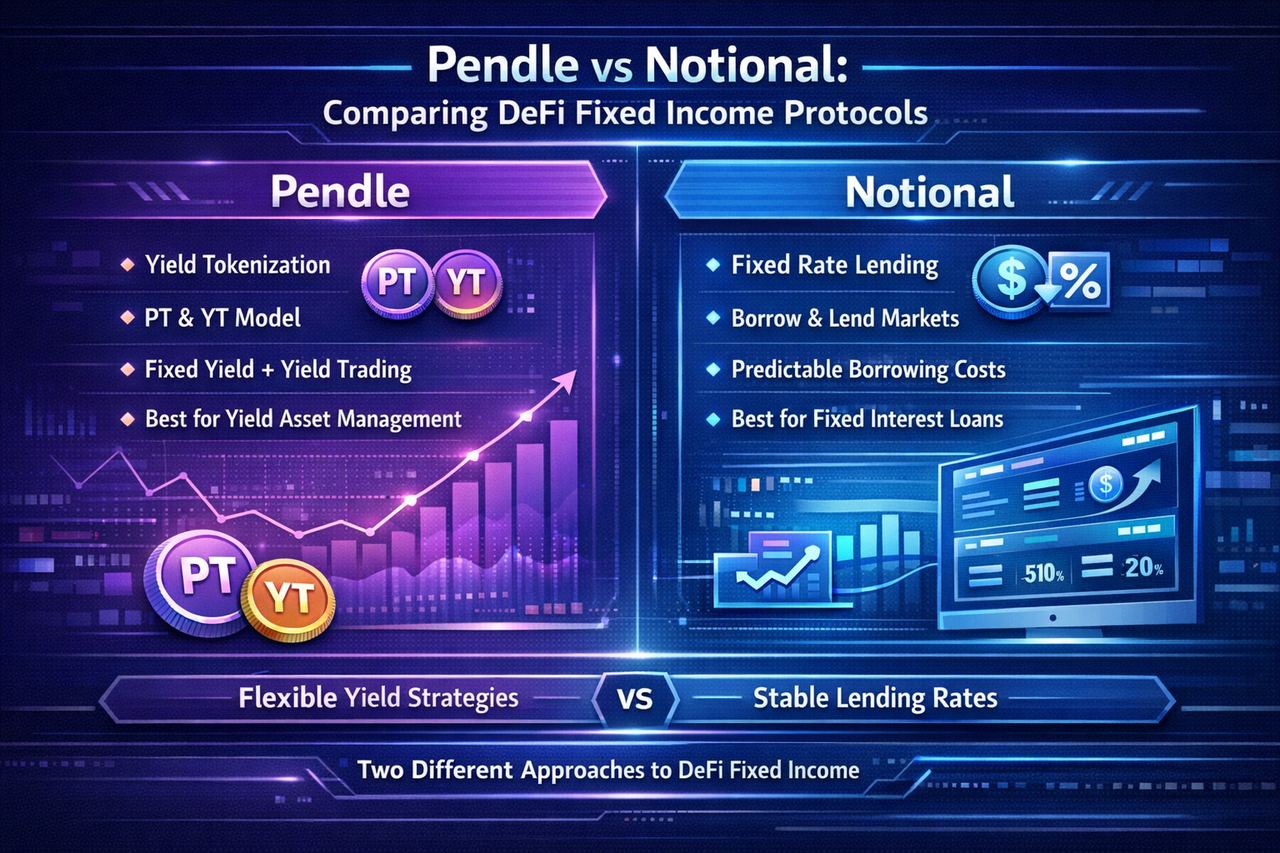
Notional, as a fixed-rate lending protocol, allows users to secure interest rates for a defined period when borrowing or lending, mitigating the uncertainty of variable rates. Its core mechanism is a fixed-term lending marketplace, providing borrowers and lenders with fixed-rate options that bring DeFi lending closer to traditional fixed-term financial products.
In terms of positioning, Pendle targets yield asset trading, while Notional focuses on fixed-rate lending.
Comparing Core Differences: Pendle vs. Notional
While both protocols address fixed income needs, Pendle emphasizes yield asset management, whereas Notional prioritizes fixed-rate lending management. Each represents a distinct direction within the same sector.
| Dimension |
Pendle |
Notional |
| Core Mechanism |
Yield asset split into PT and YT |
Fixed-rate lending |
| Main Functions |
Fixed yields, yield trading, yield hedging |
Fixed-rate lending |
| Sources of Return |
PT discount returns, YT yield trading |
Lending spread returns |
| Applicable Assets |
Yield-bearing assets (LSD, Restaking) |
Lending assets (USDC, ETH) |
| Rate Formation |
Marketplace sets PT/YT prices |
Lending market sets fixed rates |
| Main User Scenarios |
Yield management and speculation |
Fixed lending requirements |
| Risk Profile |
Yield volatility, liquidity risk |
Lending default, interest rate risk |
Pendle’s Advantages
Pendle’s primary advantage is its yield splitting mechanism, which delivers enhanced flexibility for yield assets. With PT and YT, users can tailor their exposure to fixed returns or future yield based on their risk preferences, rather than being confined to variable-yield models.
This structure allows Pendle to offer not only fixed yields but also yield speculation and risk management, enriching the financial properties of yield assets. Amid rapid growth in LSD and Restaking assets, Pendle’s yield trading capability makes it highly competitive in the yield market.
Additionally, Pendle uses a purpose-built AMM to provide liquidity for yield assets, enabling market-driven yield pricing—a key differentiator from traditional fixed income protocols.
Notional’s Advantages
Notional’s strength lies in its fixed-rate lending mechanism. For borrowers, fixed rates reduce exposure to future rate volatility; for lenders, they ensure predictable returns, enhancing certainty.
Compared to yield splitting, fixed-rate lending is straightforward—users simply select a lending term to lock in their rate. This simplicity makes Notional’s product logic accessible and ideal for users with clear lending needs.
Notional adapts traditional fixed-term lending concepts to DeFi, delivering stable returns and cost structures and establishing itself as a leading protocol in the fixed-rate lending space.
Distinct Use Cases: Pendle vs. Notional
Pendle is best suited for users already holding yield assets who seek to optimize yield management. For example, those wanting to secure fixed returns can buy PT, while users bullish on future yield growth can buy YT. Pendle operates as a yield asset management platform, ideal for complex yield strategies and risk management.
Notional is optimal for users with fixed lending needs. Whether borrowing assets and locking in financing costs, or lending to earn fixed returns, Notional offers a direct solution.
Thus, Pendle and Notional aren’t direct competitors—they address different needs: yield management and fixed-rate lending.
Competitive Edge: Pendle or Notional?
From a yield asset trading perspective, Pendle’s competitive edge is clear. Its yield splitting and interest rate marketplace provide more yield strategies, aligning with the financialization of yield assets. As LSD and Restaking assets grow, Pendle’s opportunities will expand.
For fixed lending, Notional’s straightforward structure and fixed-rate mechanism suit users with defined borrowing needs. It excels in fixed-rate lending, though its product scalability is more limited.
Overall, Pendle offers greater expansion potential in yield asset management, while Notional delivers specialized strength in fixed-rate lending.
Conclusion
Pendle and Notional are both pivotal protocols in DeFi’s fixed income sector, but their development paths diverge. Pendle’s PT and YT yield splitting mechanism equips users with tools for fixed yields, speculation, and risk management—making it ideal for the yield asset market. Notional’s fixed-rate lending marketplace provides certainty for borrowers and lenders, fitting fixed lending scenarios.
As the DeFi fixed income market matures, both models will play vital roles in different contexts. Long-term, Pendle’s yield marketplace mechanism is more scalable and poised to become a key player in on-chain interest rate markets.
FAQs
What distinguishes Pendle from Notional?
Pendle delivers fixed yields and yield trading through yield splitting, while Notional offers fixed yields via fixed-rate lending.
Who should use Pendle?
Pendle is ideal for users seeking to lock in returns, trade future yield, or manage yield risk.
Who should use Notional?
Notional is best for users with fixed lending requirements who want to secure borrowing rates in advance.
Which protocol has greater growth potential?
Pendle is more scalable in yield asset trading, while Notional is more specialized in fixed-rate lending.
Are Pendle and Notional competitors?
Both operate in the fixed income sector, but serve different needs—yield management versus fixed lending—making their competition differentiated.