As demand for leveraged exposure grew, BTC3L emerged as a structure designed to reduce operational burdens such as collateral management and liquidation monitoring. However, this simplification does not eliminate complexity; instead, it shifts it into the product’s internal mechanisms, which directly influence performance over time. Built on derivative-based positions and systematic rebalancing, BTC3L reflects a broader evolution in financial design, where complex trading strategies are packaged into simplified, tradable formats.
What is the design goal of BTC3L?
The primary design goal of BTC3L is to provide a consistent multiple of Bitcoin’s daily return, typically around 3x, without requiring users to actively manage leveraged positions.
Instead of replicating Bitcoin ownership, BTC3L is structured to:
-
maintain a target daily leverage ratio
-
abstract away margin and collateral requirements
-
automate exposure adjustments through internal mechanisms
This design focuses on accessibility and operational simplicity while embedding leverage management within the product itself.
BTC3L is designed to deliver amplified daily Bitcoin exposure through automated leverage management rather than direct asset ownership.
How BTC3L handles leverage exposure and rebalancing mechanisms
BTC3L maintains its leverage through continuous adjustment of underlying positions. This process ensures that exposure remains aligned with its target multiple.
Core mechanism
-
Leverage targeting The system aims to keep exposure near 3x of Bitcoin’s daily movement.
-
Dynamic adjustment When Bitcoin rises, exposure may be increased to maintain leverage; when it falls, exposure is reduced.
-
Periodic rebalancing Adjustments occur at set intervals or during high volatility to prevent deviation from target leverage.
-
Net asset value recalculation Each adjustment affects the token’s net value, reflecting updated exposure.
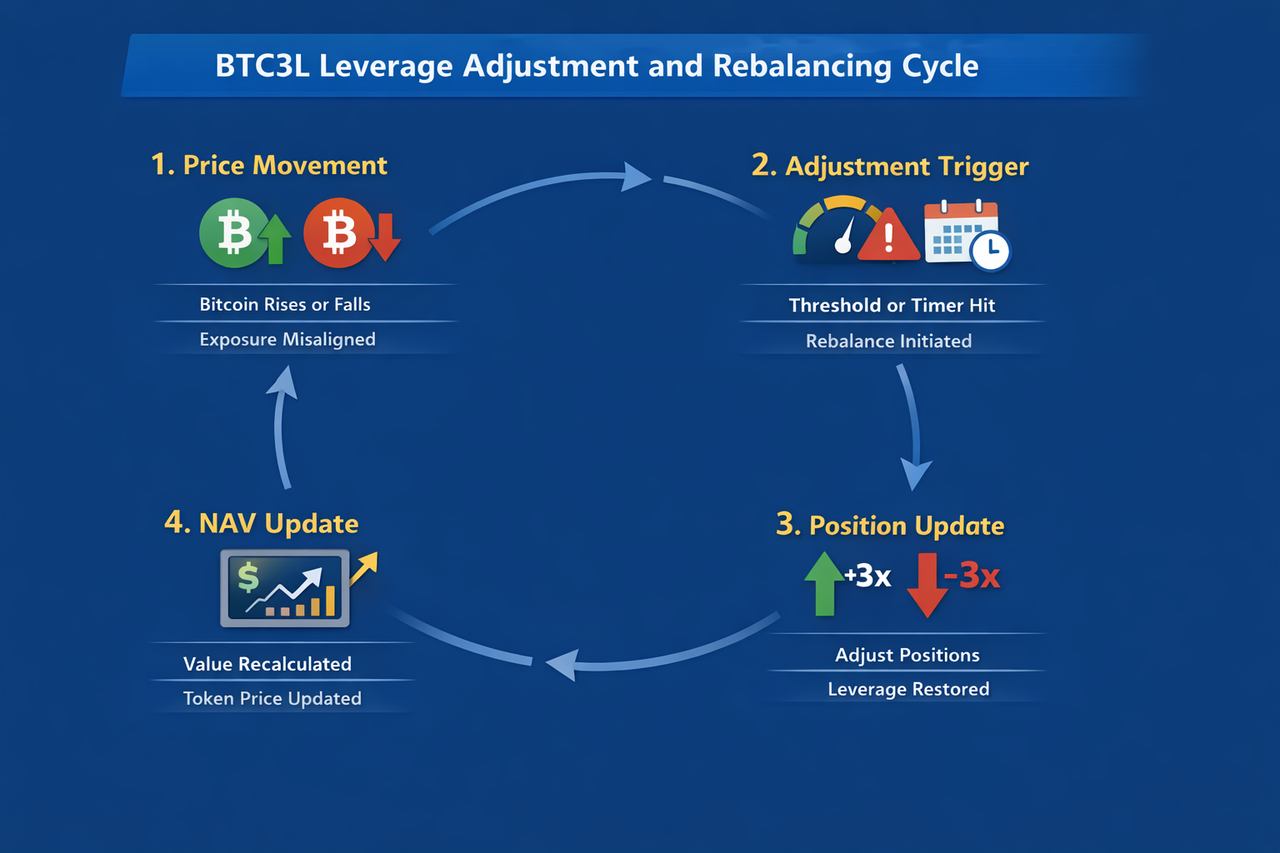
Simplified flow
-
Price movement Bitcoin first rises or falls in the market, causing the token’s existing leverage exposure to drift away from its target level.
-
Adjustment trigger Once a predefined threshold is reached or a scheduled rebalancing time arrives, the system initiates a rebalancing process.
-
Position update The product then increases or decreases its underlying derivative positions to bring exposure back toward the intended leverage target.
-
NAV update After the adjustment is completed, the net asset value is recalculated, and the change is reflected in the token’s market price.
This system maintains leverage consistency but introduces sensitivity to volatility and timing.
BTC3L maintains its leverage through dynamic adjustments in derivative exposure, while rebalancing and its underlying structure work together to keep it aligned with daily targets rather than fixed long-term ratios.
How BTC3L distributes and maintains leveraged positions over time
BTC3L maintains its leveraged exposure through a continuous, step-by-step adjustment process rather than a fixed allocation.
-
Initial exposure setup The product establishes a leveraged position based on its target ratio, typically around 3x exposure to Bitcoin’s daily movement.
-
Market movement impact As Bitcoin’s price changes, the value and effective leverage of the position begin to shift away from the target.
-
Position scaling In rising markets, exposure is increased to maintain leverage; in falling markets, exposure is reduced to limit deviation.
-
Compounding adjustment Gains or losses are applied to the updated base value, meaning each change affects the next cycle of returns.
-
Rebalancing response The system periodically adjusts positions to realign with the target leverage, especially during volatility or at scheduled intervals.
-
Volatility interaction In stable trends, scaling can enhance returns, while in fluctuating markets, repeated adjustments may reduce value over time.
This linear process highlights how BTC3L evolves step by step, with compounding and rebalancing shaping its performance across different market conditions.
BTC3L maintains leveraged exposure through sequential position adjustments, where scaling, compounding, and rebalancing collectively determine outcomes.
The role of rebalancing and underlying derivatives in BTC3L
BTC3L operates through the interaction of two core components: underlying derivatives and a continuous rebalancing mechanism, which together determine how leverage is created and maintained.
Underlying derivatives
-
BTC3L typically uses instruments such as perpetual futures to establish market exposure
-
This structure enables leveraged positioning without directly holding spot Bitcoin
-
It allows the system to scale exposure up or down depending on market conditions
Rebalancing function
-
Rebalancing keeps exposure aligned with the target leverage ratio
-
Positions are adjusted in response to price movements and market volatility
-
It serves as an internal mechanism for maintaining leverage consistency and managing risk
Structural interaction
Derivatives generate the initial leveraged exposure, while rebalancing continuously adjusts that exposure to keep it within the intended range. This ongoing interaction defines how BTC3L behaves in different market environments.
As a result, the system exhibits several key characteristics:
-
Path dependency, where outcomes depend on the sequence of price movements
-
Volatility sensitivity, with frequent adjustments during unstable markets
-
Non-linear returns, meaning performance does not follow a simple multiple over time
BTC3L functions as a dynamic system in which derivatives provide leverage and rebalancing continuously reshapes exposure based on evolving market conditions.
The differences between BTC3L and traditional margin or leveraged trading models
BTC3L differs significantly from conventional leveraged trading structures.
| Feature |
BTC3L |
Margin Trading |
Perpetual Futures |
| Leverage control |
Predefined |
User-defined |
User-defined |
| Margin management |
Not required |
Required |
Required |
| Liquidation handling |
Internalized |
Direct |
Direct |
| Rebalancing |
Automatic |
None |
None |
| Complexity |
Hidden in product |
User-managed |
User-managed |
Key distinctions
-
BTC3L removes the need for direct margin interaction
-
Traditional models provide more control but require expertise
-
BTC3L simplifies execution while embedding complexity internally
BTC3L differs from traditional leverage models by internalizing margin and risk management, reducing user control while simplifying access.
The advantages and potential issues of BTC3L’s operating model
BTC3L’s operating model is designed to simplify access to leveraged exposure, but this convenience comes with structural trade-offs that affect performance and transparency.
Advantages
-
Simplified access to leverage Provides leveraged Bitcoin exposure through a token format without requiring complex trading setups
-
No direct margin management Eliminates the need for users to manage collateral, borrowing, or liquidation thresholds
-
Automated exposure adjustment Uses built-in mechanisms to maintain leverage, reducing the need for manual intervention
Potential issues
-
Dependence on market conditions Performance is highly influenced by volatility patterns and price behavior
-
Impact of rebalancing Frequent adjustments can reduce returns, especially in sideways or unstable markets
-
Tracking divergence Fees, compounding, and execution factors can cause outcomes to differ from expected leverage
-
Reduced transparency Internal mechanisms may be less visible compared to directly managed derivatives positions
Overall, BTC3L reflects a balance between usability and structural complexity, where simplified access reduces operational effort but introduces variability in performance and limits direct user control.
BTC3L combines ease of use with embedded leverage mechanics, resulting in a system where accessibility is increased while predictability and control are reduced.
Summary
BTC3L functions by combining leveraged derivative exposure with automated rebalancing to maintain a target multiple of Bitcoin’s daily returns. Its structure simplifies access to leverage while embedding key mechanisms that influence performance.
Rather than behaving like a linear multiple of Bitcoin, BTC3L reflects the combined effects of volatility, compounding, and rebalancing. This makes it most appropriate as a short-term tactical instrument within a broader trading framework.
BTC3L is best understood as a rebalanced leveraged system whose outcomes depend on market path, volatility, and holding duration.
FAQs
Does BTC3L maintain exactly 3x leverage?
No. It targets approximately 3x daily exposure, but actual leverage may vary due to rebalancing timing and market conditions.
Frequent price swings trigger repeated rebalancing, which can erode value through compounding effects.
Is BTC3L easier than futures trading?
Operationally yes, but structurally it embeds similar risks in a simplified format.
In strong trends, compounding may enhance returns, but this depends on market conditions.
Why is BTC3L short-term oriented?
Because its daily leverage targeting and rebalancing mechanisms can lead to divergence over longer holding periods.