Traditional financial lending relies on banks or centralized platforms as intermediaries, with these platforms responsible for fund custody, credit assessment, interest rate determination, and risk management. While this approach offers stable lending services, it often comes with high entry barriers, complex procedures, and limited transparency. For crypto asset holders seeking liquidity, centralized lending platforms are typically the only option, requiring them to relinquish asset control to the platform.
As Decentralized Finance (DeFi) evolves, on-chain lending has begun to replace traditional intermediaries with Smart Contracts, enabling permissionless asset lending. Compound was developed in this context, creating an automated on-chain money market where users can deposit, borrow, and settle interest rates without relying on a third party. This model transforms the conventional lending process, allowing the lending market to operate entirely through code.
How Does Compound’s Decentralized Lending Process Begin?
Compound’s lending process starts when a user deposits assets into the protocol. After depositing supported crypto assets (such as USDC or ETH) into Compound’s liquidity pool, the protocol automatically records the deposit and makes these funds available to borrowers.
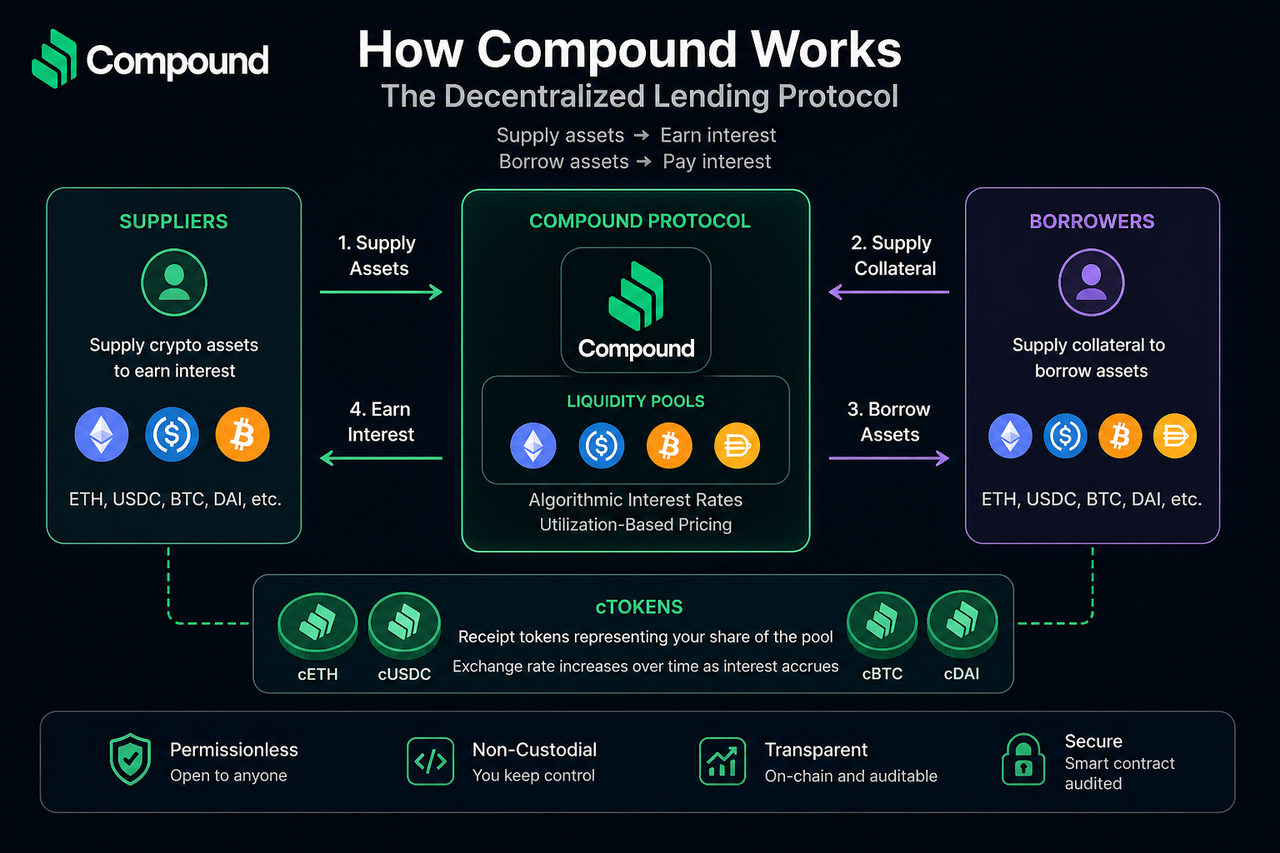
The core of this model lies in pooling all assets into a single liquidity pool, rather than matching individual lenders and borrowers. Deposit users become Liquidity Providers, while borrowers access the assets they need directly from the pool. The entire process is executed automatically by Smart Contracts, eliminating the need for manual approval.
What Happens After Users Deposit Assets?
Once users deposit assets into Compound, the protocol mints a corresponding amount of cToken as a deposit receipt. For example, depositing USDC results in receiving cUSDC. cToken represents the user’s equity in the liquidity pool and appreciates in value as interest accrues.
This means users do not need to manually claim interest; returns are automatically reflected in the redemption value of cToken. When users withdraw assets, the protocol burns the cToken and returns both principal and accumulated interest. This mechanism seamlessly integrates deposit returns into the asset certificate, enhancing the system’s automation.
How Is the Borrowing Limit Calculated?
To borrow assets from Compound, users must first provide collateral. The protocol calculates the borrowable limit based on the collateral’s value and the collateral ratio. For instance, if the collateral ratio is 75% and a user pledges assets worth $100, they can borrow up to $75 of other assets.
This over-collateralization mechanism is a key risk control measure for Compound. Given the volatility of crypto asset prices, the protocol requires borrowers to provide collateral exceeding the loan value, ensuring the liquidity pool remains solvent during market fluctuations.
How Does Compound Calculate Borrowing Rates?
Compound’s borrowing rate is determined automatically by an algorithmic model, not by manual platform intervention. The primary factor is the utilization rate—the ratio of borrowed assets to total deposited assets.
When demand for a particular asset rises, available liquidity in the pool decreases, utilization rate increases, and borrowing rates go up. Deposit rates also rise to attract more capital into the market. Conversely, when demand falls, rates decrease.
This dynamic interest rate model enables capital prices to adjust automatically with market supply and demand, allowing the protocol to continually maintain liquidity balance.
What Happens If Collateral Value Drops?
If a borrower’s collateral value falls, causing the loan amount to exceed the safe collateral threshold, Compound triggers its liquidation mechanism. Liquidators can repay part of the loan and receive a portion of the collateral as a reward.
This liquidation mechanism ensures the protocol’s funds remain secure and prevents losses from under-collateralized loans. This automated risk control is essential for the stable operation of decentralized lending protocols and is central to Compound’s ability to manage lending risk without manual oversight.
Why Is Compound’s Automated Lending Process Efficient?
Compound’s efficiency stems from its fully automated lending workflow. Deposits, borrowing, interest rate adjustments, and liquidations are all handled by Smart Contracts, eliminating manual intervention and approval, and reducing both time and intermediary costs compared to traditional lending.
Additionally, the liquidity pool model removes the need for matching lenders and borrowers, allowing users to deposit or borrow assets instantly. This real-time liquidity boosts capital utilization and positions Compound as a foundational lending protocol within the DeFi ecosystem.
Summary
Compound delivers a comprehensive decentralized lending process through liquidity pools, cToken, algorithmic interest rate models, and liquidation mechanisms. Users can deposit assets to earn returns or borrow other assets via over-collateralization, with every step executed automatically by Smart Contracts.
This automated lending model not only increases capital efficiency but also provides open, transparent lending infrastructure for Decentralized Finance. As a leading DeFi lending protocol, Compound’s operational mechanism has propelled the development of on-chain money markets and serves as a critical liquidity source for many DeFi applications.
FAQs
Does Compound’s Lending Process Require Manual Review?
No. Compound’s lending process is fully automated by Smart Contracts and does not require manual review.
How Do Users Earn Returns After Depositing Into Compound?
Users receive cToken after depositing assets, and interest is automatically reflected in the growth of cToken’s value.
What Determines Compound’s Borrowing Limit?
Borrowing limits are determined by the value of collateral assets and the collateral ratio set by the protocol.
Why Do Compound’s Borrowing Rates Change?
Compound uses a dynamic interest rate model, so borrowing rates automatically adjust based on market supply and demand and utilization rate.
What Happens If Collateral Is Insufficient?
If the collateral value drops below the safety threshold, the protocol automatically triggers the liquidation mechanism to protect the liquidity pool.







