Echelon Project Explained: A Decentralized Lending Infrastructure in the Move Ecosystem

Beginner
Quick Reads
Last Updated 2026-03-25 12:30:55
Reading Time: 1m
Comprehensive analysis of Echelon’s positioning, core mechanisms, and technical architecture, exploring its lending model, risk controls, and foundational DeFi infrastructure value in the Move ecosystem.

I. What Is the Echelon Project?
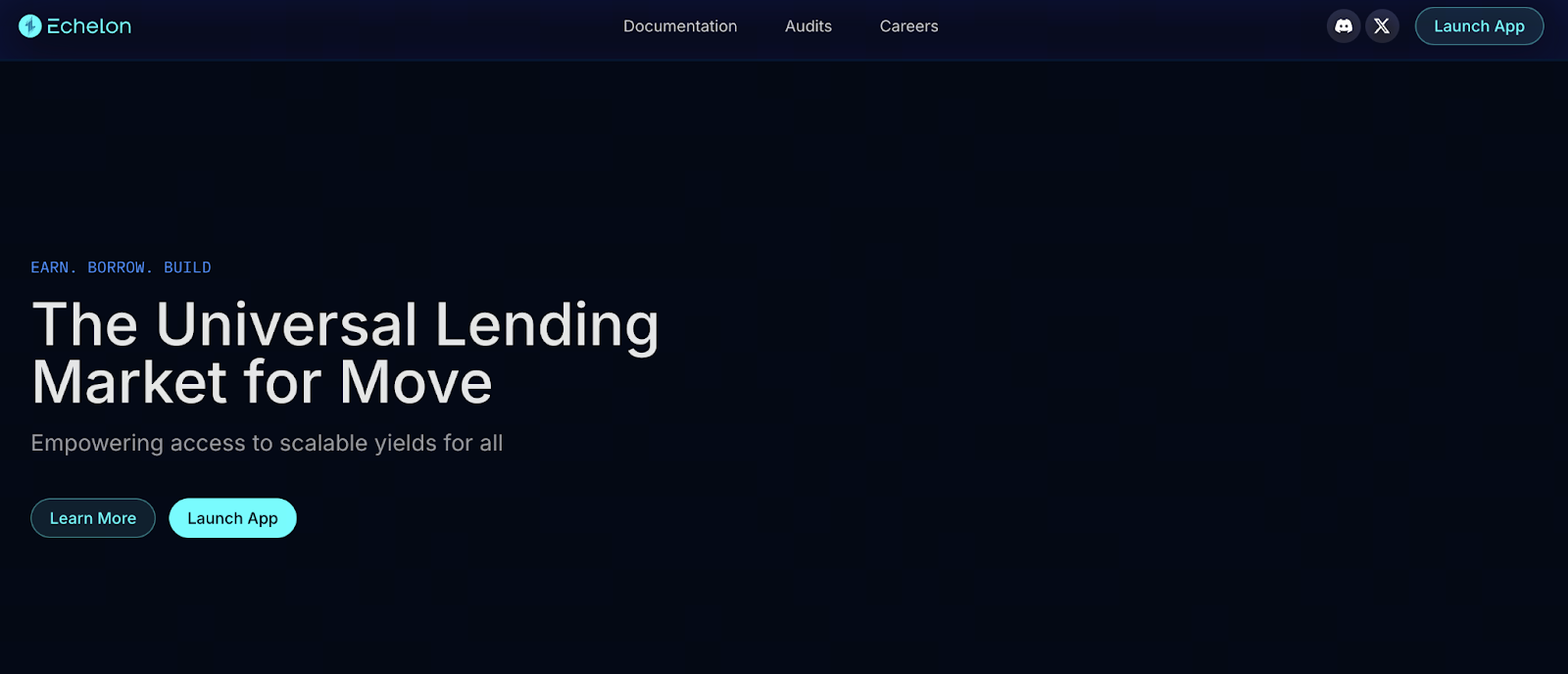

Image source: https://echelon.market/

Echelon is a decentralized lending protocol built on the Move programming language, designed to serve public blockchains within the Move ecosystem such as Aptos, Movement, and Initia. Its core objective is to deliver non-custodial, highly capital-efficient, and scalable lending infrastructure for Move-based networks.

In the DeFi landscape, lending protocols often function as the “capital hub.” Echelon aims to play this pivotal role in the Move ecosystem, providing unified lending and liquidity coordination for a wide range of assets.

II. Core Product Features of Echelon

From a product perspective, Echelon primarily offers the following features:

  • Asset Supply: Users can deposit supported crypto assets into the protocol to earn interest.
  • Overcollateralized Borrowing: Borrowers must provide collateral that exceeds the loan amount.
  • Automated Interest Rate Model: Dynamically adjusts rates based on asset supply and demand.
  • Automatic Liquidation Mechanism: Secures the protocol when collateral ratios fall below required levels.

These features together create a standardized, composable DeFi lending market, allowing Echelon to be integrated as a foundational financial module by other protocols and applications.

III. Technical Advantages of Move-Based Development

Echelon’s adoption of Move as its core development language is a major technical advantage. Move was originally developed by Meta (Facebook) for the Diem project and offers several key benefits:

  • Resource-Oriented Model: Prevents asset duplication or accidental destruction.
  • Enhanced Security Architecture: Mitigates risks of smart contract vulnerabilities.
  • Modular Structure: Simplifies protocol upgrades and expansion.

For lending protocols, asset security and state consistency are critical. Echelon leverages Move’s foundational features to minimize potential security risks at the design level, supporting stable, long-term protocol operation.

IV. Lending Mechanism and Risk Control Design

For risk management, Echelon employs multiple mechanisms to safeguard system integrity:

  • Overcollateralization: Reduces default risk.
  • Dynamic Liquidation Thresholds: Adjusted in response to asset volatility.
  • Interest Rate Incentives: Guide market supply and demand equilibrium.
  • Modular Parameter Management: Facilitates governance and optimization.

Through these mechanisms, Echelon seeks to maintain high capital efficiency while mitigating systemic risks from excessive leverage.

V. Echelon’s Role in the Move Ecosystem

The Move ecosystem remains in a phase of rapid development, with DeFi infrastructure still in its early stages. Echelon is positioned not as a single lending application, but as the financial foundation for the entire ecosystem:

  • Enables lending capabilities for wallets, DEXs, and derivatives protocols.
  • Supports a diverse array of assets, including stablecoins and liquid staking tokens.
  • Acts as the liquidity hub within the Move ecosystem.

This foundational role emphasizes long-term protocol value over short-term application popularity.

VI. Project Development Direction and Potential Value

According to publicly available information, Echelon’s future development will focus on:

  • Expanding support for additional Move ecosystem assets.
  • Optimizing capital efficiency and interest rate models.
  • Exploring integration of real-world assets (RWA) and cross-chain assets.
  • Enhancing protocol governance and modular upgrade capabilities.

If the Move ecosystem continues its growth trajectory, Echelon—as the underlying lending protocol—can expect increased usage and rising ecosystem value.

As of February 3, 2026, ELON is priced at approximately $0.58. Click here to trade: https://www.gate.com/trade/ELON_USDT

Author: Max
Disclaimer
* The information is not intended to be and does not constitute financial advice or any other recommendation of any sort offered or endorsed by Gate.
* This article may not be reproduced, transmitted or copied without referencing Gate. Contravention is an infringement of Copyright Act and may be subject to legal action.

Related Articles

What is Fartcoin? All You Need to Know About FARTCOIN
Intermediate

What is Fartcoin? All You Need to Know About FARTCOIN

Fartcoin (FARTCOIN) is a representative meme coin within the Solana ecosystem based on an AI-driven narrative. Its core concept originated from an experiment aimed at exploring the "boundaries between AI Agents and humor." More than just a digital asset with social attributes, the project deeply couples absurd humor culture with on-chain financial logic by integrating autonomous AI interaction models.
2026-04-04 22:01:19
Gold Price Forecast for the Next Five Years: 2026–2030 Trend Outlook and Investment Implications, Could It Reach $6,000?
Beginner

Gold Price Forecast for the Next Five Years: 2026–2030 Trend Outlook and Investment Implications, Could It Reach $6,000?

Analyze current gold price trends alongside authoritative five-year forecasts, integrating an evaluation of market risks and opportunities. This gives investors insight into the potential trajectory of gold prices and the main drivers expected to shape the market over the next five years.
2026-03-25 18:13:30
Aster vs Hyperliquid: Which Perp DEX Will Prevail?
Beginner

Aster vs Hyperliquid: Which Perp DEX Will Prevail?

Aster and Hyperliquid are the two representative protocols of the "purpose-built L1 path" within the current decentralized perpetual exchange (Perp DEX) sector. As a pioneer in the field, Hyperliquid has built a deep liquidity moat through its highly mature order book architecture and strong community consensus. Conversely, Aster, as a rising challenger, seeks to leapfrog the competition in high-performance trading through more aggressive multi-chain aggregation logic, private transaction modules, and an underlying execution environment optimized for 2026 market demands.
2026-03-24 11:58:33
2026 Silver Price Forecast: Bull Market Continuation or High-Level Pullback? In-Depth Analysis of Silver Candlestick Chart
Beginner

2026 Silver Price Forecast: Bull Market Continuation or High-Level Pullback? In-Depth Analysis of Silver Candlestick Chart

2026 Silver Price Forecast: Latest Outlook This article integrates current market trends, silver candlestick chart analysis, and momentum factors to assess the potential key support and resistance levels, upside targets, and pullback risks for silver prices. The goal is to help investors make informed, rational decisions.
2026-03-25 16:08:59
ASTER Tokenomics: Buybacks, Burns, and Staking as the Value Foundation of ASTER in 2026
Beginner

ASTER Tokenomics: Buybacks, Burns, and Staking as the Value Foundation of ASTER in 2026

ASTER is the native equity and governance token of the Aster ecosystem, with its core value built upon a radical "Deflationary Engine." Beyond serving as a governance tool, ASTER integrates multiple utilities including staking rewards, trading fee discounts, and liquidity incentives. Through its deep integration with the upcoming dedicated Layer 1 mainnet, it enables direct value capture from protocol cash flow to token holders.
2026-03-25 07:38:07
Crypto Future Profit Calculator: How to Calculate Your Potential Gains
Beginner

Crypto Future Profit Calculator: How to Calculate Your Potential Gains

Crypto Future Profit Calculator helps traders estimate potential earnings from futures contracts by considering entry price, leverage, fees, and market movement.
2026-04-03 23:27:09