What Is REDStone?
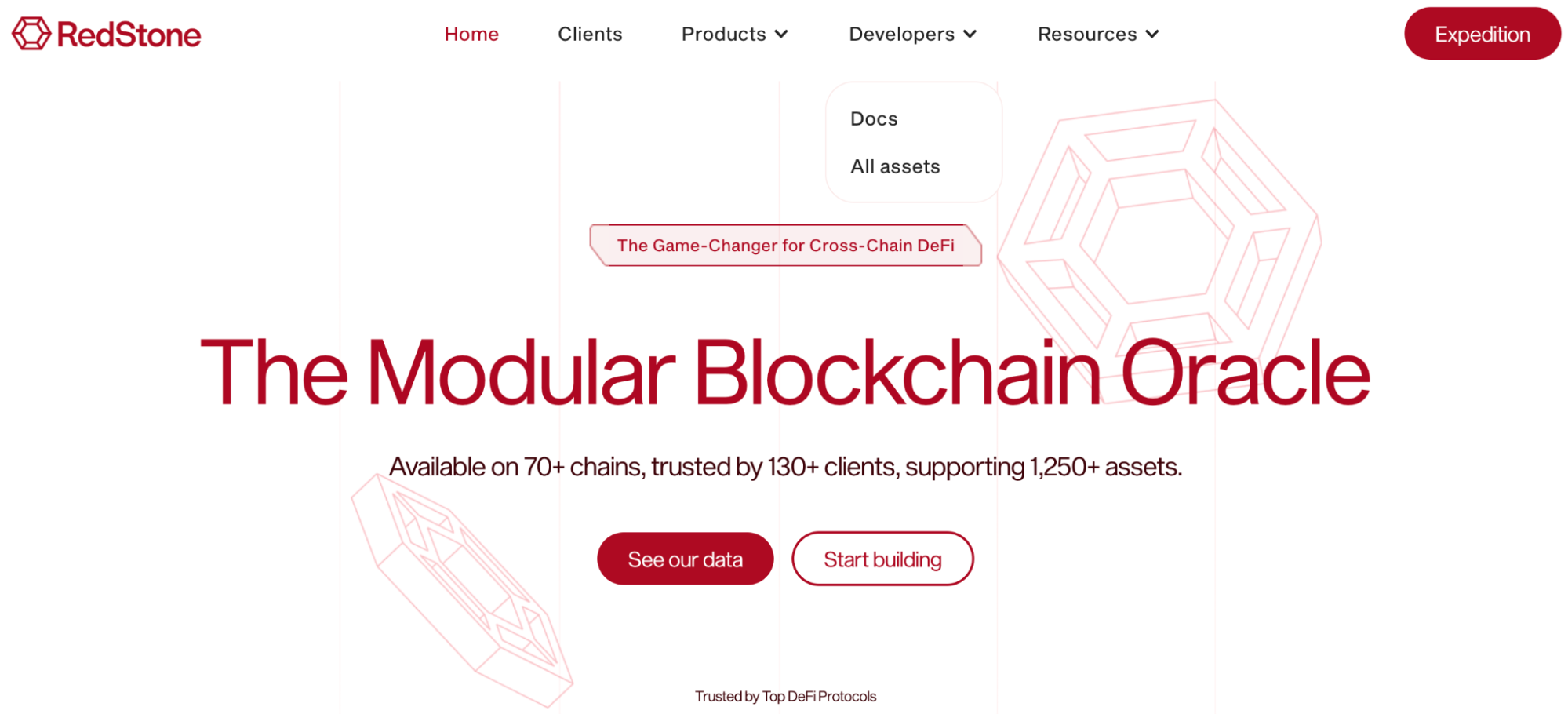
REDStone is a modular blockchain oracle platform. Its primary objective is to securely and accurately bring off-chain data onto the blockchain, delivering critical data—including price feeds, Net Asset Value (NAV), Proof of Reserve, and risk ratings—to a wide range of DeFi protocols and on-chain financial applications.
Unlike traditional oracles that focus solely on price feeds, REDStone has evolved from a single-purpose oracle to a foundational data infrastructure for on-chain finance. REDStone now serves not only crypto-native protocols but is also expanding deeper into institutional finance and Real World Asset (RWA) applications.
As of April 7, 2026, REDStone’s official website reports coverage of:
-
Over 110 blockchains
-
More than 1,300 assets
-
170+ clients
What Problems Does REDStone Solve?
Blockchains are inherently unaware of external events. Smart Contracts cannot directly access exchange prices, fund NAV, interest rates, fiat currency exchange rates, or verify whether an asset is genuinely backed by sufficient reserves. Oracles are designed to solve these challenges.
Traditional oracle solutions, however, present several limitations:
-
High costs, especially for high-frequency updates
-
Limited support speed for new chains and long-tail assets
-
Difficulty meeting complex data requirements such as RWA, fund NAV, and Proof of Reserve
-
Fragmented data, settlement, and risk assessment processes
REDStone addresses these issues by leveraging a modular architecture to deliver flexible data solutions, integrating price, execution, and risk information into a comprehensive infrastructure layer.
Key Features of REDStone
1. Modular Oracle Architecture
REDStone’s defining feature is its "modular oracle" design. According to the official tokenomics article, RedStone can provide data to "any chain, any scenario, any asset." This architecture offers increased flexibility for new chain deployments, custom data requirements, and complex use cases.
2. Beyond Price Feeds: Proof of Reserve and Risk Layer
By 2026, REDStone had moved beyond price oracles. In a March 5, 2026 article, the team introduced the RedStone Stack concept, integrating three core layers:
This marks REDStone’s transition from "oracle-as-feed" to "oracle-as-intelligence layer."
3. Focus on RWA and Institutional On-Chain Finance
A major strategic direction for REDStone over the past year is RWA and institutional-grade on-chain finance. On March 12, 2025, Securitize chose REDStone as its blockchain oracle partner, delivering NAV and interest rate data for tokenized assets including BlackRock’s BUIDL and Apollo’s ACRED. This represents REDStone’s leap from crypto-native DeFi to institutional asset tokenization.
4. Support for Diverse Assets and Scenarios
The launch of RedStone Live on March 30, 2026, highlights the project’s expansion into broader market data services. RedStone Live supports:
-
Stocks
-
Commodities
-
Forex
-
Indices
-
Crypto assets
It features 24/7 real-time market data coverage, targeting Perpetual Futures, Synthetics, risk engines, and RWA protocols.
What Is the RED Token?
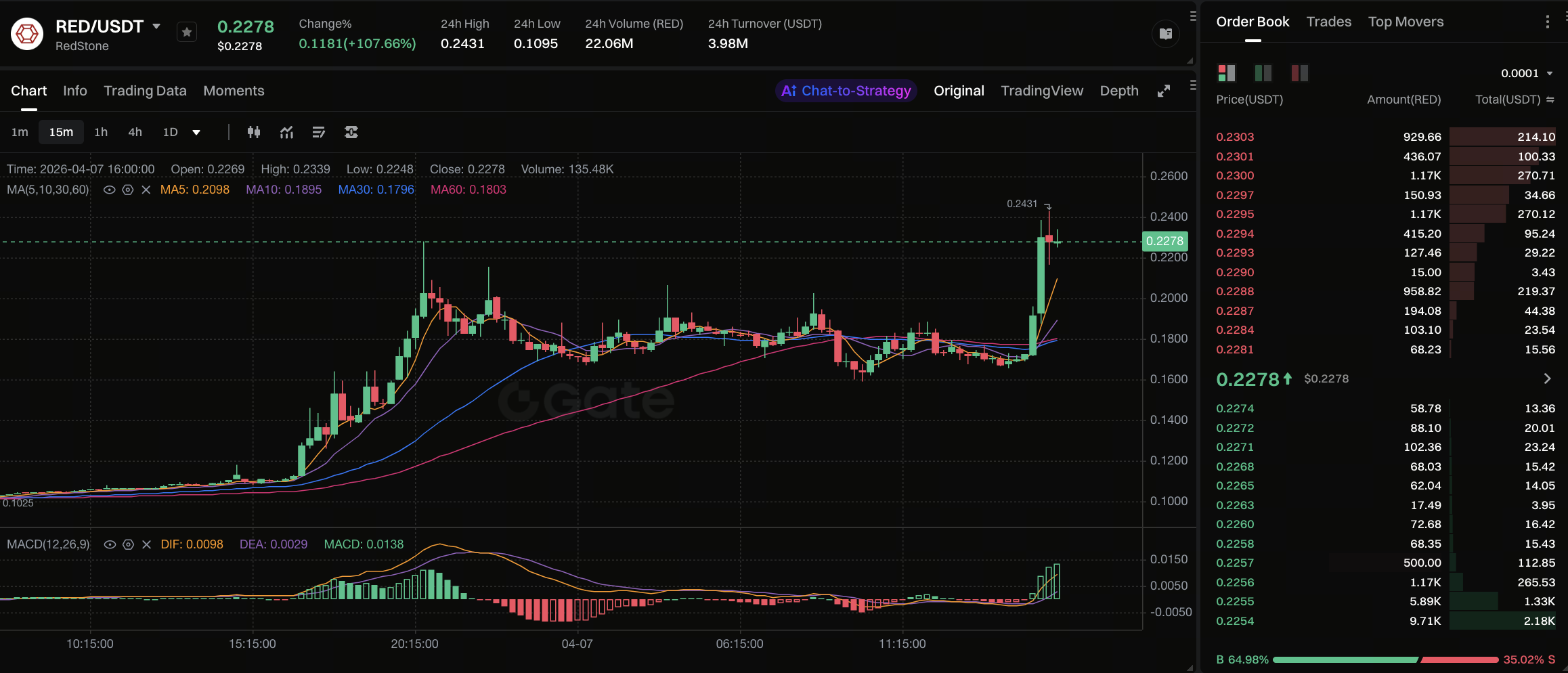 Source: Gate Market Page
RED is the native token of the REDStone ecosystem. According to the official tokenomics released February 12, 2025:
-
Token code: RED
-
Maximum supply: 1 billion
-
TGE initial circulation: 28%
-
Token standard: Ethereum ERC-20
The team states that one of RED’s main goals is to drive further decentralization of the RedStone network and establish incentives for ecosystem participants.
Core Uses of the RED Token
RED’s primary functions include:
1. Staking and Network Economic Security
This is RED’s most fundamental use. The REDStone team defines RED as a utility token, emphasizing staking for network security.
Through RedStone AVS and EigenLayer mechanisms, RED is used to enhance network economic security. The official documentation specifies:
-
Data providers can stake RED
-
Regular holders can participate in network security by staking
-
Stakers may earn rewards from RedStone data service users
This design positions RED as an integral part of network security and value capture, not merely a narrative token.
2. Ecosystem Incentives
RED also serves as a tool for ecosystem growth. Official disclosures show that 48.3% of the total token supply is allocated to community growth, including:
3. Decentralized Governance Expectations
While REDStone currently emphasizes staking and network security, the project’s trajectory suggests that RED will play a deeper governance role in the future. The establishment of RDDA (RedStone Distributed Data Association) marks a clearer path toward decentralization.
How Is REDStone Different from Other Oracle Projects?
REDStone stands out in the oracle sector in several ways:
Modular Deployment vs. Single Template
Traditional oracles operate as standardized price feed systems, whereas REDStone prioritizes configurability, scalability, and adaptability.
From DeFi Native Assets to RWA and Institutional Assets
REDStone’s most significant recent evolution is its expansion beyond BTC and ETH price feeds to support:
Transition from "Price Provider" to "Data and Risk Infrastructure"
The launch of RedStone Stack and RedStone Live in 2026 demonstrates the project’s ambitions to go beyond conventional oracles.
Latest Updates on REDStone
As of April 7, 2026, REDStone’s recent milestones include:
1. March 30, 2026: REAL Integrates RedStone Stack
REAL adopted RedStone Stack as its default infrastructure for:
-
Pricing
-
Reserve verification
-
Risk intelligence
This reinforces REDStone’s position as institutional-grade RWA infrastructure, not merely a price feed provider.
2. March 30, 2026: Launch of RedStone Live
RedStone Live expands REDStone’s coverage to stocks, commodities, forex, indices, and other traditional financial data, emphasizing low latency and 24/7 service. This signals REDStone’s growth into a comprehensive data infrastructure platform.
3. March 23, 2026: Real-Time Bitcoin Reserve Verification for Lombard
REDStone delivers real-time Proof of Reserve for LBTC, a critical capability for BTCFi, cross-chain collateral, and institutional risk management.
4. March 18, 2026: RedStone Goes Live on Tempo Mainnet
At Tempo mainnet launch, RedStone began providing forex oracle support from the first block, serving cross-border payments, payroll, and enterprise payment scenarios. This marks REDStone’s expansion from DeFi to real-world payment infrastructure.
5. January 21, 2026: Acquisition of Security Token Market and TokenizeThis
REDStone’s acquisition extends its reach beyond technology into RWA market data, institutional relationships, and industry event resources. The team describes this as an upgrade from “oracle provider” to “complete infrastructure layer.”
REDStone Application Scenarios
REDStone’s real-world use cases extend beyond traditional DeFi price feeds:
DeFi Lending and Derivatives
Lending protocols require real-time prices; derivatives platforms need low-latency, high-precision data. This is REDStone’s core foundation.
RWA Pricing and Fund NAV
REDStone’s partnership with Securitize and support for assets like BUIDL and VBILL demonstrate its key role in institutional RWA scenarios.
Proof of Reserve and On-Chain Transparency
Proof of Reserve is increasingly vital for BTCFi, tokenized funds, and stablecoins. REDStone has made this a dedicated product line.
Risk Ratings and On-Chain Risk Management
By integrating Credora’s risk layer, REDStone is evolving toward a "data + risk control" model—distinguishing itself from traditional oracle projects.
Is RED Worth Watching?
REDStone is worth attention if you are bullish on:
-
Oracle sector innovation
-
RWA tokenization
-
Institutional-grade on-chain finance
-
Proof of Reserve
-
Risk ratings and on-chain risk control
-
Multi-chain and modular infrastructure
REDStone is not merely competing with traditional oracles; it is opening up a broader market as the foundational data layer for on-chain finance.
However, the RED token faces typical risks:
-
Intense sector competition
-
High price volatility
-
Unlock schedules impacting short- and medium-term performance
-
Long-term value depends on real adoption and protocol revenue
REDStone is a foundational infrastructure project worthy of in-depth analysis and ongoing monitoring. It’s essential to consider both its tokenomics and real-world adoption, not just short-term hype.
Summary: What Is REDStone, and What Are the Highlights of RED?
REDStone is a project evolving from modular oracles to institutional-grade on-chain data infrastructure. Its core strengths include:
-
Modular architecture
-
Multi-chain coverage
-
RWA and institutional finance integration
-
Proof of Reserve and risk layer expansion
-
Combination of RED token and staking security mechanism
REDStone is rapidly transitioning from an oracle project to a financial data platform for on-chain markets. This transformation is a key reason for RED’s ongoing market attention.







