Help Center
Options
Options Guide

Gate Options Product Overview

12 hours 13 minute 1 sec ago
80.959 Read
356

What Are Options?

The options contracts offered by Gate are financial derivatives designed for the cryptocurrency market.

An option is a contract between a buyer and a seller.

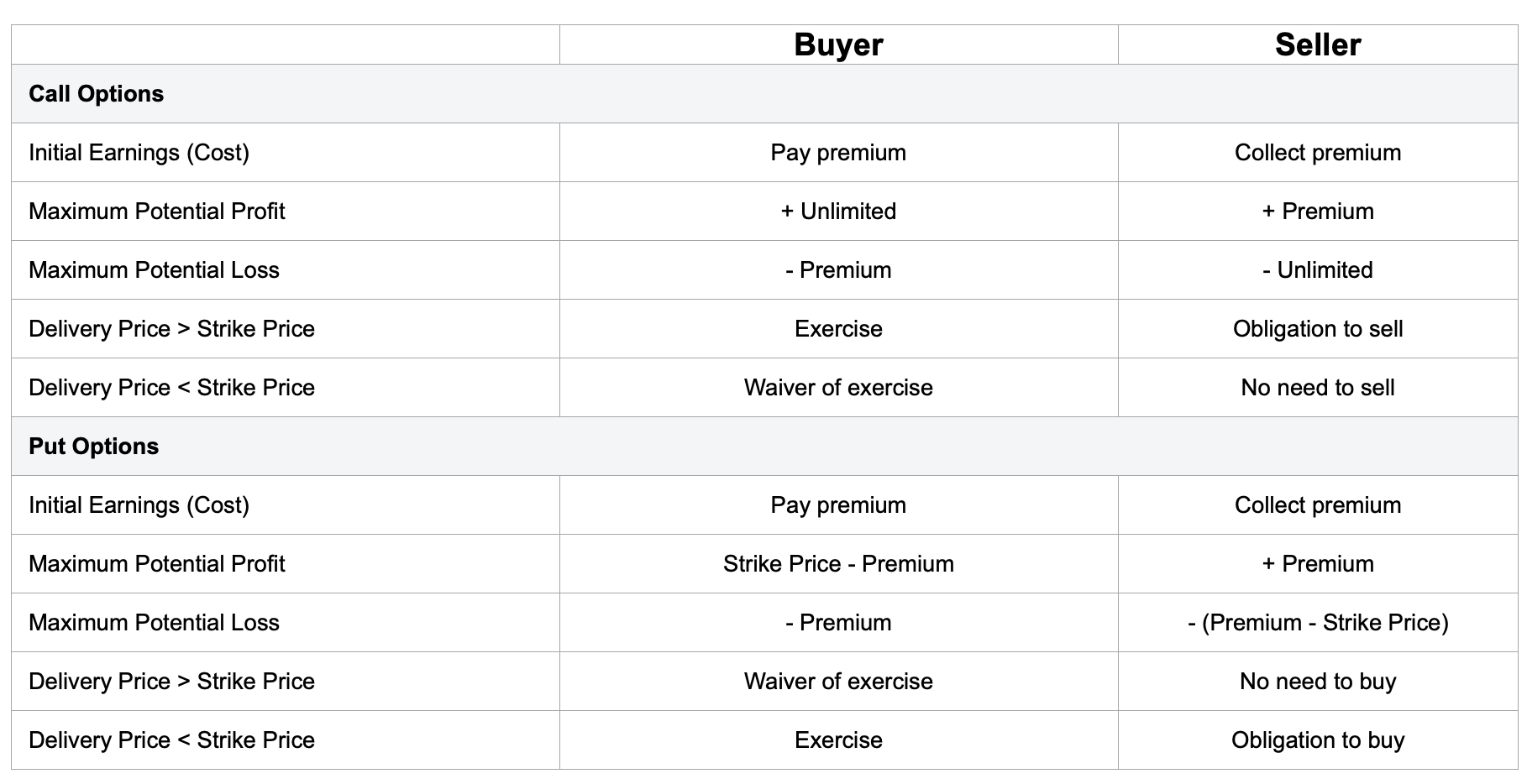
By paying a fee (the option premium) to the seller, the buyer obtains the right, but not the obligation, to buy or sell a specified amount of an underlying asset at a pre-agreed price on a specific future date.

The option buyer may choose whether to exercise the option at expiration, while the seller is obligated to fulfill the contract if the buyer exercises.

What Is Demo Trading?

Demo trading allows users to trade options contracts using virtual funds in a simulated trading mode. The trading interface and operation are identical to live trading, and are clearly labeled as "Testnet".

Demo trading does not incur any real costs. All funds used are virtual funds provided by the platform and are for experience and practice purposes only.

How to Read an Option Name

For simplicity, options are identified using standardized symbols in the following format: Market-Expiry Date-Strike Price-Type

  • Market: The underlying asset market
  • Expiry Date: In YYMMDD format (e.g. 250627 represents June 27, 2025)
  • Strike Price: The pre-agreed fill price at expiration
  • Type: C for Call options, P for Put options

Example: BTC-250627-18500-C represents a BTC option that expires on June 27, 2025, has a strike price of 18,500 USDT, and is a Call option.

Common Terms

  • Underlying Asset: The cryptocurrency specified in the option contract.
  • Premium: The fee paid by the option buyer to the seller to obtain the right to exercise the option upon expiration.

Buying Call / Put Options: Premium = Order Price × ABS(Order Amount) × Contract Multiplier

  • Expiration Date: The final date on which an option can be exercised. For European-style options, this is the only exercise date.
  • Strike Price: The price at which the underlying asset is bought or sold when the option is exercised.
  • Option Type: Includes Call options and Put options.

What Are ITM, ATM, and OTM?

In options trading, ITM / ATM / OTM describe the option's moneyness, which reflects the relationship between the current underlying price and the strike price.

  • ATM (At The Money) – At-the-money option
  • ITM (In The Money) – In-the-money option
  • OTM (Out Of The Money) – Out-of-the-money option

How Are Value and PnL Calculated?

  • Unrealized PnL reflects the floating profit or loss of an open position based on the last price. It changes as market prices fluctuate.

    Formula: Unrealized PnL = (Mark Price – Entry Price) × Contract Multiplier × Amount

  • Realized PnL includes settled profits and losses, such as trading fees and PnL from manually closed positions.

    Formula: Realized PnL = Trading Fees + Closed PnL

  • PnL at Expiration is determined at expiration based on the relationship between the strike price and the market price:

    ATM / OTM options: Not exercised, PnL = 0

    ITM options: Automatically exercised

    PnL at Expiration = (Settlement Price – Strike Price) × Contract Multiplier × Amount – Exercise Fee

    Note: PnL at Expiration only reflects the payoff from the position itself and does not include the option premium paid when opening the position.

Cash-Settled Options on Gate

All options on the Gate platform are cash-settled. Cash-settled options do not involve physical delivery of the underlying asset. At expiration or exercise, profits and losses are settled in cash based on the price difference between the market price and the strike price.

When a cash-settled option is exercised, only the cash value of the price difference is credited to the option buyer's account.

Settlement at Expiration

  • Call Options
    • If Market Price > Strike Price at expiration, the buyer receives: (Market Price – Strike Price) × Contract Multiplier
    • If Market Price ≤ Strike Price, the option expires worthless and the buyer loses the premium.
  • Put Options
    • If Market Price < Strike Price at expiration, the buyer receives: (Strike Price – Market Price) × Contract Multiplier
    • If Market Price ≥ Strike Price, the option expires worthless and the buyer loses the premium.

What Is Initial Margin?

Initial margin is the minimum amount required to open a position.

For option sellers, initial margin is the minimum margin required when opening a short option position. It is used to cover potential risk exposure and is dynamically adjusted based on the underlying price, option moneyness (OTM level), and system-defined margin ratios.

Initial Margin Formula:

Initial Margin = [max(Margin Ratio₁ × Underlying Price, Margin Ratio₂ × Underlying Price – OTM Amount) + Option Price] × Contract Multiplier

Example:

Selling a BTC Call option: Underlying Price: $115,000, Strike Price: $116,000, Option Price: $200

Initial Margin ≈ (max(0.1 × 115,000, 0.15 × 115,000 – 1,000) + 200) × 0.01 = $164.5

What Is Maintenance Margin?

Maintenance margin is the minimum margin required to keep the position from being liquidated.

During the holding period, the account must maintain a margin level above the maintenance margin requirement to prevent excessive risk. If the margin falls below this level, the liquidation will be triggered to limit further losses.

Maintenance Margin Formula: Maintenance Margin = (Maintenance Margin Ratio × Underlying Price + Option Price) × Contract Multiplier

Example: Maintenance Margin ≈ (0.075 × 115,000 + 200) × 0.01 = $88.25

What Is Liquidation Reference Price?

The liquidation reference price is calculated by applying an upward and downward adjustment to the mark price. This results in a maximum liquidation reference price and a minimum liquidation reference price, with different adjustment ratios applied to different option contracts.

The liquidation reference price serves two purposes:

  1. To calculate position value and determine whether account equity becomes negative.
  2. To take over user positions at the liquidation reference price when reducing positions in markets with insufficient liquidity.

What Is Liquidation?

Classic Account

The system continuously monitors account margin levels and equity. If equity at the liquidation reference price becomes negative, the account is immediately taken over.

Margin level ≥ 100% and beyond the margin call period:

  • The system first cancels open orders that occupy the most margin.
  • If risk remains high, short positions are automatically reduced. If market liquidity is insufficient, positions are taken over at the liquidation reference price.

If equity becomes negative during this process, all positions are immediately liquidated.

Margin level ≥ 100% within the margin call period: No immediate liquidation; users receive margin call notifications.

Margin level ≥ 80%: Risk warnings are sent to remind users to add margin or reduce positions.

Unified Account

When the maintenance margin ratio (MMR) falls to 100% or below, the partial liquidation will be triggered to reduce risk. The process is as follows:

  • Order Cancellation and Position Reduction (Priority)

    • The system will first cancel open orders that occupy a higher amount of margin and then check whether the MMR has returned to a safe level.
    • If the risk is still not sufficiently reduced, the system will liquidate short option positions according to priority, followed by repayment of outstanding borrowings.
    • During the liquidation process, positions with better liquidity and higher risk exposure will be reduced first. Positions are liquidated in batches to minimize market impact.
  • Market Execution and Liquidation Reference Price

    • The system will prioritize execution in the secondary market. If market liquidity is insufficient, the remaining positions will be taken over at the liquidation reference price.
    • After each liquidation step, the system recalculates the MMR. Once the ratio recovers to above 100%, liquidation will stop, and any remaining positions may continue to be held.
  • Special Scenarios

    • In extreme market conditions, all positions may be liquidated and losses may exceed margin.
    • In such cases, the insurance fund will be used to cover deficits, and manual review may be initiated if necessary.

What Is a Market Order?

A market order is an order that is filled immediately at the best available prices in the market. Buy orders match against the best available ask prices, and sell orders match against the best available bid prices. If a single price level cannot fully fill the order, the system continues matching deeper order book levels. The final fill price is calculated as a volume-weighted average price (VWAP). If there is insufficient liquidity, missing quotes, or excessive deviation from the mark price, market orders may be restricted, partially filled, or canceled.

What Is IV-Based Order Placement?

IV-based order placement allows users to place option orders using implied volatility (IV) instead of price. By entering a target IV, the system automatically converts it into the corresponding option price and places the order on the order book. As market conditions change, the order price continuously adjusts to reflect the specified IV. This feature is particularly suitable for professional traders who prefer quoting volatility rather than manually adjusting prices.

What Are Advanced Order Types?

Advanced order types provide professional traders with more precise control over order execution. Supported execution conditions include Post Only, IOC, and FOK. These options allow traders to place maker-only orders, execute immediately with partial fills allowed, or require full execution in a single fill. Advanced order types enable more flexible trading strategies, better execution control, and optimized trading fees.

Gate reserves the right of final interpretation for this product.

Sign up now for your chance to win up to $10,000!
signup-tips