# GET vs ETC: Understanding the Key Differences Between These Traffic Management Systems
This comprehensive guide compares Global Entertainment Token (GET) and Ethereum Classic (ETC), two distinct cryptocurrencies serving different market purposes. GET, issued on Cardano, targets the entertainment industry ecosystem, while ETC operates as a decentralized smart contract platform emphasizing immutability and proof-of-work security. The analysis examines price histories, tokenomics, institutional adoption, and technological infrastructure to help investors understand each asset's investment characteristics. Covering market valuation, risk assessment, and 2025-2030 price forecasts, this article provides actionable strategies for beginner, experienced, and institutional investors. Whether seeking emerging entertainment economy exposure or hard money anti-inflation assets, readers gain clarity on positioning GET and ETC within their investment portfolios through data-driven comparisons on Gate.
Introduction: GET vs ETC Investment Comparison
In the cryptocurrency market, the comparison between Global Entertainment Token (GET) and Ethereum Classic (ETC) is an important topic for investors. The two assets differ significantly in market capitalization ranking, use cases, and price performance, representing distinct positions within the crypto ecosystem.
Global Entertainment Token (GET): As a native token issued on the Cardano chain, GET aims to become a common currency for the entertainment industry worldwide. It enables companies, artists, and creators within its ecosystem to collaborate on the platform, while allowing users and fans to access content, directly support, and participate in decision-making for projects and creators they support.
Ethereum Classic (ETC): As the continuation of the original Ethereum chain, ETC is a decentralized platform for executing smart contracts, ensuring applications run without downtime, censorship, or third-party interference. It upholds the "code is law" principle and provides a means for managing digital assets without intermediaries.
This article will conduct a comprehensive analysis of GET vs ETC from multiple perspectives including historical price trends, market valuation, supply mechanisms, ecosystem development, and market positioning, aiming to help investors understand the investment characteristics of these two assets.
I. Price History Comparison and Current Market Status
Global Entertainment Token (GET) and Ethereum Classic (ETC) Historical Price Trends
- GET: Issued on the Cardano chain on December 14, 2025, with an all-time high of $0.0336 reached on May 14, 2025, and an all-time low of $0.0005705 recorded on December 5, 2025.
- ETC: Launched as a hard fork of Ethereum on July 30, 2016, with an all-time high of $167.09 reached on May 7, 2021, and an all-time low of $0.615038 recorded on July 25, 2016.
- Comparative analysis: In recent market cycles, GET has experienced significant volatility, declining from its $0.0336 peak to $0.0017345 in the current period, representing a decline of approximately 94.84%. ETC, despite its mature market status since 2016, has fallen from its $167.09 all-time high to $11.811, representing a decline of approximately 92.93% from its peak.
Current Market Conditions (December 27, 2025)
- GET current price: $0.0017345
- ETC current price: $11.811
- 24-hour trading volume: GET $12,463.14 vs ETC $1,257,055.23
- Crypto Fear & Greed Index: 23 (Extreme Fear)
View real-time prices:
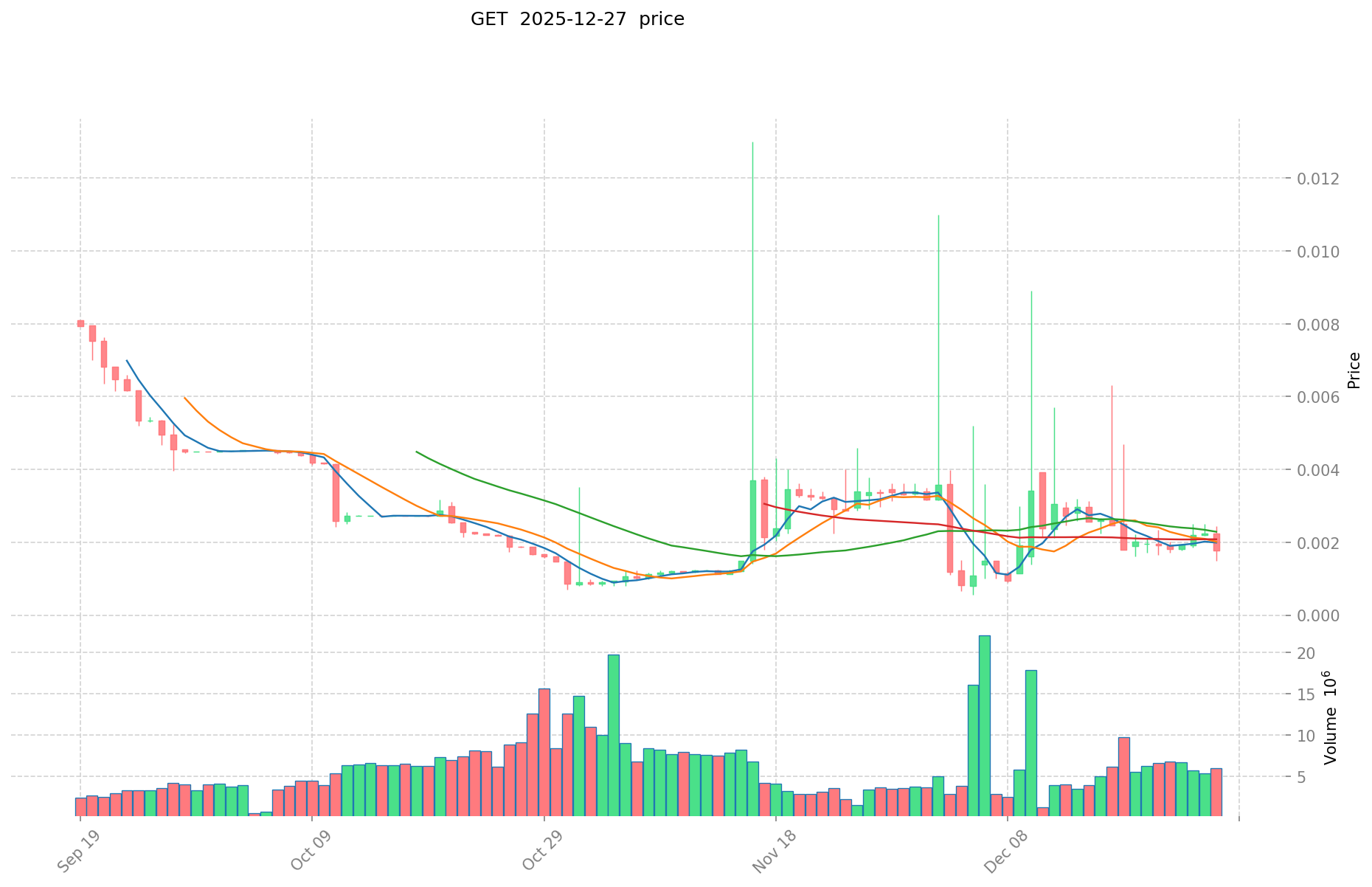

GET vs ETC Investment Value Analysis
II. Core Factors Influencing GET vs ETC Investment Value
Supply Mechanism Comparison (Tokenomics)
- ETC: ETC operates as a hard money cryptocurrency with a fixed supply model, emphasizing the principle of immutability and resistance to arbitrary monetary policy changes. The network maintains consistent block rewards and follows a deflationary design philosophy aligned with the "code is law" principle.
- GET: Information regarding GET's specific tokenomics and supply mechanism is not available in the provided reference materials.
- 📌 Historical Pattern: ETC's commitment to a fixed supply model reflects its positioning as a store of value, contrasting with inflationary systems. The supply discipline influences long-term value preservation potential for conservative investors.
Institutional Adoption and Market Applications
- Institutional Holdings: ETC has not achieved the same level of institutional adoption as Ethereum (ETH), though it maintains a dedicated supporter base among those who prioritize blockchain immutability and the proof-of-work consensus mechanism.
- Enterprise Adoption: ETC's applications are limited compared to mainstream cryptocurrencies, with its value proposition centered on smart contract programmability and decentralized computation rather than widespread enterprise integration.
- Regulatory Stance: Different jurisdictions approach ETC with varying regulatory frameworks, though specific policy comparisons between GET and ETC are not detailed in available sources.
Technology Development and Ecosystem Construction
- ETC Technology Development: ETC maintains its commitment to proof-of-work (PoW) consensus, with developers claiming superior fault tolerance of 50% compared to proof-of-stake (PoS) networks' 33% capacity. However, the network experienced multiple 51% attacks in 2019 and 2020, raising significant security concerns.
- GET Technology Development: Specific technical developments and upgrades for GET are not documented in the provided reference materials.
- Ecosystem Comparison: ETC emphasizes smart contract programmability and composability as key success factors, though comprehensive ecosystem metrics comparing DeFi, NFT, payment, and smart contract deployment between GET and ETC are not available in the reference sources.
Macroeconomic Environment and Market Cycles
- Performance in Inflationary Environments: ETC positions itself as a hard money asset with fixed supply principles, potentially offering inflationary hedge characteristics. However, no direct comparative analysis with GET's inflation-resistant properties is available.
- Macroeconomic Policy Impact: ETC price volatility is influenced by broader market sentiment, Ethereum network dynamics, and ETF expectations. The relationship between interest rates, US dollar index movements, and comparative performance with GET requires additional data.
- Geopolitical Factors: Cross-border transaction demand and international circumstances affect cryptocurrency adoption patterns, though specific geopolitical impacts on GET versus ETC are not detailed in current reference materials.
III. 2025-2030 Price Forecast: GET vs ETC
Short-term Forecast (2025)
- GET: Conservative $0.001617928-$0.0017212 | Optimistic $0.002117076
- ETC: Conservative $7.095-$11.825 | Optimistic $15.3725
Medium-term Forecast (2026-2028)
- GET may enter consolidation phase with institutional accumulation, projected price range $0.0015758042118-$0.003260772831316
- ETC may enter recovery phase supported by network upgrades, projected price range $6.9353625-$25.0972818525
- Key drivers: institutional capital inflows, ETF approvals, ecosystem development
Long-term Forecast (2029-2030)
- GET: Base case $0.002710862836882-$0.003012069818758 | Optimistic scenario $0.00397593216076-$0.003633761029349
- ETC: Base case $15.659182828575-$22.0551870825 | Optimistic scenario $27.568983853125-$28.037656578628125
View detailed price predictions for GET and ETC
GET:
| 年份 |
预测最高价 |
预测平均价格 |
预测最低价 |
涨跌幅 |
| 2025 |
0.002117076 |
0.0017212 |
0.001617928 |
0 |
| 2026 |
0.00264841044 |
0.001919138 |
0.0017272242 |
10 |
| 2027 |
0.0032429593924 |
0.00228377422 |
0.0015758042118 |
31 |
| 2028 |
0.003260772831316 |
0.0027633668062 |
0.00151985174341 |
59 |
| 2029 |
0.00397593216076 |
0.003012069818758 |
0.002710862836882 |
73 |
| 2030 |
0.003633761029349 |
0.003494000989759 |
0.002795200791807 |
101 |
ETC:
| 年份 |
预测最高价 |
预测平均价格 |
预测最低价 |
涨跌幅 |
| 2025 |
15.3725 |
11.825 |
7.095 |
0 |
| 2026 |
18.222325 |
13.59875 |
6.9353625 |
15 |
| 2027 |
22.115647125 |
15.9105375 |
14.31948375 |
34 |
| 2028 |
25.0972818525 |
19.0130923125 |
14.06968831125 |
60 |
| 2029 |
27.568983853125 |
22.0551870825 |
15.659182828575 |
86 |
| 2030 |
28.037656578628125 |
24.8120854678125 |
17.120338972790625 |
110 |
四、投资策略对比:GET vs ETC
长期 vs 短期投资策略
- GET:适合关注娱乐产业生态发展、寻求新兴赛道机会的投资者。由于项目发行时间较短(2025年12月),长期投资需关注生态采用率和创作者经济发展进展
- ETC:适合寻求抗通胀属性、青睐固定供应量硬资产特性的保守型投资者。其proof-of-work共识机制和"代码即法律"原则提供明确的长期价值定位
风险管理与资产配置
- 保守型投资者:GET 5% vs ETC 95%。ETC的市场成熟度、交易量(日均交易额$1,257,055.23)和确立的安全模型更适合风险规避型配置
- 激进型投资者:GET 40% vs ETC 60%。可在ETC稳定基座基础上增加GET的新兴生态敞口,利用其高波动性特征
- 对冲工具:建议配置稳定币作为风险缓冲(占比15%-20%)、通过期权工具对冲单边风险、考虑跨币种组合以分散非系统性风险
五、潜在风险对比
市场风险
- GET:项目成立时间短,市场认知度有限。当前价格较历史高点下跌94.84%,存在流动性风险(日交易额仅$12,463.14)。生态内创作者和用户采用率不确定,影响长期价值支撑
- ETC:虽为2016年上线项目,但市场地位不如Ethereum稳固。价格从历史高点$167.09跌至$11.811(下跌92.93%),显示市场信心不足。机构采用程度有限,难以对抗宏观经济周期冲击
技术风险
- GET:作为Cardano链上资产,依赖Cardano网络稳定性。参考资料未提供GET具体技术规格和升级路线,存在信息不对称风险
- ETC:虽声称proof-of-work共识的容错率优于proof-of-stake(50% vs 33%),但历史上在2019年和2020年遭遇多次51%攻击,直接威胁网络安全性。算力分布集中度可能影响去中心化程度
监管风险
- 全球监管政策对两者存在差异化影响。ETC作为Ethereum分叉产品,可能随Ethereum监管框架调整而受波及。GET作为娱乐产业代币,面临内容监管、支付结算监管的双重风险。不同司法管辖区对娱乐产业代币的合规性认定存在不确定性
六、结论:Which Is the Better Buy?
📌 投资价值总结
- GET优势:聚焦娱乐产业垂直生态,有明确的应用场景定位;Cardano链基础设施支持;预测2030年涨幅达101%(从$0.0017345至$0.003633761),长期增长潜力;适配创作者经济趋势
- ETC优势:固定供应量模型,具有硬资产和抗通胀特性;proof-of-work共识保证不可篡改性,符合"代码即法律"哲学;交易流动性充足,市场认可度相对稳定;2030年预测涨幅110%,稳健增长空间
✅ 投资建议
- 新手投资者:优先选择ETC。市场历史更长、交易量更大(101倍优于GET)、风险特征相对明确。可通过$11.811的相对低点逐步建立头寸
- 有经验投资者:采用"60% ETC + 40% GET"的组合策略。利用ETC的稳定性和流动性作为主体配置,通过GET的新兴生态机遇增强收益
- 机构投资者:重点关注ETC的ETF可及性和流动性深度。若寻求alternative exposure,待GET生态发展指标更明确(如创作者数量、平台交易额)后再布局
⚠️ 风险提示:加密货币市场波动性极高,当前Fear & Greed指数处于23(极端恐惧)。本文基于历史数据和参考资料分析,不构成投资建议。投资者应自行评估风险承受能力,谨慎决策。
FAQ
GET与ETC分别是什么?各自有什么用途?
GET是基于以太坊的实用代币,用于生态激励与治理。ETC(以太坊经典)是独立公链,提供智能合约与去中心化应用部署服务,两者都支持区块链交易与价值转移。
GET和ETC在收费系统中有什么区别?
GET采用动态费率机制,根据网络拥堵程度调整手续费,费用透明且可预测。ETC使用固定费率结构,收费标准相对稳定但缺乏灵活性。GET的收费系统更智能高效,能更好地优化用户成本。
如何选择使用GET还是ETC进行高速收费?
GET适合低频交易用户,费用更低。ETC适合高频交易用户,速度更快,交易额更大时优势明显。根据您的交易频率和交易额选择即可。
GET和ETC哪个更便宜、更方便?
GET和ETC各有优势。GET交易费用更低,适合频繁交易者。ETC交易额大,生态应用广泛,长期持有更便利。选择需根据个人交易习惯和投资策略而定。
GET和ETC的安全性对比如何?
GET采用现代加密算法和多层安全架构,提供私钥管理保护。ETC基于以太坊经典区块链,安全性取决于网络共识机制。两者都具备较强安全性,GET在应用层更灵活,ETC在链层安全性更成熟稳定。
* The information is not intended to be and does not constitute financial advice or any other recommendation of any sort offered or endorsed by Gate.