Golden Cross Explained: How Beginners Can Interpret Crypto Market Signals

Beginner
Quick Reads
Last Updated 2026-03-29 13:32:05
Reading Time: 1m
This article offers an in-depth explanation of the golden cross, guiding readers in interpreting technical signals and trend changes in the cryptocurrency market. It helps new investors pinpoint optimal buying opportunities and improve their decision-making.

What Is a Golden Cross

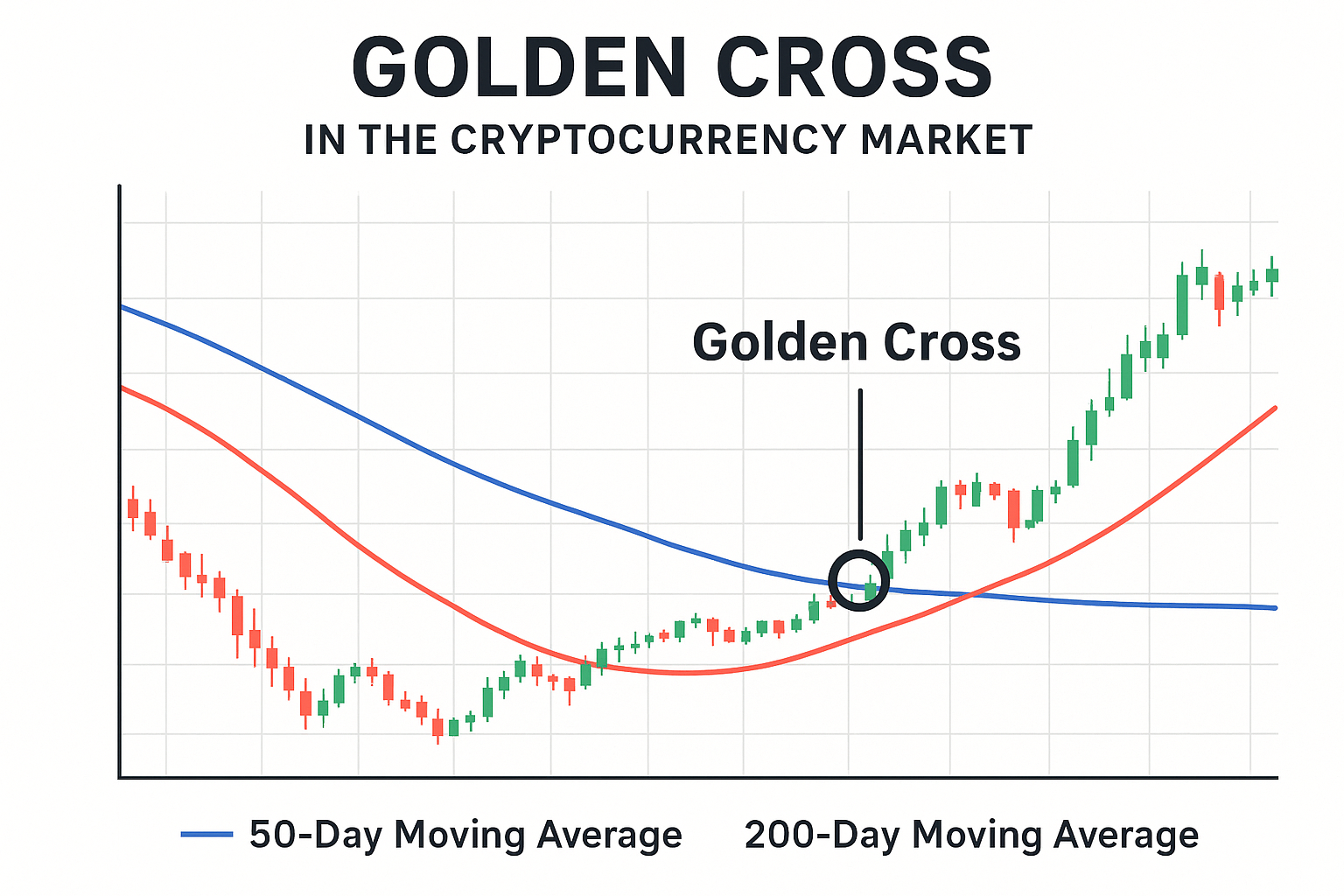
A golden cross is a technical analysis pattern in the crypto market, where a short-term moving average—such as the 50-day moving average—crosses above a long-term moving average—such as the 200-day moving average. Many traders interpret this crossover as a signal that the market is transitioning from a downtrend to an uptrend. The golden cross helps investors find good entry points and take advantage of potential upward movement.

What Conditions Create a Golden Cross

Generally, the golden cross forms when the following conditions are met:

  • Short-term moving average crosses above long-term moving average: The short-term moving average (e.g., 20-day or 50-day moving average) breaks upward through the long-term moving average (e.g., 100-day or 200-day moving average).
  • Volume confirmation: The golden cross occurs alongside higher trading volume, showing greater market participation and acceptance of the trend change.
  • Trend confirmation: After the crossover, price stays above the moving averages, which reduces the risk of false signals.

Significance of the Golden Cross

The golden cross is more than just a convergence of moving averages. It signals stronger bullish momentum in the crypto market as investor sentiment shifts from cautious to optimistic. This pattern often suggests the market may reverse from a bear to a bull market. It also points to stronger buy signals and more chances for short-term profits. Investors can use the golden cross to find opportunities for medium- and long-term investments.

How to Use the Golden Cross in Real Trading

Investors can use the golden cross in the following ways:

  • Follow market trends: When a golden cross appears, consider gradually starting or adding to positions.
  • Set stop-losses: Place stop-losses at support levels below the moving averages to manage risk.
  • Use complementary technical indicators: Combine the golden cross with other signals like MACD or RSI to improve reliability.

Important Considerations and Risk Notice

While many investors regard the golden cross as a bullish signal, it’s important to be aware of these risks:

  • False signals: In sideways or volatile markets, moving average crossovers can happen often, leading to misjudgments.
  • Fundamental analysis: Relying only on technical indicators may cause investors to miss important market fundamentals.
  • Capital management: Use sensible position sizes to avoid major losses from entering positions during rapid price increases.

In conclusion, the golden cross is not just a technical chart pattern—it is an indicator of changing market trends. New investors should use it along with other analytical tools. Developing a clear investment strategy can help you navigate the crypto market more confidently.

Author: Max
Disclaimer
* The information is not intended to be and does not constitute financial advice or any other recommendation of any sort offered or endorsed by Gate.
* This article may not be reproduced, transmitted or copied without referencing Gate. Contravention is an infringement of Copyright Act and may be subject to legal action.

Related Articles

AI-Native Settlement Layers: How United Stables Is Building the Next Financial Rail
Beginner

AI-Native Settlement Layers: How United Stables Is Building the Next Financial Rail

Stablecoins were originally designed as dollar substitutes within exchanges, primarily used for asset pricing and trade settlement. As on-chain financial ecosystems have matured, their role has expanded beyond simple payments to include collateral assets, cross-chain liquidity mediums, and unified settlement units. In particular, as AI systems and automated agents begin to participate directly in economic activity, demand has risen sharply for programmable value units capable of instant settlement. This shift is pushing stablecoins toward the role of foundational financial infrastructure.
2026-03-25 03:16:17
The ve(3,3) Flywheel Explained: How AERO Tokenomics Powers Aerodrome’s DeFi Economy
Beginner

The ve(3,3) Flywheel Explained: How AERO Tokenomics Powers Aerodrome’s DeFi Economy

In the competition for DeFi liquidity, high-inflation mining alone is no longer enough to build lasting advantages. Aerodrome applies the ve(3,3) economic model to redesign token emissions, voting mechanisms, and revenue distribution, creating a liquidity flywheel centered on governance and cash flow. This article examines AERO tokenomics, the veAERO locking mechanism, and protocol revenue models to explain how Aerodrome builds a sustainable DeFi economic system.
2026-03-25 06:41:58
Aerodrome Tokenomics: How ve(3,3) Powers Base's Most Profitable DEX
Beginner

Aerodrome Tokenomics: How ve(3,3) Powers Base's Most Profitable DEX

AERO is the native token of Aerodrome Finance, a core decentralized exchange and liquidity protocol in the Base ecosystem. It is primarily used for liquidity incentives and ecosystem operations. veAERO is a governance NFT that users receive by locking AERO, representing both voting power and the right to share protocol revenue. Through a dual track structure of AERO as a utility token and veAERO as a governance credential, Aerodrome separates liquidity usage value from long term governance power, allowing participants to act as liquidity providers, governance decision makers, and revenue sharers within the same system.
2026-03-25 06:40:31
DePIN Identity Network and Real World Applications: How Humanity Protocol Brings on-chain Identity Into the Physical World
Beginner

DePIN Identity Network and Real World Applications: How Humanity Protocol Brings on-chain Identity Into the Physical World

Most Web3 identity systems remain confined to on-chain environments and struggle to achieve meaningful adoption in real world settings. Through a DePIN architecture and physical verification hardware, Humanity Protocol aims to bring decentralized identity into access control systems, hospitality, public services, and offline events, allowing on-chain identity to function not just as a digital credential, but as foundational infrastructure for real world access.
2026-03-25 07:40:53
How is the price of PAXG determined? Pegging mechanism, trading depth, and influencing factors
Beginner

How is the price of PAXG determined? Pegging mechanism, trading depth, and influencing factors

PAXG (Pax Gold) is a tokenized asset backed by physical gold reserves, launched by fintech firm Paxos and issued as an ERC-20 token on the Ethereum blockchain. The core concept is to digitally represent real-world gold assets, allowing investors to hold and trade gold via the blockchain network. Because each PAXG token corresponds to a specific quantity of physical gold, its price is theoretically expected to closely track the global gold market.
2026-03-24 19:11:40
How Does PAXG Work? In-Depth Overview of the Physical Gold Tokenization Mechanism
Beginner

How Does PAXG Work? In-Depth Overview of the Physical Gold Tokenization Mechanism

PAXG (Pax Gold) is a tokenized asset backed by physical gold, issued by the fintech company Paxos and traded on the Ethereum blockchain as an ERC-20 token. The core concept is to tokenize physical gold on-chain, with each PAXG token representing ownership of a certain amount of gold. This structure enables investors to hold and trade gold in the form of a digital asset.
2026-03-24 19:12:51