# rsETHAttackUpdate

73.87K
#rsETHAttackUpdate
Kelp DAO Bridge Hacked, A 10 Billion Dollar Shock to DeFi
On Saturday April 18 2026, the crypto market was hit by the biggest DeFi attack of the year. Hackers drained exactly 116,500 rsETH, worth around 292 million dollars, from the LayerZero powered bridge that moves Kelp DAO’s rsETH token across chains. The exploit happened in a single transaction at 17:35 UTC. The attackers tricked the bridge with a forged LayerZero packet and emptied the rsETH.
What Happened? The Technical Breakdown
Single DVN Vulnerability: The Unichain to Ethereum bridge route ran on a 1 of 1 DV
ETH0,09%
AAVE1,53%
ARB2,18%
post-image
  • Reward
  • Comment
  • Repost
  • Share
#rsETHAttackUpdate
Kelp DAO Bridge Hacked, A 10 Billion Dollar Shock to DeFi
On Saturday April 18 2026, the crypto market was hit by the biggest DeFi attack of the year. Hackers drained exactly 116,500 rsETH, worth around 292 million dollars, from the LayerZero powered bridge that moves Kelp DAO’s rsETH token across chains. The exploit happened in a single transaction at 17:35 UTC. The attackers tricked the bridge with a forged LayerZero packet and emptied the rsETH.
What Happened? The Technical Breakdown
Single DVN Vulnerability: The Unichain to Ethereum bridge route ran on a 1 of 1 DV
ETH0,09%
AAVE1,53%
ARB2,18%
discovery
#rsETHAttackUpdate
Kelp DAO Bridge Hacked, A 10 Billion Dollar Shock to DeFi
On Saturday April 18 2026, the crypto market was hit by the biggest DeFi attack of the year. Hackers drained exactly 116,500 rsETH, worth around 292 million dollars, from the LayerZero powered bridge that moves Kelp DAO’s rsETH token across chains. The exploit happened in a single transaction at 17:35 UTC. The attackers tricked the bridge with a forged LayerZero packet and emptied the rsETH.
What Happened? The Technical Breakdown
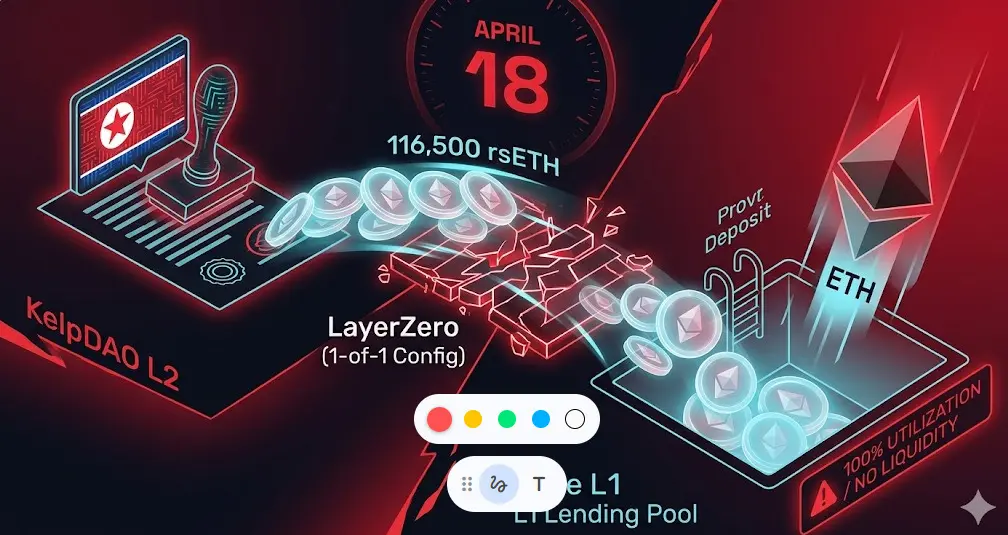
Single DVN Vulnerability: The Unichain to Ethereum bridge route ran on a 1 of 1 DVN setup, meaning only one verifier was active. The attacker manipulated RPC nodes, created a fake packet, and the lone verifier signed off on it.
Bridge Drained: The OFT adapter on Ethereum held 116,723 rsETH. After the attack, the balance dropped to 223 rsETH in just one block.
Where Did the Money Go: Out of the stolen rsETH, 89,567 were deposited into Aave V3 as collateral. The hacker then borrowed 82,650 WETH and 821 wstETH against it. Health factors sat between 1.01 and 1.03, so the positions were right on the edge of liquidation.
The Kelp DAO team hit the emergency multisig and paused all contracts within 46 minutes. If they had not acted, the attacker could have pulled another 40,000 rsETH and pushed total losses to 391 million dollars.
Impact on the Crypto Market: How the Dominoes Fell
1. Liquidity Crisis at Aave
Aave held 83 percent of the total rsETH supply. With the hacker posting collateral and borrowing, Aave was suddenly exposed to between 124 and 230 million dollars in potential bad debt.
Result:
Aave’s TVL fell from 45 billion to 30 billion dollars in three days, a 33 percent drop.
Users panicked and withdrew funds. Around 10.1 billion dollars in assets left the protocol.
ETH borrowing rates jumped from 2 percent to 8 percent, the highest level since at least January 2024.
USDT and USDC borrowing rates spiked from 3.4 percent to 14 percent.
Aave froze rsETH and wrsETH markets across 11 networks including Ethereum, Arbitrum, Avalanche, Base, Linea, and Mantle.
2. Price Action and TVL Drop
The AAVE token lost between 15 and 18 percent of its value.
Overall DeFi TVL fell from 99 billion to 89 billion dollars on April 18, wiping out 10 billion dollars.
Justin Sun withdrew 65,580 ETH in a single transaction, about 154 million dollars.
3. Chain Reaction
SparkLend and Fluid also shut down their rsETH markets. Lido stopped new deposits into rsETH related products. Relay infrastructure kept running, but vault withdrawals stalled because of collateral tied up in Aave’s WETH market.
Who Is Responsible? All Eyes Turn
LayerZero pointed to the Lazarus Group. The RWATimes report flagged their TraderTraitor subgroup. The attacker wallets were funded through Tornado Cash.
Important detail: According to Llamarisk and the Aave report, Aave’s own contracts were not compromised. The issue was entirely in Kelp DAO’s bridge configuration.
Recovery Plan: A 30,000 ETH Lifeline
Mantle proposed lending up to 30,000 ETH to the Aave DAO to cover the bad debt. The loan term would be 36 months with an interest rate of Lido yield plus 1 percent. Stani Kulechov announced the support with the phrase DeFi United.
Kelp DAO managed to recover 40,373 rsETH. That only covers 26 percent of the 152,577 rsETH demand across all L2s. The mainnet version of rsETH is unaffected for now because it is directly backed by staking.
Three Lessons From This Incident
1. Bridge Security Equals DeFi Security: Running a single verifier DVN means trusting 292 million dollars to one packet. Projects using LayerZero will now likely require multi DVN setups and optional verifiers. 2. Systemic Risk in LRTs: When liquid restaking tokens like rsETH get concentrated in giant protocols like Aave, a single exploit shakes the whole market. Having 83 percent in one protocol is too much exposure. 3. Oracles Lag Behind: During the hack, Aave still priced rsETH near peg and allowed 106,467 ETH in borrowing. The bridge exploit did not reflect in price feeds fast enough.
What Happens Next
Short term, rsETH versions on L2s will stay illiquid. The 40,373 rsETH in the bridge cannot cover all rsETH on L2s. That means rsETH on Arbitrum, Base, and Mantle will act like receipts without a vault for a while.
Medium term, if Aave’s bad debt is cleared through the Mantle loan and Kelp DAO repayments, confidence could return. Regulators will likely take a harder look at bridge standards. As Al Jazeera Economy reported, this attack is part of a growing trend of DeFi security breaches in 2026.
Final Thought
The #rsETHAttackUpdate did not just hit Kelp DAO. Aave losing 10 billion dollars showed how interconnected all of DeFi really is. Going forward, asking who audits the bridge will matter more than asking what the APY is.
Stay tuned, because it is still unclear how Kelp DAO will distribute the recovered 40,373 rsETH. That decision will determine the losses for rsETH holders on L2s.

repost-content-media
  • Reward
  • Comment
  • Repost
  • Share
#rsETHAttackUpdate
The rsETH crisis has now moved beyond panic and entered the phase that truly defines DeFi—recovery, accountability, and structural reform.
Six days after the largest DeFi exploit of 2026, the immediate attack has been contained, but the real battle is now about restoring trust, repairing the peg, and deciding who absorbs the damage. The April 18 exploit exposed one of the most dangerous weaknesses in cross-chain infrastructure: a 1-of-1 bridge verification system that gave a single validator complete authority over hundreds of millions in value.
The attacker exploited KelpD
ZRO-0,93%
ETH0,09%
AAVE1,53%
CryptoChampion
#rsETHAttackUpdate
The rsETH crisis has now moved beyond panic and entered the phase that truly defines DeFi—recovery, accountability, and structural reform.
Six days after the largest DeFi exploit of 2026, the immediate attack has been contained, but the real battle is now about restoring trust, repairing the peg, and deciding who absorbs the damage. The April 18 exploit exposed one of the most dangerous weaknesses in cross-chain infrastructure: a 1-of-1 bridge verification system that gave a single validator complete authority over hundreds of millions in value.
The attacker exploited KelpDAO’s LayerZero V2 bridge between Unichain and Ethereum by compromising the DVN verification path. Through RPC poisoning and validator manipulation, they successfully minted 116,500 unbacked rsETH tokens out of thin air. These fake assets were then deposited into Aave V3 as collateral to borrow large amounts of real WETH, creating a total loss of approximately 292 million USDT—the biggest DeFi hack of the year.
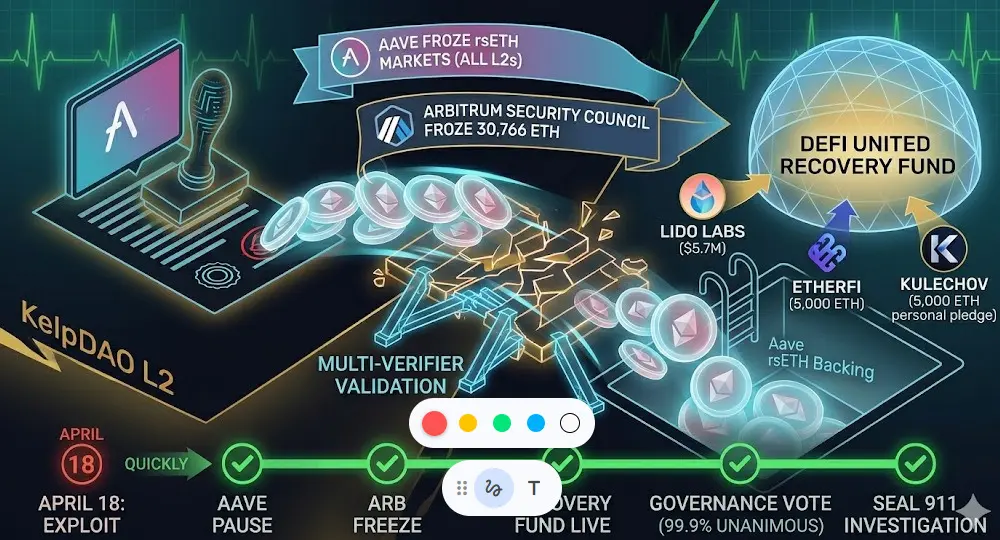
Emergency response was fast. Aave froze rsETH and wrsETH markets across all major deployments within 77 minutes. KelpDAO’s multisig also froze core contracts, preventing a second attempted theft worth nearly 95 million USDT. This action stopped the bleeding, but not the damage.
As of April 24, recovery remains incomplete. Around 70 million USDT tied to the exploit has been recovered by the Arbitrum Security Council, significantly higher than earlier estimates. However, much of the stolen capital has already moved through THORChain, making full recovery increasingly difficult. The overall recovery rate remains below 50%, and governance decisions on how recovered funds will be distributed are still pending.
The most important development is the rise of the DeFi United coalition—a coordinated rescue effort led by Aave to restore rsETH backing and eliminate bad debt across lending platforms. This is now the largest industry-wide recovery initiative DeFi has ever seen.
Aave founder Stani Kulechov personally committed 5,000 ETH. EtherFi governance approved up to 5,000 ETH from its DAO treasury with strong community support from 1,800 token holders. Lido committed 2,500 stETH, while Golem Foundation and Golem Factory added another 1,000 ETH. LayerZero, Mantle, Ink Foundation, Tydro, and others have joined discussions, with Mantle proposing a structured liquidity loan to strengthen Aave’s position.
More than 13,500 ETH has already been pledged, and a full recovery roadmap is expected within one week.
For users, the situation depends entirely on exposure type. Ethereum mainnet rsETH backed by real EigenLayer deposits remains fundamentally safe because the underlying staking positions were never compromised. Non-rsETH Aave users are also unaffected. But wrapped rsETH holders on Layer 2 networks face uncertainty because bridge reserve backing is broken, and final loss distribution has not been finalized.
The biggest lesson from this exploit is simple: 1-of-1 bridge security is dead.
The industry is now moving toward mandatory 2-of-3 multi-DVN verification, real-time bridge reserve monitoring, and strict TVL concentration limits. This attack permanently changed how DeFi will secure cross-chain assets.
The attack may be over, but the real test begins now. If DeFi United succeeds, it proves decentralized finance can survive black swan events through coordination instead of collapse. If it fails, the pressure for regulation, mandatory insurance, and stricter protocol oversight will become impossible to resist.
This is no longer just about rsETH.
This is about whether DeFi can protect itself when everything goes wrong.
#GateSquare #CreatorCarnival #ContentMining #Gate13周年
repost-content-media
  • Reward
  • Comment
  • Repost
  • Share
#rsETHAttackUpdate :
The rsETH Attack: A $292M DeFi Shock That Redefined Crypto Security in 2026
The crypto market was violently shaken on April 18, 2026, when KelpDAO’s rsETH ecosystem suffered a devastating exploit worth approximately $292 million. This was not just another DeFi hack—it became a systemic stress test for the entire decentralized finance ecosystem, exposing structural weaknesses in cross-chain infrastructure, collateral design, and protocol interdependence.
What followed was not only a token collapse—but a liquidity shock, confidence crisis, and a forced global reassessment o
ETH0,09%
AAVE1,53%
ARB2,18%
post-image
post-image
  • Reward
  • Comment
  • Repost
  • Share
#rsETHAttackUpdate
The past week has been a stark reminder of both the fragility and the resilience of DeFi. I've been following the events closely, and in the spirit of the competition, here is my entry for #rsETHAttackUpdate.
#rsETHAttackUpdate: A $292M Wake-Up Call for DeFi
What happened on April 18 was unlike a typical hack. The attacker didn't brute-force their way in—they minted 116,500 rsETH tokens out of thin air using a forged cross-chain message, backed by zero collateral. Within minutes, those phantom tokens were deposited on Aave to borrow millions in real ETH.
The damage rippled
AAVE1,53%
ETH0,09%
ZRO-0,93%
post-image
post-image
  • Reward
  • Comment
  • Repost
  • Share
#rsETHAttackUpdate 🚨
A Wake-Up Call for Liquid Staking, Trust Models, and the Hidden Fragility of DeFi
The crypto market thrives on innovation, speed, and the constant push toward decentralization. But every so often, an event shakes that foundation and forces the entire ecosystem to pause, reflect, and reassess its assumptions. The recent rsETH attack incident is exactly one of those moments — not just another exploit, but a deeper signal that the infrastructure we’re building still carries invisible risks.
This isn’t just about funds being compromised. It’s about how trust is constructed in
post-image
  • Reward
  • Comment
  • Repost
  • Share
#rsETHAttackUpdate
Kelp DAO Bridge Hacked, A 10 Billion Dollar Shock to DeFi
On Saturday April 18 2026, the crypto market was hit by the biggest DeFi attack of the year. Hackers drained exactly 116,500 rsETH, worth around 292 million dollars, from the LayerZero powered bridge that moves Kelp DAO’s rsETH token across chains. The exploit happened in a single transaction at 17:35 UTC. The attackers tricked the bridge with a forged LayerZero packet and emptied the rsETH.
What Happened? The Technical Breakdown
Single DVN Vulnerability: The Unichain to Ethereum bridge route ran on a 1 of 1 DV
ETH0,09%
AAVE1,53%
ARB2,18%
post-image
post-image
post-image
  • Reward
  • 8
  • Repost
  • Share
world_oneday:
To The Moon 🌕
View More
#rsETHAttackUpdate
The rsETH crisis has now moved beyond panic and entered the phase that truly defines DeFi—recovery, accountability, and structural reform.
Six days after the largest DeFi exploit of 2026, the immediate attack has been contained, but the real battle is now about restoring trust, repairing the peg, and deciding who absorbs the damage. The April 18 exploit exposed one of the most dangerous weaknesses in cross-chain infrastructure: a 1-of-1 bridge verification system that gave a single validator complete authority over hundreds of millions in value.
The attacker exploited KelpD
ZRO-0,93%
ETH0,09%
AAVE1,53%
ARB2,18%
post-image
  • Reward
  • 6
  • Repost
  • Share
MasterChuTheOldDemonMasterChu:
Just charge forward 👊
View More
#rsETHAttackUpdate
Six days after the largest DeFi hack of 2026, the rsETH crisis has entered its most critical recovery phase. The attack is contained. The bleeding has stopped. But the full resolution covering bad debt distribution, rsETH peg restoration, and multi-chain fund recovery is still actively unfolding as of this morning. Here is everything confirmed today.
Attack Summary What Happened on April 18
On April 18, 2026 at 17:35 UTC, an attacker exploited KelpDAO's LayerZero V2 bridge between Unichain and Ethereum mainnet. The bridge was configured with a catastrophically weak 1-of-1 D
post-image
Falcon_Official
#rsETHAttackUpdate
Six days after the largest DeFi hack of 2026, the rsETH crisis has entered its most critical recovery phase. The attack is contained. The bleeding has stopped. But the full resolution covering bad debt distribution, rsETH peg restoration, and multi-chain fund recovery is still actively unfolding as of this morning. Here is everything confirmed today.
Attack Summary What Happened on April 18
On April 18, 2026 at 17:35 UTC, an attacker exploited KelpDAO's LayerZero V2 bridge between Unichain and Ethereum mainnet. The bridge was configured with a catastrophically weak 1-of-1 DVN meaning a single validator node operated by LayerZero Labs had full authority to approve cross-chain messages with zero independent verification. The attacker poisoned the RPC infrastructure used by LayerZero's DVN DDoSing legitimate nodes to force failover onto compromised ones then spoofed a valid cross-chain message that tricked the bridge into minting 116,500 unbacked rsETH tokens directly to attacker-controlled addresses. Those tokens were immediately deposited into Aave V3 as collateral, allowing the attacker to borrow large amounts of real WETH against completely fictitious backing. Total damage: 292 million USDT the largest DeFi exploit of 2026.
Recovery Progress What Has Been Confirmed Today
Recovery is moving but remains incomplete. The Arbitrum Security Council has now recovered approximately 70 million USDT in ETH tied to the attack an increase from the 30,766 ETH figure reported earlier this week. Those funds remain in an intermediary wallet pending governance decision on distribution methodology. However, a large share of the stolen assets has already been moved through THORChain, significantly complicating full recovery. KelpDAO's multisig froze core contracts shortly after the exploit was identified, which successfully blocked a second attempted theft worth approximately 95 million USDT confirming that emergency response mechanisms activated correctly after the initial breach. The overall recovery rate remains well below 50% of total stolen funds as of April 24.
DeFi United Industry Coalition Forms
The most significant development today is the formal expansion of the DeFi United recovery initiative a coordinated industry-wide rescue effort led by Aave to stabilize rsETH backing and eliminate bad debt across affected lending platforms. Confirmed contributions as of April 24 include Aave founder Stani Kulechov personally committing 5,000 ETH from his own capital, stating: "Aave is my life's work and we're working nonstop to find the best possible outcome for users." EtherFi governance received overwhelming approval from 1,800 token holders, greenlighting a contribution of up to 5,000 ETH from its DAO treasury. Lido Finance has committed up to 2,500 stETH exclusively to address the rsETH backing gap. Golem Foundation and Golem Factory combined contributed 1,000 ETH from their treasuries. LayerZero has also proposed a contribution toward restoring rsETH backing, stating it has been closely coordinating with Aave, EtherFi, Ethena, Arbitrum, and Kelp throughout the process. Tydro, Ink Foundation, and Mantle have all joined the coalition with Mantle proposing a large structured loan to support Aave's liquidity position. Within one week, a comprehensive roadmap detailing all involved entities and fund distribution methodologies is expected to be published.
Aave Official Response Reserve Freeze Status
Aave's Guardian initiated emergency freezes on rsETH and wrsETH markets across all deployments within 77 minutes of the initial exploit at 18:52 UTC on April 18. As of April 24, rsETH reserves remain paused across Ethereum Core, Arbitrum, Base, Mantle, and Linea with Aave explicitly stating the extended pause is designed to facilitate maximum fund recovery as resolution plans progress. Aave governance has disabled rsETH markets across both V3 and V4 deployments. All other Aave pools remain fully safe and operational the incident is scoped exclusively to rsETH and does not reflect any vulnerability in the Aave protocol itself.
Broader DeFi Contagion The Full Damage Picture
The contagion extended well beyond KelpDAO. Aave saw 6,200 million USDT in net outflows a 23% reduction. Morpho lost 716 million USDT down 9%. Sky protocol lost 272 million USDT down 4%. JupLend lost 76 million USDT down 8%. Total DeFi TVL dropped approximately 10 billion USDT immediately following the attack, with JPMorgan estimating broader ecosystem impact at 20 billion USDT. Lido suspended its EarnETH product which had approximately 9% of its TVL directly exposed to KelpDAO's rsETH and deployed a 3 million USDT liquidity buffer while processing withdrawals for pre-incident requests at pre-attack valuations. DVV, GGV, and EarnUSD from Lido confirmed zero direct rsETH exposure and continued operating normally. SparkLend and Fluid both implemented emergency pauses on rsETH exposure. Utilization-driven interest rates spiked across multiple lending platforms, forcing borrower deleveraging and portfolio adjustments throughout the ecosystem.
User Funds Current Status by Position Type
The safety of user funds depends entirely on which product and chain they held exposure through.
Ethereum mainnet rsETH holders backed by legitimate EigenLayer staking deposits retain their underlying backing EigenLayer delegations were confirmed fully intact and were never compromised. Aave users with non-rsETH positions across all pools are fully safe and unaffected. Users holding wrapped rsETH on Layer 2 networks face genuine uncertainty the bridge reserve backing those tokens is broken, and loss distribution across chains has not yet been formally determined. Users who filed EarnETH withdrawals before the liquidity crunch will be redeemed at pre-incident valuations. Later withdrawal requests will be processed after liquidity conditions normalize. The official guidance from every affected protocol remains unchanged: do not interact with rsETH on any chain until formal resolution is announced.
Security Patch What Changed
The 1-of-1 DVN configuration that enabled this attack has been identified as the definitive root vulnerability and will not appear in any future KelpDAO or LayerZero deployments. LayerZero acknowledged that it had recommended multi-DVN configurations to KelpDAO prior to the exploit but that its protocol still permitted 1-of-1 deployments a gap it is now addressing at the protocol level. On-chain security researcher banteg publicly identified that multiple other projects still operated 1-of-1 bridge configurations as of April 19 including several on Arbitrum, Base, and BSC triggering urgent security reviews across the DeFi ecosystem. A minimum 2-of-3 multi-DVN verification standard is now being adopted as the industry baseline across all high-value bridge deployments.
Investor Sentiment Fear or Opportunity
Market sentiment around rsETH specifically remains deeply negative and will stay that way until the DeFi United recovery roadmap is formally published and bad debt distribution is confirmed. However, the broader DeFi sector is showing early signs of a refugee trade with capital rotating from affected protocols into uncompromised alternatives. Santiment confirmed this pattern emerging six days into the Kelp fallout. The DeFi United coalition's speed and scale with over 13,500 ETH already pledged across confirmed contributors is larger than any previous DeFi exploit recovery effort and signals meaningful ecosystem maturity. The fact that 1,800 EtherFi token holders voted overwhelmingly to deploy recovery capital confirms that DeFi governance mechanisms can mobilize at crisis speed when the stakes are high enough.
Lessons for DeFi Security What This Changes Permanently
Three structural changes are now underway across DeFi as a direct result of this exploit. First, 1-of-1 DVN configurations are being eliminated from every major bridge protocol the KelpDAO attack demonstrated that a single validator compromise can drain hundreds of millions in minutes. Second, real-time invariant monitoring tracking lock-to-mint ratios across all chains simultaneously is being mandated as a core security requirement, not an optional add-on. Third, bridge TVL concentration limits are entering governance discussions across major protocols no single bridge should hold reserve backing for a significant percentage of a token's circulating supply without automated circuit breakers.
Recovery Timeline
The base case resolution timeline is 30 to 60 days for the DeFi United roadmap to execute, bad debt to be distributed, and rsETH markets to begin reopening on a chain-by-chain basis starting with Ethereum mainnet. The bull case for rsETH recovery depends on three variables converging: full DeFi United capital commitments being finalized within one week as announced, Arbitrum Security Council governance approving the 70 million USDT recovered funds distribution, and no additional THORChain movements by the attacker that further complicate on-chain forensics.
For existing rsETH holders, this is a hold-and-monitor situation not a sell into illiquidity and not a buy until the formal recovery path is confirmed. For the broader DeFi ecosystem, the DeFi United initiative represents the strongest coordinated crisis response in the sector's history. If it succeeds, it sets a new standard for how DeFi handles black swan events. If it fails, the regulatory pressure for mandatory DeFi insurance and bridge security audits becomes politically unavoidable.
The attack is over. The recovery has begun. The outcome depends on whether DeFi's biggest names can deliver on their biggest commitments.
repost-content-media
  • Reward
  • Comment
  • Repost
  • Share
#rsETHAttackUpdate
Six days after the largest DeFi hack of 2026, the rsETH crisis has entered its most critical recovery phase. The attack is contained. The bleeding has stopped. But the full resolution covering bad debt distribution, rsETH peg restoration, and multi-chain fund recovery is still actively unfolding as of this morning. Here is everything confirmed today.
Attack Summary What Happened on April 18
On April 18, 2026 at 17:35 UTC, an attacker exploited KelpDAO's LayerZero V2 bridge between Unichain and Ethereum mainnet. The bridge was configured with a catastrophically weak 1-of-1 D
post-image
  • Reward
  • 7
  • Repost
  • Share
ybaser:
2026 GOGOGO 👊
View More
Load More