
Futures
Access hundreds of perpetual contracts
TradFi
Gold
One platform for global traditional assets
Options
Hot
Trade European-style vanilla options
Unified Account
Maximize your capital efficiency
Demo Trading
Introduction to Futures Trading
Learn the basics of futures trading
Futures Events
Join events to earn rewards
Demo Trading
Use virtual funds to practice risk-free trading
Launch
CandyDrop
Collect candies to earn airdrops
Launchpool
Quick staking, earn potential new tokens
HODLer Airdrop
Hold GT and get massive airdrops for free
Launchpad
Be early to the next big token project
Alpha Points
Trade on-chain assets and earn airdrops
Futures Points
Earn futures points and claim airdrop rewards


More


The three giants jointly invest: How does BitcoinZK use ZK technology to break the boundaries of the Bitcoin ecosystem?
Author: Foresight News
The Bitcoin Layer2 space has seen a major breakthrough. Recently, the next-generation Bitcoin privacy scaling protocol BitcoinZK has officially announced that it has secured a joint strategic investment from three major players in the Web3 storage and computing transmission sector—Crust Network, Protocol Labs (IPFS), and ARO Network. This strong alliance of capital and technology marks the official entry of Bitcoin’s Layer 2 networks into a new stage driven by ZK, with multi-technology-stack integration.
1. Why BitcoinZK? A Bitcoin-native L2 with 100% ZK proofs
BitcoinZK is the first Bitcoin Layer2 protocol to propose “100% ZK characteristics.” Its core innovation lies in comprehensively applying zero-knowledge proof (ZK) technology to user-behavior verification and cross-chain communication. While achieving high throughput, it ensures that all proofs are publicly verifiable and that data availability is fully decentralized.
Compared with existing solutions, BitcoinZK has three breakthrough features:
Bitcoin-native compatibility: Supports bridging BTC to EVM-compatible Layer2 networks, enabling participation in complex smart contract scenarios such as DeFi and NFTs without the need for custody;
Turing-complete and modular architecture: By using ZK cross-chain bridges and a modular design, it enables flexible expansion and low-cost deployment;
Distributed compute power integration: Innovatively introduces ARO Network’s edge cloud computing resources to provide low-cost, high-efficiency compute support for ZK proof generation and verification.
2. Three major leaders team up to empower: full-domain integration of storage, transmission, and compute resources
This investment not only injects substantial capital into BitcoinZK, but more importantly brings deep technical support from three ecosystem systems:
Crust Network provides a decentralized storage solution to ensure the anti-censorship and persistent availability of BitcoinZK’s data layer;
Protocol Labs (IPFS) supports the underlying data distribution and transmission architecture, strengthening distributed storage and access capabilities for off-chain data;
ARO Network, relying on its edge cloud platform and the PeerDTS transmission protocol, boosts ZK proof generation speed by 40%, and improves node synchronization efficiency by 3x.
With these combined, BitcoinZK becomes the first Bitcoin L2 project to achieve decentralization across three layers—storage, verification, and transmission—truly building a sustainable ecosystem with a “protocol layer + infrastructure layer + incentive layer” three-in-one design.
3. Technology deployment and a deflationary economic model: how does ZYRA capture value?
As BitcoinZK’s native token, ZYRA sets a fixed total supply of 1 billion coins and strengthens scarcity through multi-layer deflationary mechanisms:
Miner incentives (50%): Released over 10 years via equipment mining, combined with the GPoW (proof of guaranteed work) and GPoS (proof of equity guaranteed stake) mechanisms to ensure network security and token decentralization;
Ecosystem revenue buybacks: The protocol uses 80% of cross-chain bridge fees, Gas fees, and edge cloud service profits for continuous buybacks and burning of ZYRA;
Resource complementarity model: BitcoinZK consumes ARO Network’s redundant compute power for ZK verification, while selling idle bandwidth resources to internet service providers, forming a closed-loop profit model.
4. Global ecosystem progress: from Seoul, Hong Kong to Dubai
BitcoinZK has launched technology evangelism and ecosystem integration worldwide. Between 2023 and 2025, the project held major technology launches in Seoul, Hong Kong, and Dubai, respectively, and reached strategic partnerships with well-known projects such as SecondLive and Cryptos.A, jointly推进 applications of Bitcoin Layer2 in the metaverse and AI data ecosystems.
According to the roadmap, the first phase of BitcoinZK’s mainnet will be launched in 2025, and the ZYRA token will be listed on major exchanges at the same time.
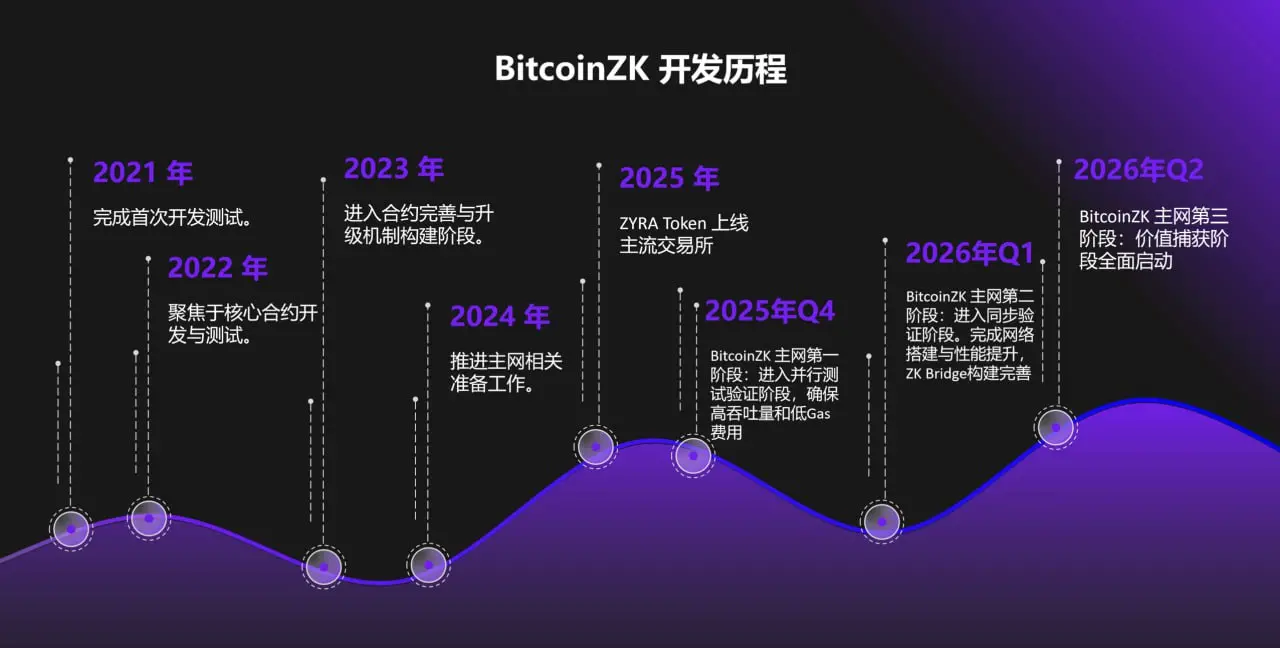
5. Conclusion: Bitcoin L2’s new ZK narrative
The emergence of BitcoinZK not only resolves the long-standing issues of Bitcoin’s network throughput and smart contract bottlenecks, but for the first time achieves large-scale integration of ZK technology, decentralized storage, and edge computing within Bitcoin’s second-layer expansion. With support from three top-tier teams, this protocol is expected to become a core infrastructure driving Bitcoin into a “ZK + Depin + AI” converged era.
As its core slogan states—“Build a new ecosystem for the BTC Layer2 network, and redefine the value of decentralized compute power in Web3 Depin”—BitcoinZK is trying to define not only technical scalability, but a revolution in how resources are organized and how ecosystems coordinate.