 According to Markus Thielen – head of research at 10x Research, it may be too early for Bitcoin investors to become optimistic about the long-term impact of a potential recession on BTC prices.
In a market report on April 11, Thielen noted that credit spreads continue to widen, indicating that “concerns about recession may be penetrating deeper into the economy.”
“Expecting a price increase is too early,” he said.
Bitcoin may face obstacles in the short term
Although the long-term impact of a recession may be positive for Bitcoin due to the monetary easing policy often implemented after the Federal Reserve (Fed) cuts interest rates, Thielen warns that Bitcoin may face many challenges before regaining its bullish momentum.
“Typically, Bitcoin will experience its first price drop when China devalues the yuan or when the Federal Reserve cuts interest rates. This happens because the initial interest rate cuts usually do not create a significant impact and simultaneously reinforce the perception that the economy is weakening,” Thielen said.
!()https://img.gateio.im/social/moments-79b182657097fd84153622c265416172[bitcoin]BTC price chart 4 hours | Source: TradingviewAI czar crypto and the White House’s artificial intelligence, David Sacks, stated in a post on April 10 that it is time to cut interest rates, after the Core Consumer Price Index (Core CPI) rose 2.8% year-on-year in March — the lowest level since March 2021.
CME Group’s FedWatch tool indicates a 64.8% chance that the Federal Reserve (Fed) will not cut interest rates at the Federal Open Market Committee meeting in May.
Traders often believe that reducing interest rates and expanding the money supply will have a positive impact on asset prices, especially Bitcoin and other cryptocurrencies.
However, Thielen noted that according to historical data, when the annual credit spreads begin to “widen,” Bitcoin often faces more downward pressure and takes longer to recover.
“This model shows that while long-term opportunities may arise, Bitcoin still faces short-term pressure,” Thielen said.
He also added that currency devaluation in history often has a negative impact on the market in the short term, before creating an upward trend in the long term.
All of this is happening against the backdrop of increasing concerns from investors about the weakening of the US dollar.
According to data from TradingView, the US Dollar Index (DXY) currently at 100.337, down 2.92% over the past 5 days.
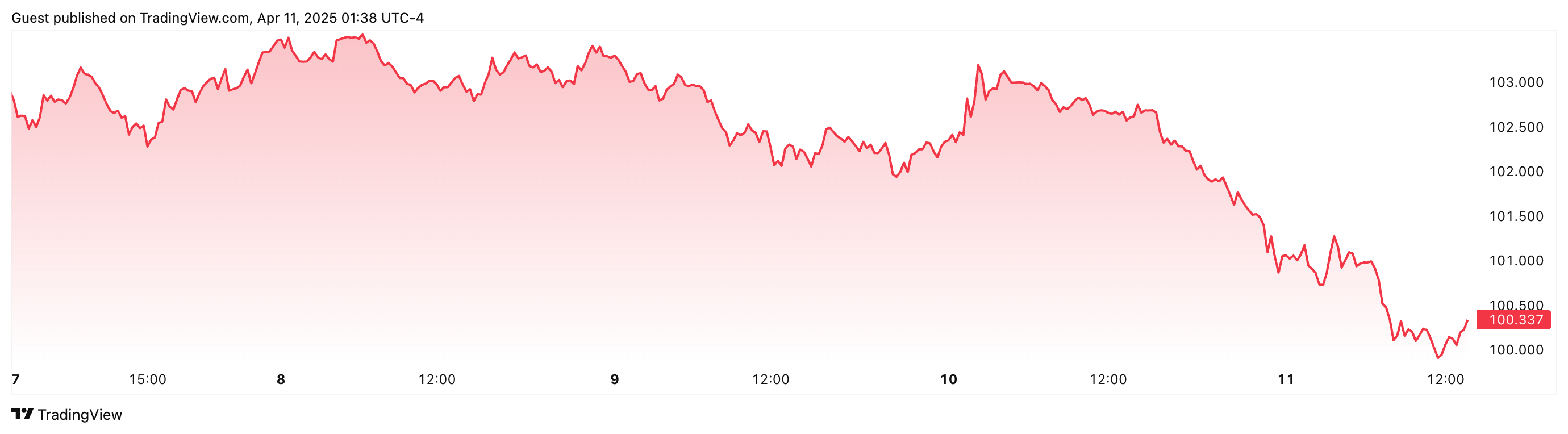 DXY Index | Source: TradingViewThe account specializing in trading information, The Kobeissi Letter, published on 10/4 that:
“The US dollar has left the game. Once again, something is being broken.”
Meanwhile, Robbie Mitchnick, head of digital assets at BlackRock, stated at the end of March that Bitcoin is likely to thrive in a recessionary macroeconomic environment.
“I don’t know if we’re going to go into a recession, but if it does, a downturn will be a big catalyst for Bitcoin,” Mitchnick said.
You can see the price of Bitcoin here.
Disclaimer: This article is for informational purposes only and is not investment advice. Investors should do thorough research before making any decisions. We are not responsible for your investment decisions.
- CryptoQuant: Major reversal signals from the behavior of long-term Bitcoin investors
- The change in trader psychology indicates the next step in the Bitcoin halving cycle.
- Litecoin surpasses $100? Trump temporarily suspends tariffs, hopes for a rise in ETFs
Minh Anh
@media only screen and (min-width: 0px) and (min-height: 0px) {
div[id^=“wrapper-sevio-d89f58f5-7b63-40be-98c0-6b1fd62584fb”] {
width:320px;
height: 100px;
}
}
@media only screen and (min-width: 728px) and (min-height: 0px) {
div[id^=“wrapper-sevio-d89f58f5-7b63-40be-98c0-6b1fd62584fb”] {
width: 728px;
height: 90px;
}
}
Disclaimer: The information on this page may come from third parties and does not represent the views or opinions of Gate. The content displayed on this page is for reference only and does not constitute any financial, investment, or legal advice. Gate does not guarantee the accuracy or completeness of the information and shall not be liable for any losses arising from the use of this information. Virtual asset investments carry high risks and are subject to significant price volatility. You may lose all of your invested principal. Please fully understand the relevant risks and make prudent decisions based on your own financial situation and risk tolerance. For details, please refer to
Disclaimer.


