What Is Bitcoin Proof of Reserves? Understanding Block’s Transparency Initiative

Last Updated 2026-05-07 08:42:14
Reading Time: 1m
With increasing demands for transparency across the crypto industry, Proof of Reserves is emerging as a key mechanism. This article offers an accessible overview of the background surrounding Block’s introduction of Bitcoin Proof of Reserves, how it works, and its significance in strengthening trust and risk management.

What Is Bitcoin Proof of Reserves?

In the crypto world, Proof of Reserves is a mechanism that enables third parties to verify whether a platform’s assets actually exist. Using blockchain technology, companies can make their asset addresses public, allowing anyone to check if the balances match their claims. The core goal is to move beyond trusting a company’s word and empower users to independently verify assets through on-chain data.

Background of Block’s Proof of Reserves Launch

Block, founded by Jack Dorsey, recently announced the adoption of a Bitcoin Proof of Reserves mechanism, applying it to both corporate assets and product offerings like Cash App and Square.
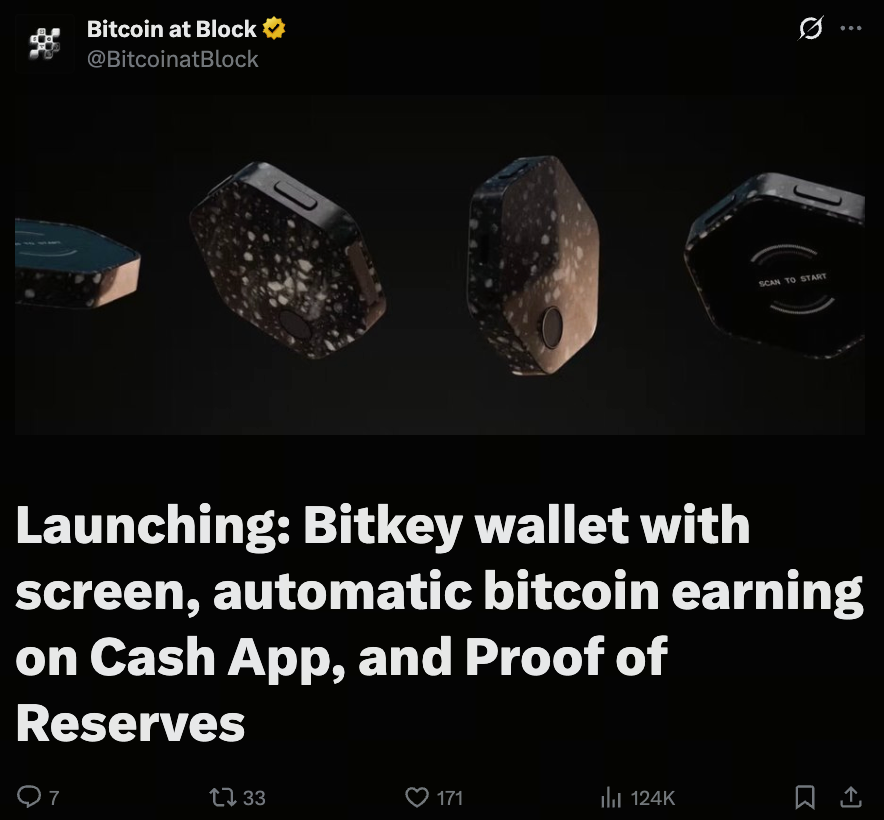
Background of Block’s Proof of Reserves Launch

(Source: BitcoinatBlock)

The core principle behind this initiative is that users should be able to verify asset existence themselves, rather than simply trusting the platform. Block currently discloses a verifiable Bitcoin holding of about 8,883 BTC, valued at several hundred million dollars, and enables public verification via on-chain signatures.

How Does Proof of Reserves Work?

The basic Proof of Reserves process consists of several steps:

  1. Public Asset Address Disclosure
    The platform reveals the blockchain addresses holding its assets.

  2. On-Chain Signature Verification
    Cryptographic signatures are used to prove that these addresses are controlled by the platform.

  3. User Self-Verification
    Anyone can use a blockchain explorer to check asset balances.

This approach offers real-time transparency and allows for initial verification without third-party audits, while reducing the risk of asset misappropriation.

Advantages and Controversies of Proof of Reserves

While Proof of Reserves increases transparency, there are still differing views in the market.

Advantages

  • Strengthens trust mechanisms

  • Reduces the risks of opaque operations

  • Enhances users’ confidence in asset security

Potential Issues

  • Only proves asset existence; may not reflect liabilities

  • Public disclosure may introduce security risks

For example, Michael Saylor has noted that over-disclosing asset information could compromise security.

Block’s Strategic Direction

Beyond launching Proof of Reserves, Block is also advancing several Bitcoin-related features, including:

  • Hardware wallet products

  • Automatic conversion of payments into Bitcoin

  • Merchant rewards programs

These actions show that Block’s long-term vision is not just asset transparency, but also expanding Bitcoin’s use in everyday payments.

Summary

Bitcoin Proof of Reserves represents a major step toward transparency in the crypto industry. On-chain verification enables users to directly monitor asset status and reduces reliance on centralized platforms. Block’s strategy suggests that the future of financial services will be built on verifiable trust, where technology—not just platform promises—proves everything.

Author: Allen
Disclaimer
* The information is not intended to be and does not constitute financial advice or any other recommendation of any sort offered or endorsed by Gate.
* This article may not be reproduced, transmitted or copied without referencing Gate. Contravention is an infringement of Copyright Act and may be subject to legal action.

Related Articles

In-depth Explanation of Yala: Building a Modular DeFi Yield Aggregator with $YU Stablecoin as a Medium
Beginner

In-depth Explanation of Yala: Building a Modular DeFi Yield Aggregator with $YU Stablecoin as a Medium

Yala inherits the security and decentralization of Bitcoin while using a modular protocol framework with the $YU stablecoin as a medium of exchange and store of value. It seamlessly connects Bitcoin with major ecosystems, allowing Bitcoin holders to earn yield from various DeFi protocols.
2026-03-24 11:55:44
The Future of Cross-Chain Bridges: Full-Chain Interoperability Becomes Inevitable, Liquidity Bridges Will Decline
Beginner

The Future of Cross-Chain Bridges: Full-Chain Interoperability Becomes Inevitable, Liquidity Bridges Will Decline

This article explores the development trends, applications, and prospects of cross-chain bridges.
2026-04-08 17:11:27
Solana Need L2s And Appchains?
Advanced

Solana Need L2s And Appchains?

Solana faces both opportunities and challenges in its development. Recently, severe network congestion has led to a high transaction failure rate and increased fees. Consequently, some have suggested using Layer 2 and appchain technologies to address this issue. This article explores the feasibility of this strategy.
2026-04-06 23:31:03
Sui: How are users leveraging its speed, security, & scalability?
Intermediate

Sui: How are users leveraging its speed, security, & scalability?

Sui is a PoS L1 blockchain with a novel architecture whose object-centric model enables parallelization of transactions through verifier level scaling. In this research paper the unique features of the Sui blockchain will be introduced, the economic prospects of SUI tokens will be presented, and it will be explained how investors can learn about which dApps are driving the use of the chain through the Sui application campaign.
2026-04-07 01:11:45
Navigating the Zero Knowledge Landscape
Advanced

Navigating the Zero Knowledge Landscape

This article introduces the technical principles, framework, and applications of Zero-Knowledge (ZK) technology, covering aspects from privacy, identity (ID), decentralized exchanges (DEX), to oracles.
2026-04-08 15:08:18
What is Tronscan and How Can You Use it in 2025?
Beginner

What is Tronscan and How Can You Use it in 2025?

Tronscan is a blockchain explorer that goes beyond the basics, offering wallet management, token tracking, smart contract insights, and governance participation. By 2025, it has evolved with enhanced security features, expanded analytics, cross-chain integration, and improved mobile experience. The platform now includes advanced biometric authentication, real-time transaction monitoring, and a comprehensive DeFi dashboard. Developers benefit from AI-powered smart contract analysis and improved testing environments, while users enjoy a unified multi-chain portfolio view and gesture-based navigation on mobile devices.
2026-03-24 11:52:42





