Pourquoi s’intéresser au classement des stablecoins ?
Au sein de l’univers Web3, les stablecoins constituent des outils indispensables pour la DeFi, le trading, les paiements internationaux et la préservation du capital. Suivre le classement par capitalisation boursière et analyser les caractéristiques des stablecoins permet non seulement aux utilisateurs de prendre des décisions éclairées, mais aussi d’identifier les jetons bénéficiant de la confiance du marché et d’une viabilité à long terme.
Classement des stablecoins en 2025
D’après les dernières données de capitalisation boursière disponibles à la date de rédaction, voici un panorama des principaux stablecoins accompagné d’une analyse :
- USDT (Tether)
Tether domine actuellement le marché des stablecoins, avec une capitalisation boursière d’environ 160 milliards de dollars, soit plus de 60 % du marché global. L’USDT est un choix privilégié pour constituer des paires de trading et assurer des transferts d’actifs entre chaînes, grâce à sa grande liquidité et son adoption mondiale. Toutefois, la transparence de ses réserves fait ponctuellement l’objet de débats. - USDC (USD Coin)
USDC, avec une capitalisation boursière proche de 64,3 milliards de dollars, fait figure de stablecoin majeur, émis aux États-Unis et strictement conforme à la réglementation. Ses réserves sont essentiellement constituées de liquidités et de bons du Trésor américain à court terme. Des audits indépendants et réguliers renforcent sa transparence. - USDe (Ethena USDe)
Conçu par Ethena, USDe occupe la troisième place, affichant une capitalisation boursière d’environ 9,5 milliards de dollars. Nouvel acteur combinant des mécanismes collatéralisés et algorithmiques, il suscite l’intérêt du secteur et des développeurs. - DAI (MakerDAO)
DAI est le stablecoin crypto-collatéralisé le plus en vue, avec une capitalisation boursière avoisinant 5,3 milliards de dollars. Il repose principalement sur l’ETH et une gouvernance communautaire décentralisée. Bien que la gestion des risques soit avancée, la volatilité des actifs qui le garantissent reste un défi à surveiller. - USD1 (World Liberty Financial USD)
USD1, émis par la société américaine World Liberty Financial, est un stablecoin émergent adossé à des devises, avec une capitalisation boursière d’environ 2,16 milliards de dollars. Il bénéficie d’un capital propre et d’un positionnement de marque distinctif, et entretiendrait des liens commerciaux avec la famille Trump. - FDUSD (First Digital USD)
FDUSD, émis par First Digital, est adossé à des devises et dispose d’une capitalisation boursière proche de 1,45 milliard de dollars. Il est principalement disponible sur les plateformes d’échange asiatiques et s’intègre étroitement à l’écosystème blockchain. - PYUSD (PayPal USD)
Lancement de PayPal en 2023, PYUSD atteint une capitalisation boursière d’environ 960 millions de dollars. Première initiative d’un acteur majeur du paiement dans la crypto, PYUSD profite de la notoriété et de la confiance associées à la marque PayPal. - RLUSD (Ripple USD)
RLUSD, émis par Ripple, possède une capitalisation boursière proche de 600 millions de dollars et sert aux transferts internes et règlements transfrontaliers sur le réseau Ripple.
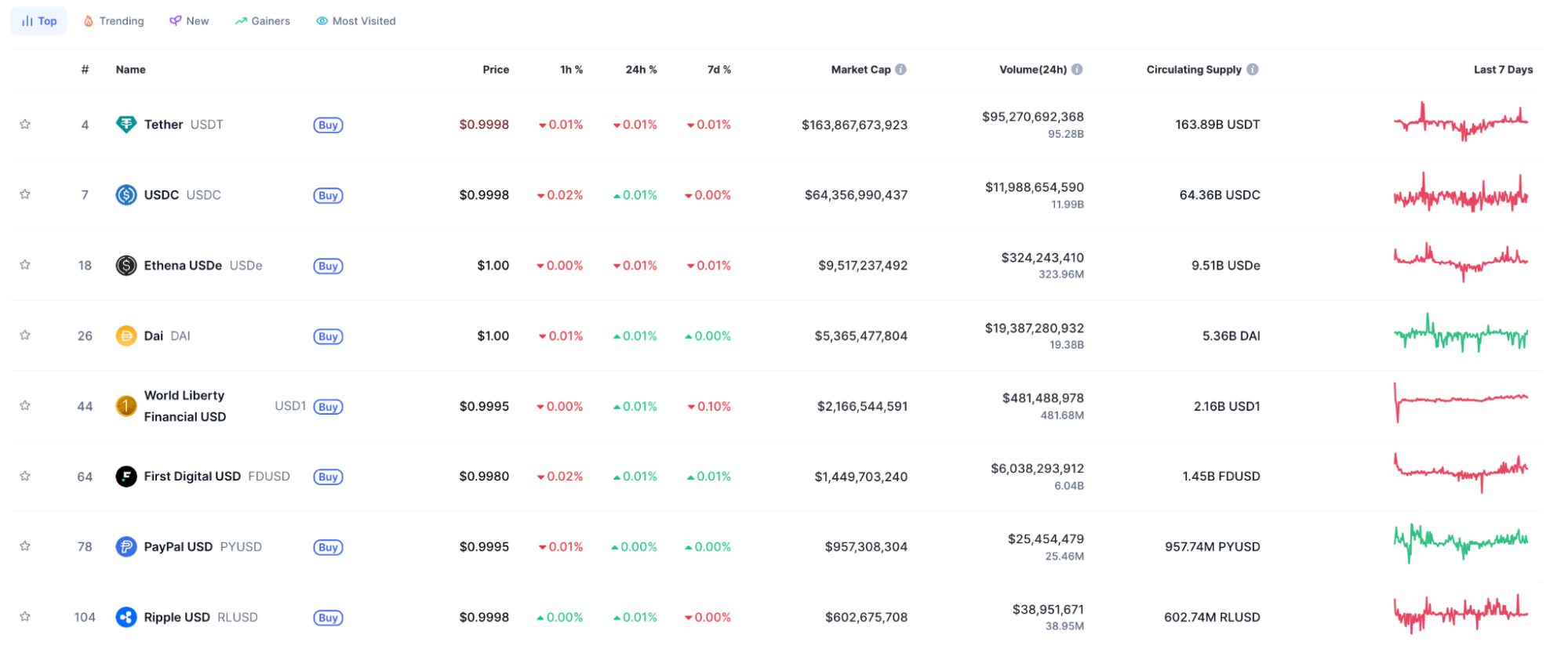
(Source : CoinMarketCap)
Pourquoi le classement des stablecoins est déterminant et quelles stratégies de sélection adopter ?
La capitalisation boursière comme gage de confiance
L’USDT et l’USDC représentent à eux seuls plus de 70 % du marché des stablecoins, reflet de leur grande liquidité et de la profondeur de leur volume d’échange. Ces actifs constituent les supports privilégiés des grands acteurs du marché.
Réglementation et transparence, moteurs de l’adoption
USDC est émis par une entité strictement réglementée, avec des réserves hautement transparentes. USDe, USD1, FDUSD et d’autres stablecoins innovants restent sous surveillance : leur conformité réglementaire devra s’affirmer dans le temps.
Chaque catégorie de stablecoin possède ses atouts et ses limites
- L’USDC et l’USDT sont adossés à des devises fiduciaires, garantissant la stabilité des prix mais impliquant une gestion centralisée.
- DAI est collatéralisé par des cryptomonnaies, ce qui lui offre une résistance à la censure, mais l’expose aux fluctuations des actifs de réserve.
- USDe, stablecoin hybride ou algorithmique, reste encore au stade expérimental.
Principaux cas d’usage des stablecoins
- Market making et arbitrage sur les plateformes d’échange, avec l’USDT et l’USDC utilisés comme actifs de référence pour les paires de trading
- Transferts inter-blockchains, où les stablecoins facilitent le mouvement de fonds entre différents réseaux
- Prêts et rendement DeFi : DAI et USDC sont fréquemment utilisés comme collatéral dans les protocoles de prêt ou pour générer du rendement
- Intégration avec les institutions et plateformes de paiement, telles que PayPal et World Liberty, qui accélèrent l’adoption via leurs écosystèmes professionnels
Perspectives
À mesure que des textes comme la GENIUS Act se mettent en place, de nouvelles banques et entreprises devraient émettre leurs propres stablecoins et participer à la concurrence. Les nouveaux entrants, comme l’USDe d’Ethena, le PYUSD de PayPal ou le RLUSD de Ripple, pourraient progresser dans le classement à mesure que leur adoption s’accroît et qu’ils obtiennent une approbation réglementaire.
Pour approfondir vos connaissances de l’écosystème Web3, cliquez ici pour vous inscrire : https://www.gate.com/
Résumé
Le secteur des stablecoins reste jeune mais attire déjà des flux de capitaux supérieurs à ceux de plusieurs grands systèmes bancaires. En analysant les classements, les investisseurs peuvent cerner les grandes tendances en matière de confiance, de transparence et de respect des réglementations. Pour bien choisir un stablecoin, il est préférable de privilégier les usages concrets, la supervision, la sécurité et l’envergure de l’écosystème, plutôt que la seule capitalisation ou la popularité à court terme.