CFD (Contract for Difference) is a financial derivative settled on price differences. CFDs support leverage and two-way trading, making them widely used in stocks, Forex, commodities, and cryptocurrency markets.
As online trading platforms and digital asset markets have evolved, CFDs have become a key part of the global retail derivatives market. However, compared to traditional Spot Trading, CFDs have a more complex risk structure. While the leverage mechanism improves capital efficiency, it also amplifies losses from price swings.
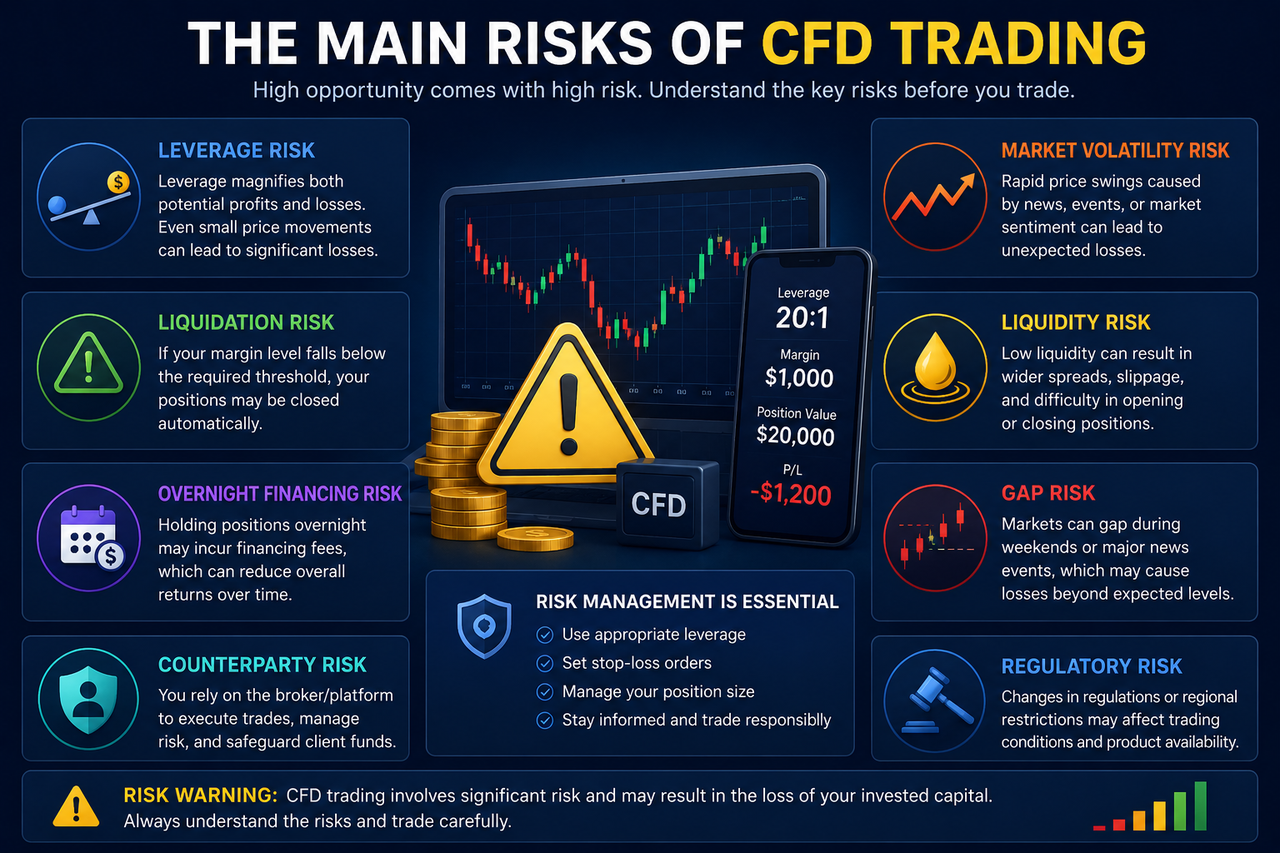
Why Are CFDs Considered High-Risk Trades?
CFDs are high-risk derivatives, primarily due to their leverage structure.
In CFD trading, users typically only need to post a fraction of the margin to control positions far larger than their account principal. As a result, even minor market price changes can have a significant impact on account Net Asset Value (NAV).
For example, at 20x leverage, a 5% market move could theoretically equate to a profit or loss of the entire margin.
Leverage can boost returns, but it equally magnifies potential losses.
What Is Leverage Risk?
Leverage risk is one of the core risks in the CFD market.
Because traders control positions much larger than their actual account funds, even small market swings can quickly lead to outsized losses.
The relationship between leverage and risk is typically expressed as:
${Leverage} = \frac{\text{Position Size}}{\text{Margin}}$
The higher the leverage ratio, the more sensitive the account is to market moves.
Under high leverage, even slight price changes can rapidly erode account Net Asset Value (NAV)—a key reason why CFDs are classified as high-risk derivatives.
What Is Liquidation Risk?
Liquidation is a critical part of CFD risk management.
If adverse market moves cause account Net Asset Value (NAV) to fall below the Maintenance Margin Requirement, the platform may automatically close some or all positions to prevent further losses.
Liquidation risk typically relates to:
- High leverage ratios
- Rapid market swings
- Oversized positions
- Insufficient margin
In highly volatile markets—such as Crypto CFDs or crude oil CFDs—liquidation risk is even more pronounced.
During extreme conditions, rapid price swings can trigger automatic liquidations before additional margin can be posted.
Why Is Market Volatility Risk Significant?
CFDs are fundamentally derivatives based on price volatility, making market swings a core risk.
Stocks, Forex, commodities, and cryptocurrency markets are all affected by macroeconomic data, interest rate decisions, geopolitical events, shifts in market sentiment, and changes in liquidity.
When volatility spikes, CFD position PnL can shift rapidly.
This is especially true in cryptocurrency markets, which operate 24/7 and exhibit higher volatility—so Crypto CFD price swings are typically much larger than those in traditional markets.
Why Do CFDs Involve Liquidity Risk?
Liquidity risk is the danger of being unable to execute trades quickly at expected prices.
In low-liquidity environments, CFD prices may see wider spreads, more slippage, unstable quotes, and difficulty closing positions.
This risk is heightened during major news events or extreme market moves, when market depth can evaporate and execution efficiency drops.
Some CFD products depend on broker quotes, so the platform's liquidity model also impacts price stability.
What Risks Come With Overnight Financing Fees?
Most CFDs have no fixed Expiry Date, so long-term positions typically incur overnight financing fees.
Overnight fees are tied to the use of leveraged capital. The longer a CFD position is held, the more financing costs can add up and impact returns.
For high-leverage positions, even if market prices are stable, accumulated overnight fees can become a significant cost.
CFD trading relies on brokers or platforms for pricing and liquidity—making platform risk a key consideration.
Platforms can differ in:
- Risk control mechanisms
- Liquidity sources
- Leverage limits
- Liquidation rules
- Fee structures
CFDs in some markets may also be affected by regulatory changes.
Thus, platform stability, market transparency, and the regulatory environment all shape overall CFD risk.
Why Are Crypto CFDs Riskier?
Compared to traditional stock or Forex CFDs, Crypto CFDs generally carry higher risk. This is due to higher digital asset volatility, 24/7 trading, more pronounced liquidity shifts, more frequent high-frequency liquidations, and faster-moving market sentiment.
In extreme conditions, crypto markets can see violent price swings in short periods, leading to rapid liquidation of leveraged positions.
How Do CFD Risks Differ From Traditional Spot Trading?
Traditional Spot Trading involves actual asset ownership, so losses are usually limited to the invested capital.
CFDs, by contrast, use leverage—amplifying account risk. Traders face not just market price risk, but also margin risk, liquidation risk, and financing cost risk.
CFDs also focus on short-term price swings, so their risk profile can change much faster than with traditional long-term assets.
CFD Core Risk Structure Comparison
| Risk Type |
CFD Risk Manifestation |
| Leverage Risk |
Amplifies both gains and losses |
| Liquidation Risk |
Automatic position closure if margin is insufficient |
| Volatility Risk |
Rapid market price swings |
| Liquidity Risk |
Wider spreads and slippage |
| Financing Risk |
Increased holding costs from overnight fees |
| Platform Risk |
Differences in pricing and risk controls |
| Market Risk |
Impact from macro and sentiment shifts |
Summary
CFDs are high-risk leveraged derivatives, with risk structures focused on leverage, market volatility, margin, and liquidity.
Because CFDs magnify market price moves, even small swings can have a large impact on account Net Asset Value (NAV). Liquidation, overnight financing fees, and platform liquidity changes can all affect trading results.
FAQs
Why Are CFDs High Risk?
CFDs use leverage, so even small market moves can greatly amplify account PnL swings.
Why Do CFDs Trigger Liquidation?
If account Net Asset Value (NAV) falls below the Maintenance Margin Requirement, the platform may auto-close positions for risk control.
Can CFDs Lose All Principal?
With high leverage, sharp market moves can cause account funds to shrink dramatically—potentially to near total loss.
What Are Overnight Financing Fees?
Overnight financing fees are the cost of holding CFD positions over the long term.
Why Are Crypto CFDs Riskier?
Digital asset markets are more volatile and trade longer hours, so leverage risk is usually more pronounced.
How Do CFD and Spot Trading Risks Differ?
Spot Trading typically only involves asset price risk, while CFDs also introduce leverage, margin, and liquidation risk structures.







