
Futures
Access hundreds of perpetual contracts
TradFi
Gold
One platform for global traditional assets
Options
Hot
Trade European-style vanilla options
Unified Account
Maximize your capital efficiency
Demo Trading
Introduction to Futures Trading
Learn the basics of futures trading
Futures Events
Join events to earn rewards
Demo Trading
Use virtual funds to practice risk-free trading
Launch
CandyDrop
Collect candies to earn airdrops
Launchpool
Quick staking, earn potential new tokens
HODLer Airdrop
Hold GT and get massive airdrops for free
Pre-IPOs
Unlock full access to global stock IPOs
Alpha Points
Trade on-chain assets and earn airdrops
Futures Points
Earn futures points and claim airdrop rewards


Promotions
AI
Gate AI
Your all-in-one conversational AI partner
Gate AI Bot
Use Gate AI directly in your social App
GateClaw
Gate Blue Lobster, ready to go
Gate for AI Agent
AI infrastructure, Gate MCP, Skills, and CLI
Gate Skills Hub
10K+ Skills
From office tasks to trading, the all-in-one skill hub makes AI even more useful.
GateRouter
Smartly choose from 30+ AI models, with 0% extra fees


The situation for Taiwan's stablecoins heats up! Rumors suggest that "6 banks" may be the first to issue them.
Author: Ariel, Encrypted City
Six Taiwanese Banks in a Potential List for Stablecoin Issuance
Taiwan’s draft Virtual Asset Service Act has been passed by the Executive Yuan. Although it has not yet undergone the third reading in the Legislative Yuan, the Financial Supervisory Commission (FSC) has been actively working on subsidiary regulations. Initial planning is to allow only domestic financial institutions to issue stablecoins, encouraging many businesses to jump in.
According to a report by the Economic Daily News, there are 6 banks rumored to be the first to issue stablecoins: CTBC Bank, Cathay United Bank, Taishin Bank, KGI Bank, Union Bank, and Taipei Fubon Bank.
The strategies of these 6 banks in blockchain and virtual-asset-related areas are summarized as follows:
Besides the banks above, Taiwan’s state-owned banks First Bank and Hua Nan Bank have also told the Commercial Times that they have a strong interest in stablecoins. The chairman of E.SUN Financial Holding has also stated that the company will not miss out on the stablecoin and tokenization markets.
In addition, the strategic distribution partnership between Capital Layer, a blockchain enterprise settlement infrastructure provider, and Dunyang Technology, Taiwan’s largest systems integrator, is also seen as part of stablecoin deployment.
In 2018, Taiwan’s first “Taiwan Dollar stablecoin” quietly exited the market
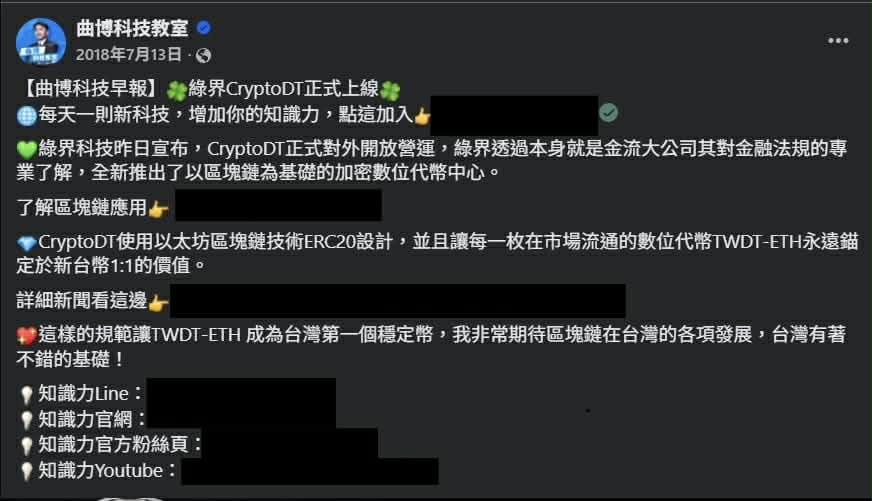
On the other hand, years ago, Taiwan’s third-party payment provider Green World Fintech Service launched CryptoDT blockchain financial services and issued Taiwan Stablecoin (TWDT-ETH). It adopted the Ethereum token standard ERC-20, with each token pegged 1:1 to the value of the new Taiwan dollar. The circulating TWDT-ETH represented that there was 1 yuan guaranteed for each token in the trust account; the total number of tokens was equal to the trust balance. It also regularly published the balances and had them verified and certified by accountants.
Recently, the tech YouTuber “Tech Classroom,” which has repeatedly said that “stablecoins are just prepaid cards” and criticized stablecoins as hype pushed by crypto industry players, actually had once praised Taiwan Stablecoin as “Taiwan’s first stablecoin,” and said it was very much looking forward to the future development of blockchain in Taiwan.
Image source: Tech Classroom fan page | Taiwan Stablecoin issued by Green World Fintech Service, which was regarded at the time as Taiwan’s first “Taiwan Dollar stablecoin”
However, at that time, Taiwan Stablecoin lacked market demand and real use cases. It was quickly delisted by partner exchanges and quietly exited the market. With Taiwan’s domestic special legislation gradually becoming clearer and international attention on stablecoins increasing, it remains to be seen whether Green World will restart the project, or whether it will attract other payment providers to jump in and compete for this opportunity.
In 2026, is Taiwan’s stablecoin ready?
Under the current draft regulations, stablecoin issuers must properly set aside reserves for the fiat currencies they receive, and they are not allowed to distribute interest or rewards—this has also sparked curiosity about how issuers will make profits in the future.
An insider told the Economic Daily News that the purpose of banks issuing stablecoins is to further seize opportunities in blockchain finance and real-world asset tokenization (RWA).
Previously, the FSC vice chairperson, Zhuang Xiuyuan, also revealed that some Taiwanese import and export traders have already started using stablecoins in actual payment and settlement. When the amount of stablecoins accumulated by traders gradually increases, they will inevitably seek to connect with traditional financial institutions.
After Taiwan Stablecoin’s long period of failure, is the market truly ready to welcome Taiwan’s stablecoin? Zhuang Xiuyuan said that she is optimistic that, driven by supply-chain payment demand, new demand for Taiwan dollar stablecoins will emerge domestically, and at this time the role of financial institutions is to provide seamless integration between fiat currency and stablecoins.