What is RENDER: Understanding the 3D Graphics Pipeline Process

9-12-2025, 1:36:02 AM
AI
Blockchain
Crypto Ecosystem
DeFi
Web 3.0
Article Rating : 4.5
half-star
0 ratings
Explore the significance of Render Network in revolutionizing the 3D graphics pipeline through decentralized GPU computing. This article uncovers Jules Urbach's vision behind Render Network's creation, tracing its origins, milestones, and technical architecture. It highlights key challenges faced, market performance, and RENDER's role in the blockchain industry, while examining its ecosystem applications and partnerships. Providing detailed insights into its community dynamics and future roadmap, readers will benefit from understanding how RENDER tackles rendering efficiency and resource distribution. Discover steps to engage with the network, including purchasing RENDER on Gate and leveraging Solana wallets.

What is RENDER: Understanding the 3D Graphics Pipeline Process

Render Network's Positioning and Significance

In 2020, Jules Urbach launched Render Network (RENDER) to address the growing demand for GPU computing resources, particularly in 3D rendering and emerging applications.

As a decentralized GPU rendering platform, Render Network plays a crucial role in the 3D graphics and blockchain technology sectors.

As of 2025, Render Network has become a leading decentralized rendering solution, boasting 518,584,616 circulating tokens and an active developer community. This article will delve into its technical architecture, market performance, and future potential.

Origins and Development History

Background

Render Network was created by Jules Urbach in 2020 to solve the increasing demand for GPU computing power in rendering and emerging applications.

It emerged during the rise of blockchain technology and decentralized computing, aiming to leverage idle GPU resources to boost rendering speed, reduce costs, and scale operations.

Render Network's launch brought new possibilities for 3D artists, animators, and developers in the digital content creation industry.

Key Milestones

  • 2020: Mainnet launch, achieving decentralized GPU rendering capabilities.
  • 2022: Major upgrade introducing improved scalability and efficiency in GPU resource allocation.
  • 2023: Adoption by major animation studios, pushing the price to new highs.
  • 2024: Ecosystem expansion, with numerous 3D rendering and AI applications built on the network.

With support from the Render Foundation, Render Network continues to optimize its technology, security, and real-world applications in the 3D rendering and blockchain spaces.

How Does Render Network Work?

Decentralized Control

Render Network operates on a global network of decentralized computers (nodes), free from control by any single entity.

These nodes collaborate to validate transactions and rendering jobs, ensuring system transparency and attack resistance, while empowering users with greater autonomy and enhancing network resilience.

Blockchain Core

Render Network's blockchain is a public, immutable digital ledger that records every transaction and rendering job.

Transactions are grouped into blocks and linked through cryptographic hashes, forming a secure chain.

Anyone can view the records, establishing trust without intermediaries.

The network utilizes the Solana blockchain for improved performance and scalability.

Ensuring Fairness

Render Network adopts Solana's Proof-of-Stake (PoS) consensus mechanism to validate transactions and prevent fraudulent activities.

Validators maintain network security by staking SOL tokens and running nodes, and are rewarded with RENDER tokens.

Its innovative features include high throughput and energy efficiency.

Secure Transactions

Render Network uses public-key cryptography to secure transactions:

  • Private keys (like secret passwords) are used to sign transactions
  • Public keys (like account numbers) are used to verify ownership

This mechanism ensures fund security, while transactions remain pseudonymous.

Additional security features include smart contract audits and continuous network monitoring.

RENDER's Market Performance

Circulation Overview

As of September 12, 2025, RENDER's circulating supply is 518,584,616.1640741 tokens, with a total supply of 532,219,654 tokens. The maximum supply is capped at 532,219,654 RENDER tokens, indicating a fixed supply model.

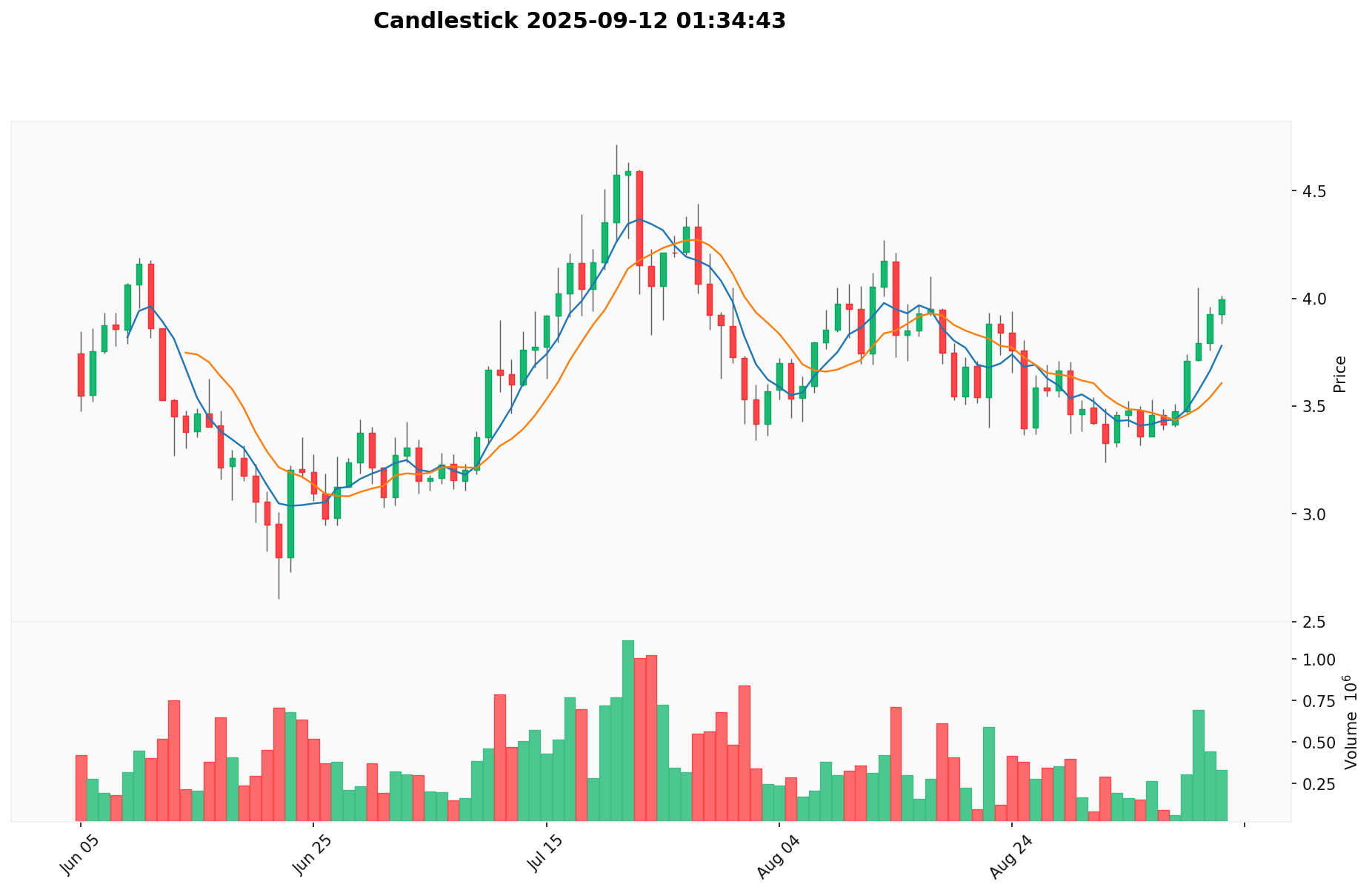
Price Fluctuations

RENDER reached its all-time high of $13.596115966188627 on March 18, 2024, likely driven by bullish market sentiment and increased adoption of decentralized GPU rendering solutions.

Its lowest price was $0.036763626053, recorded on June 16, 2020, possibly due to broader market uncertainties and the early stage of the project.

These fluctuations reflect market sentiment, adoption trends, and external factors influencing the decentralized rendering industry.

Click to view the current RENDER market price

price-image

On-chain Metrics

  • Daily Trading Volume: $1,231,398.89945 (indicates network activity)
  • Active Addresses: 108,775 (reflects user engagement)

RENDER Ecosystem Applications and Partnerships

Core Use Cases

RENDER's ecosystem supports various applications:

  • Rendering Services: Decentralized GPU rendering for 3D artists and studios, providing near real-time rendering capabilities.
  • AI and Machine Learning: Utilization of idle GPU resources for AI model training and inference.

Strategic Partnerships

RENDER has established partnerships with software providers and content creators to enhance its technological capabilities and market influence. These partnerships provide a solid foundation for RENDER's ecosystem expansion.

Controversies and Challenges

RENDER faces the following challenges:

  • Technical Issues: Scaling the network to meet growing demand for GPU resources.
  • Regulatory Risks: Potential scrutiny over decentralized computing networks.
  • Competitive Pressure: Emergence of other blockchain-based rendering solutions.

These issues have sparked discussions within the community and market, driving continuous innovation for RENDER.

RENDER Community and Social Media Atmosphere

Fan Enthusiasm

RENDER's community is vibrant, with active participation in GPU sharing and rendering projects. On X, related posts and hashtags (such as #RenderNetwork) frequently trend, with monthly post volumes reaching significant numbers. Price movements and new feature releases ignite community enthusiasm.

Social Media Sentiment

Sentiment on X shows a mix of opinions:

  • Supporters praise RENDER's decentralized GPU rendering capabilities and see it as the "future of distributed computing".
  • Critics focus on network capacity and competition from traditional rendering services.

Recent trends show overall positive sentiment during market uptrends.

Hot Topics

X users actively discuss RENDER's potential in revolutionizing the rendering industry, energy efficiency of GPU sharing, and integration with emerging technologies like AI and VR.

More Information Sources for RENDER

  • Official Website: Visit RENDER official website for features, use cases, and latest updates.
  • Whitepaper: RENDER Whitepaper details its technical architecture, goals, and vision.
  • X Updates: On X platform, RENDER uses @rendernetwork, as of September 12, 2025, with a significant follower base, posts covering technology upgrades, community events, and partnership news, generating substantial engagement.

RENDER Future Roadmap

  • 2026: Launch enhanced GPU allocation algorithms to improve rendering efficiency and resource distribution
  • Ecosystem Goals: Support integration with major 3D modeling and animation software
  • Long-term Vision: Become the global standard for decentralized rendering and GPU computation

How to Participate in RENDER?

  1. Purchase Channels: Buy RENDER on Gate.com
  2. Storage Solutions: Use compatible Solana wallets for secure storage
  3. Participate in Governance: Through the RENDER Foundation's governance platform
  4. Build the Ecosystem: Visit the developer documentation to contribute to the network or develop applications

Summary

RENDER is redefining distributed computing through blockchain technology, offering decentralized GPU rendering, improved resource utilization, and cost-effective solutions for 3D artists and studios. Its active community, rich resources, and strong market performance make it stand out in the cryptocurrency field. Despite facing challenges in scaling and market competition, RENDER's innovative spirit and clear roadmap position it as a key player in the future of decentralized technology. Whether you're a newcomer or a seasoned player, RENDER is worth watching and participating in.

FAQ

What do you mean by render?

Render refers to providing or creating something useful. In Web3, it often means generating digital assets or processing blockchain data for display or use.

What is render on a house?

Render is a protective exterior coating applied to houses. It's a modern plaster that enhances appearance, provides weather resistance, and creates a smooth finish.

What is render in graphics?

Rendering in graphics is the process of generating 2D images from 3D models. It creates visual output from digital data, resulting in photorealistic or stylized images for final display.

What is an example of render?

An example of RENDER is when a 3D artist uses software to create realistic graphics for a video game or movie, transforming digital models into lifelike visuals.

* The information is not intended to be and does not constitute financial advice or any other recommendation of any sort offered or endorsed by Gate.
Related Articles
Solidus Ai Tech ($AITECH): Revolutionizing Innovation with 1.5M GPUs and Advanced AI Technology

Solidus Ai Tech ($AITECH): Revolutionizing Innovation with 1.5M GPUs and Advanced AI Technology

Discover the groundbreaking AI-powered high-performance computing platform with 1.5 million GPUs. This revolutionary infrastructure is reshaping scientific research, enabling complex simulations and large-scale machine learning models. By combining AI and GPU power, researchers can now tackle unprecedented challenges in climate modeling, drug discovery, and astrophysics.
6-25-2025, 4:05:58 AM
GoPlus Security (GPS): Analyzing Core Logic and Use Cases for Blockchain Protection

GoPlus Security (GPS): Analyzing Core Logic and Use Cases for Blockchain Protection

Discover how GoPlus Security's multi-chain threat detection is revolutionizing blockchain security. With a 98.7% detection rate and 2.3-second response time, this innovative system outperforms traditional solutions, providing real-time protection for DApps, wallets, and exchanges across multiple chains. Learn why GoPlus Security is the future of blockchain safety.
6-24-2025, 3:19:36 AM
Quantum Financial System Explained: What It Is and Why It Matters

Quantum Financial System Explained: What It Is and Why It Matters

This article explores the Quantum Financial System (QFS), an innovative framework using quantum computing, blockchain, and AI to transform global finance. It explains QFS's enhancements over traditional banking, offering rapid transactions, low costs, and quantum-resistant security. Additionally, the article delves into QFS integration with Web3 technologies, showcasing its potential to revolutionize decentralized finance. Readers will understand QFS's real-world applications by 2025, recognizing its benefits in fraud reduction and efficient transactions. Key phrases highlight QFS's impact on finance, appealing to financial professionals, tech companies, and regulatory bodies.
9-12-2025, 6:48:43 PM
$MIRA Token: What It Is and How Mira Network Works

$MIRA Token: What It Is and How Mira Network Works

Explore the revolutionary Mira Network and $MIRA token, transforming AI verification through decentralized blockchain technology. This article delves into Mira's sophisticated protocol and architecture, enabling robust trust in AI outputs across industries like DeFi, NFTs, and healthcare. Understand $MIRA's utility in network operations and ecosystem governance, with metrics highlighting ecosystem growth since its 2025 launch. Ideal for tech enthusiasts and investors, learn about $MIRA's investment landscape and promising prospects within the expanding Web3 and AI domains.
9-28-2025, 4:55:54 PM
Recall Network (RECALL): Building Trust for AI Agents on Chain

Recall Network (RECALL): Building Trust for AI Agents on Chain

Recall Network leverages blockchain to revolutionize how trust is established for AI agents on-chain, offering transparent and immutable records of their performances. Through the AgentRank system, AI agents earn trust via performance and social proof, incentivized by RECALL tokens that drive improved capabilities. The decentralized platform enables reliable AI agent verification, eliminating biases and creating auditable performance records. It reshapes AI-human interactions, benefiting industries like finance and healthcare by ensuring trustworthy AI services. Recall Network is a pivotal innovation in the Web3 ecosystem, fostering AI accountability and efficiency.
10-16-2025, 10:50:13 AM
How Active is the FET Community and Ecosystem in 2025?

How Active is the FET Community and Ecosystem in 2025?

The article delves into the dynamic evolution of the Fetch.AI (FET) community and ecosystem in 2025, highlighting its significant milestones and growth. It discusses the project's social media reach of 2 million followers, showcasing its impact and engagement strategies. The article further explores the 75% surge in developer contributions, reflecting increased interest in Fetch.AI technologies. It also examines the expansion of the DApp ecosystem to over 200 applications, emphasizing the enhanced adoption and diversity within the sector. This comprehensive overview serves as an informative piece for tech enthusiasts, investors, and developers interested in AI and blockchain innovations.
10-25-2025, 11:35:31 AM
Recommended for You
Is Lombard (BARD) a good investment?: A Comprehensive Analysis of Tokenomics, Market Position, and Future Potential

Is Lombard (BARD) a good investment?: A Comprehensive Analysis of Tokenomics, Market Position, and Future Potential

This article provides a comprehensive analysis of Lombard (BARD) as an investment, focusing on its tokenomics, market position, and potential. It discusses BARD's volatility since its launch and prospects for growth in the DeFi landscape. Key aspects include price history, technical details, investment risks, and potential returns. Tailored for investors interested in emerging DeFi projects and Bitcoin utility transformation, the article addresses investment strategies, risk management, and market adoption factors. Keywords: Lombard, BARD, DeFi, investment analysis, tokenomics, Bitcoin.
12-16-2025, 7:31:16 PM
Is 0G (0G) a good investment?: A Comprehensive Analysis of Risk, Potential Returns, and Market Outlook for 2024

Is 0G (0G) a good investment?: A Comprehensive Analysis of Risk, Potential Returns, and Market Outlook for 2024

The article provides a comprehensive evaluation of 0G as an investment, highlighting its position as a leading Layer 1 blockchain network for AI applications. It discusses 0G's decentralized AI Operating System, its market performance, and key technological and economic factors that influence its investment potential. The analysis addresses the token's price trends, investment risks, and potential returns, suitable for investors interested in blockchain and AI intersections. The structure includes sections on price history, project overview, market performance, and investment strategies, allowing readers to quickly assess 0G's viability. Keywords: 0G investment, AI blockchain, market analysis, price performance, investment risks.
12-16-2025, 7:29:47 PM
Is WEMIX (WEMIX) a good investment?: A Comprehensive Analysis of Price Performance, Market Potential, and Risk Factors for 2024

Is WEMIX (WEMIX) a good investment?: A Comprehensive Analysis of Price Performance, Market Potential, and Risk Factors for 2024

This article provides an in-depth analysis of WEMIX's investment potential, covering price performance, market prospects, and risk factors as of 2025. It explores WEMIX's historical volatility, technical architecture, and token utility within its mega-ecosystem. Targeted at investors interested in decentralized solutions, the report outlines liquidity conditions, governance mechanisms, and strategic considerations for long-term investment decisions. With concise data on price history and future outlook, the article serves as a resource for understanding WEMIX's viability in the evolving cryptocurrency landscape.
12-16-2025, 7:28:38 PM
Is FTX Token (FTT) a good investment?: Analyzing the Risks, Recovery Prospects, and Future Viability of FTT After the Exchange Collapse

Is FTX Token (FTT) a good investment?: Analyzing the Risks, Recovery Prospects, and Future Viability of FTT After the Exchange Collapse

The article discusses the investment potential of the FTX Token (FTT), analyzing its market position, historical price performance, and the impacts following the collapse of the FTX exchange. It explores the token's functionality within the ecosystem, its tokenomics, and burning mechanisms aimed at increasing scarcity. This comprehensive review assists investors in assessing FTT's viability amidst extreme volatility, regulatory uncertainties, and platform dependencies. Suitable for experienced investors seeking high-risk opportunities, the report highlights caution necessary due to FTT's speculative nature and significant depreciation. Keywords: FTX Token, investment analysis, market risk, deflationary supply, Gate.
12-16-2025, 7:27:13 PM
EGLD vs NEAR: A Comprehensive Comparison of Two Leading Layer-1 Blockchain Platforms

EGLD vs NEAR: A Comprehensive Comparison of Two Leading Layer-1 Blockchain Platforms

The article provides an in-depth comparison of two leading Layer-1 blockchain platforms: MultiversX (EGLD) and NEAR Protocol (NEAR). It addresses investment value concerns, exploring historical price trends, market status, technical features, and exchange accessibility. Investors are guided on decision-making based on risk tolerance and market conditions, highlighting which token might be a better buy considering the current extreme fear sentiment. The structure includes price history analysis, market valuation metrics, protocol architecture, and price forecasting through 2030, optimizing keyword density for readability and quick scanning.
12-16-2025, 7:24:29 PM
IMX vs DYDX: A Comprehensive Comparison of Two Leading Layer-2 Trading Platforms

IMX vs DYDX: A Comprehensive Comparison of Two Leading Layer-2 Trading Platforms

The article "IMX vs DYDX: A Comprehensive Comparison of Two Leading Layer-2 Trading Platforms" explores investment value, market performance, and technical features of IMX and DYDX. It addresses which platform is a better buy, considering factors like historical price trends, market capitalization, token supply structure, and ecosystem engagement. Ideal for investors seeking insights into Layer-2 solutions in gaming infrastructure and decentralized finance trading. Structured into sections covering price dynamics, project overview, market liquidity, and investment strategies, ensuring clarity in comparative analysis. Optimize your investment portfolio with insights from this detailed comparison.
12-16-2025, 7:16:56 PM